Clinical
Pet Obesity Day: Tips for tackling a weighty topic

Does the idea of talking to clients about their overweight pets make your palms sweat? This Pet Obesity Day, we’re sharing expert tips to make this tough conversation easier and more effective.
Advertisement
When you think about tough conversations in veterinary medicine, what comes to mind?
Delivering bad news, of course—nobody wants to have to deliver that. And difficult money talks are famously uncomfortable (although they don’t have to be!).
Advertisement
Then, there’s overweight pets. Talk about a heavy topic, right?
There are plenty of reasons why this subject can be a minefield:
- Societal/cultural implications
- Judgment/shame
- Food as love
- Logistics (measuring food, multiple people feeding)
- Misinformation/preconceived notions
This Pet Obesity Day, we’re serving up some key takeaways from our Nutrition Guidelines Certificate Course to help with assessing your clients’ weight, broaching the topic with clients, and customizing a nutrition plan that takes the patient’s needs and the family’s considerations into account.
AAHA Nutrition Guidelines Certificate Course
Ready to build your nutrition assessment skills, tackle tough client questions, and help families stick to their pet’s weight loss plan? This CE course provides 2.5 hours of CE for veterinarians and veterinary technicians, and provides you with the tools you need to be a true nutrition champion for your patients.
Through October 13 only, get 25% off with code PetObesityPrevention25
Get the scoop
When getting the patient’s history, you need to ask about the three types of factors: animal-related (typical activities, for example), diet-related (a list of all food the pet receives in a day), human/feeding management (what they look for when choosing a food). Asking about any challenges they anticipate regarding reducing the pet’s caloric intake could also be helpful. And, in general, the best way to get the answers you need is to begin with open-ended questions, narrowing down as you move along.
For instance, an open-ended inquiry might look like: “Walk me through how Phoebe has been doing since our last visit, including any concerns or changes.” Closed-ended inquiries are yes/no questions, like, “Has Phoebe experienced any vomiting, diarrhea, flatulence, or constipation?” The first example may lead to the client offering these details anyway, and might also introduce other considerations you might not have thought to ask about.
Incorporating AAHA’s standards
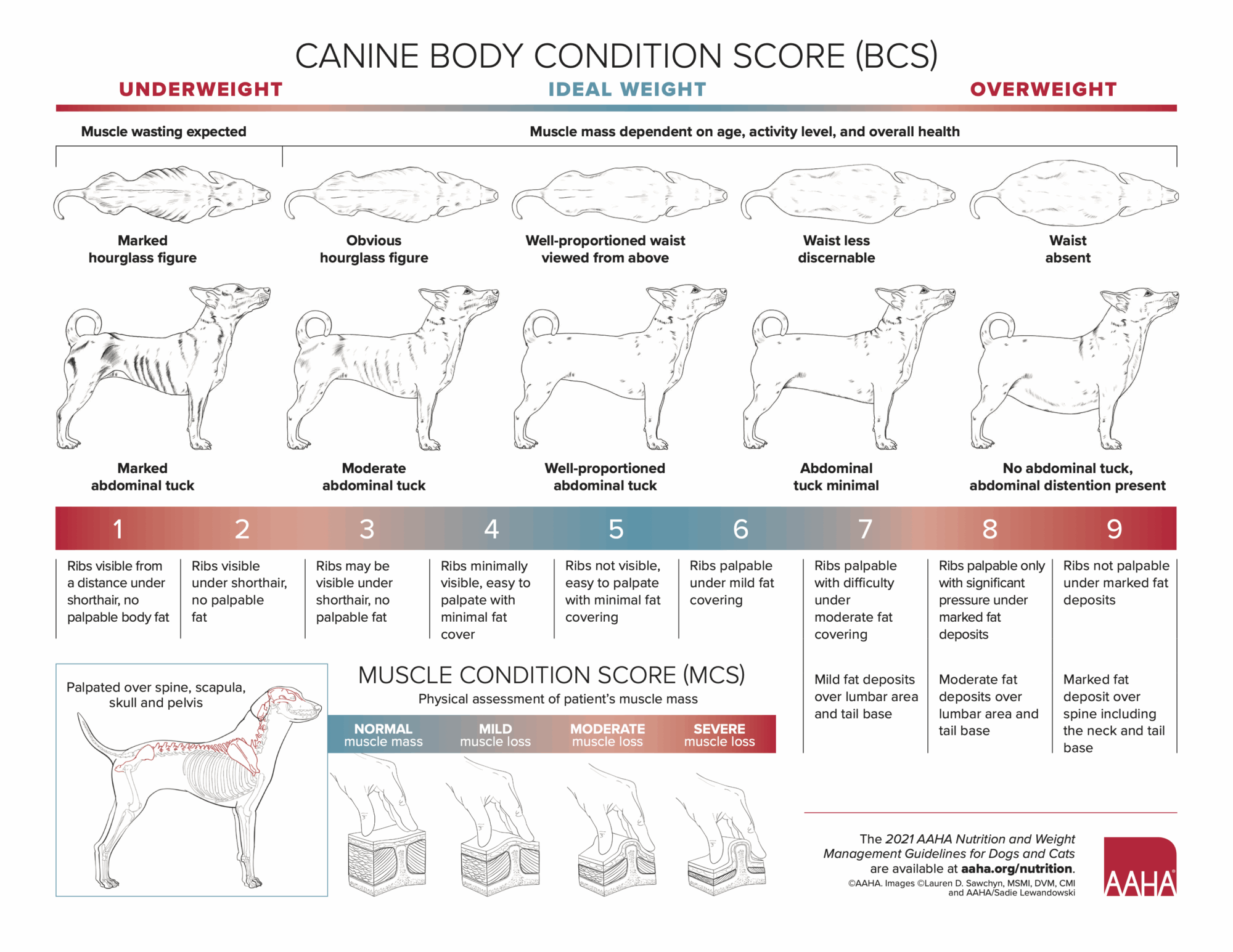
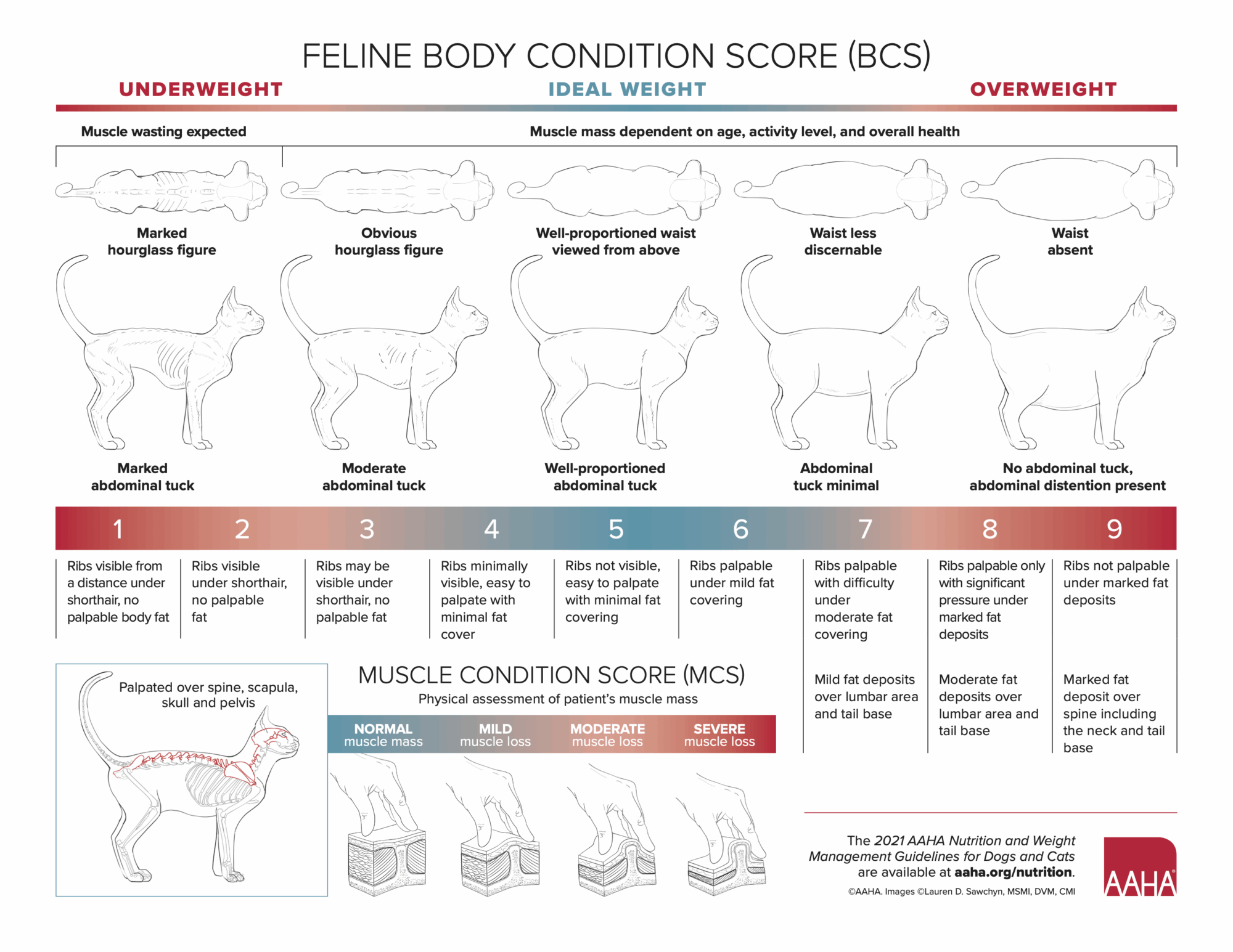
Several of AAHA’s Standards of Accreditation touch on the importance of getting a solid patient history and using the right tools to track their weight management journey. Medical records must clearly reflect a nutritional assessment, which includes the patient’s current diet (amount, frequency, and type), as well as any recommendations (temporary or otherwise). Additionally, a body condition score (BCS) and/or a muscle condition score (MCS) using a standardized scale or scoring system should be recorded in the medical record for every patient evaluation.
Conduct a physical exam
Once the history is complete, it’s time to get physical. Assess the patient, then take both a body condition score (BCS) and a muscle condition score (MCS). This will ensure your full team understands how the pet’s weight compares to the ideal, as well as whether they’ve experienced muscle loss. Using these charts also makes it easier for you to objectively track progress over time.
Teamwork makes the dream work
Getting the whole team involved in these cases is a great way to show support for your client—and to make sure everyone is on the same page. Confirm with team members whether you’re using 1-5 or 1-10 for the BCS; if you’re not all using the same range, communication will be problematic.
Other examples of including the team include the CSR asking the client to write down the names of the pet’s food and treats, or bringing it in the day of the visit. They can also let the client know they’ll be sending a questionnaire to fill out ahead of time, which will help the team understand the pet’s diet, appetite, and behavior.
Technicians have the opportunity to start the in-person conversation by asking the client specific questions about their pet and their diet, including whether the pet is eating anything new, how often the pet eats and where they eat, whether other pets are in the home, and what members of the household are involved in feeding.
(Want more tips for making this a team effort? Don’t skip AAHA’s Tech Utilization Guidelines!)
Talk about it
Now comes the tricky part: the client conversation. The key to a successful discussion about a pet’s need to lose weight is to remain aware of the fact that this can be a sensitive topic—but you all share a common goal, which is to keep this beloved pet happy and healthy.
AAHA’s Nutrition and Weight Management Guidelines
How confident are you in performing individualized nutritional assessments for your patients? How about providing recommendations for treatment or management of under- or overweight pets? These guidelines are a comprehensive resource that allow the whole team to optimize pet health through personalized nutrition and weight management strategies. Read them here.
First, invite the client into the conversation and establish that common goal with a question like, “Are you comfortable chatting about Rosco’s weight today?”
As you go into this conversation, make sure to focus on the health and wellbeing of the pet. Phrases like, “I believe Rosco’s weight may be a contributing factor as to why he’s not grooming himself and may lead to more serious medical concerns,” will help the family understand that there’s more to their pet’s plumpness than they might realize.
Then, work together with the family on a solution. This gives you the opportunity to hear and understand their concerns. Perhaps they’re worried that he won’t be as happy without his nightly table scraps, but you can ease their mind by explaining that he’ll also enjoy some extra playtime or a family walk. Frame it as a team effort: “Let’s work together to come up with a plan for Rosco that will help him lose weight, but will still leave room for some training treats.”
Create a customized plan
To achieve specific weight loss goals, you need a plan with specific measurements. To do this, keep in mind that cats and dogs can safely lose 0.5–2% of their body weight per week.
For example, let’s say Douglas the cat currently weighs 20 lbs. You estimate Douglas’ ideal weight to be around 12 lbs, so he needs to lose around 8 lbs to get there. How many pounds could he safely lose in one week?
The answer: 0.1–0.4 lbs per week, at least to start.
You’ll then determine, based on Douglas’s food, how much his family should feed him at mealtime; in this case, it’s about 80% of the amount he’s been getting. If that food has 300 kcal/cup, according to the label on the bag, and they’ll be feeding him twice daily (without giving him treats), you’d instruct them to give him 1/3 cup (0r 100 kcal) twice a day.
Remember, though, that you’ll need to recalculate that amount as Douglas loses weight to ensure his progress continues at a safe rate.
To achieve these goals, be highly specific with the instructions you give your clients. “Feed him fewer treats” is less useful than, “One 20-kcal treat fits into his nutritional plan, and you can break it up and give it to him throughout the day.” Stress the importance of making sure the entire family understands this plan and is on board.
That’s not the end of the story, though! You’ll need to reassess once the patient has lost weight to determine what their maintenance plan should look like. Most of the time, you can increase a patient’s caloric intake by 10-20% at this point.
Conclusion
Nutrition and weight-loss conversations can be tough. But, when you present evidence-guided recommendations in a way that takes the client’s perspective and concerns into consideration, you set yourself and the pet’s family up for success. Aim to be direct but empathetic, curious rather than judgmental, and you’ll start navigating these difficult topics with ease and effectiveness in no time.
Additional resources
The Association for Pet Obesity Prevention (APOP) and the World Pet Obesity Association recently introduced new free tools and resources to help veterinary teams work with families to facilitate weight loss in overweight pets. From daily feeding calculators to multilingual 9-point body condition score charts, there’s plenty of information to peruse at PetObesityPrevention.org.
Additionally, APOP is conducting their 2025 Pet Obesity & Nutrition Opinion Survey. The survey, which will remain open through the end of 2025, invites veterinary professionals, pet owners, and members of the pet health industry to provide their perspectives regarding obesity and nutrition management in companion animals.
Photo credit: FatCamera/E+ via Getty Images
Disclaimer: Trends™ content is meant to inform, educate, and inspire by providing an array of diverse viewpoints. Any content published should not be viewed as an official stance, position, or endorsement by the American Animal Hospital Association (AAHA) or its Board of Directors.
