Clinical
Acupuncture’s science-based role in modern pain management
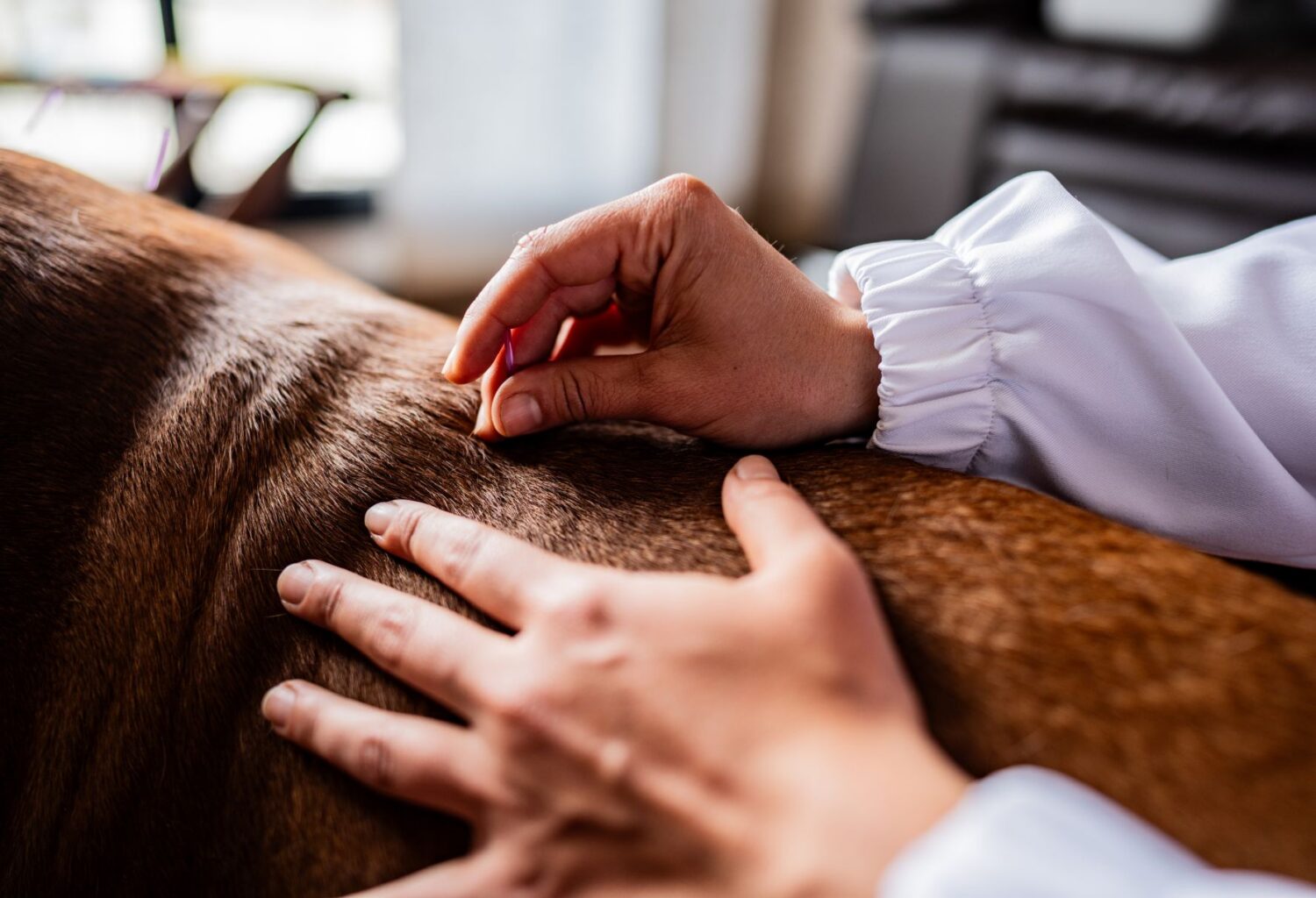
Curious about veterinary acupuncture? Intimidated by what feels like a whole new language? You may be surprised by just how science-based this modality is.
Pain management in veterinary patients often requires a multimodal approach. But in your clinic, does that approach include acupuncture?
Some veterinary professionals see it as a modality beyond the boundaries of evidence-based care. But many others, like Bonnie Wright, DVM, DACVAA, say that it’s not a departure from science—rather, it’s an extension of it.
Advertisement
And in large part, the disparity simply comes down to how acupuncture is understood.
Speaking scientifically about veterinary acupuncture
Wright, the faculty lead at Evidence Based Veterinary Acupuncture, is board-certified in veterinary anesthesia and analgesia, and that’s actually what set her on the path to learning about acupuncture.
“When you’re an anesthesiologist, you’re usually doing acute perioperative pain, but everybody starts getting you involved when they have hard pain cases,” she said. When she was starting out in her career, 20-plus years ago, she noticed that anesthesiologists were constantly the ones talking about pain and pain scales. “A lot of where we are today is based on that work. So, we were the natural people to talk to, but a lot of the perioperative anesthetic drugs aren’t that good for chronic pain.”
Gabapentin and amantadine were just beginning to be recognized, leaving her with what she considered a rather limited toolbox. “We had a really good, science-based [acupuncture] course taught in Colorado, and so, I thought, Well, I need another tool. I should go find out about this,” she recalled.
The transition from anesthesia to acupuncture was simpler than you might think, and Wright said the way she learned it was key. “It was taught from the same science base that I was already familiar with,” she said. “I wasn’t put in a position where I had to learn a totally foreign language to understand it, and that helped me.”
Qi and fascial adherence
Wright’s acupuncture education used the same kind of scientific, medical language she was accustomed to, but she’s quick to point out that there’s absolutely nothing wrong with attending a school based in traditional Chinese veterinary medicine that teaches through an energy-focused lens. The techniques are the same; it’s mainly just the language that differs, so where one school would call the sensation of the needle the coming of Qi, the other would refer to it as fascial adherence.
A shared root
After all, pain medicine is rooted in the nervous system.
“The nervous system has the peripheral compartment all the way up to the spine, and then the spine up to the brain, and there’s the ability for the body to manage pain at each of those levels,” Wright said. “Most of our drugs work mostly at the spinal cord and brain in the pain world, with some exceptions. When we start thinking of things like acupuncture, more of the focus is actually on that peripheral compartment, where you put the needle and where pain sort of starts to emerge.”
The nerve fibers that run everywhere, all throughout the body, don’t only respond to damage, she explained, but also to things like vibration, mechanical stimuli, and electrical stimuli. “[Veterinary professionals] are taught mostly about drugs and receptors, and those things work on those nerves too,” she said, “but sometimes I think we don’t realize that there’s also a lot of other things on those nerve endings that allow other forms of medicine to also have a good effect on managing those homeostatic cascades of pain and then pain amplification.”
Guidance on pain management
The 2022 AAHA Pain Management Guidelines for Dogs and Cats cover everything from new analgesics to nonpharmacologic modalities to provide all members of the veterinary team with the tools they need to effectively assess and manage their patients’ pain.
Essentially, she said, “Anytime the body has a complex homeostatic system where it can have pain that feels one way today, but then it amplifies and it’s worse tomorrow, so you don’t use that injured area and then hopefully in two or three weeks it deamplifies it again— when you have that sort of homeostatic system going on, things like acupuncture that help the homeostasis to alter are going to enter in. It’s a less direct way of intervening than giving a drug, but you’re helping to change and modify, or, as I like to say, nudge the homeostasis into a different direction than it might be going.”
A larger system
But it’s not only about the nervous system, Wright continued. “The nervous system is embedded throughout this myofascial system. So our muscles and our tendons all come together and attach to bones and in the places where the nerves and the lymphatics all come together. That’s actually where the acupuncture points are,” she said. “The big fascial and soft tissue structures of the body help to house this whole system, and so acupuncture is working on the nerves.”
That’s the aspect that’s most well-studied and understood. However, there’s much more.
“What we’re now realizing is that the acupuncture is also working right there in those microscopic fascial sheets that surround the big macroscopic myofascial muscle and fascial sheets,” she said, “and there’s actually a huge amount of our body’s fluid that runs in those corridors as opposed to the part that’s in blood vessels.”
This interstitial fluid is a dynamic, moving system that, Wright said, tends to be ignored because it’s not in the vascular tree. “But it actually has to keep moving throughout the body, and that’s part of what goes through lymphatics, which is where the immune system lives. And so, in addition to that little acupuncture needle talking to the nervous system, that little acupuncture needle is also engaged in this fascia and fluid system and is influencing things that have to do with your overall immune system and the way that’s tied in to your endocrine system,” she explained.
From there, she goes back to the aforementioned complex homeostatic systems.
“Think about the endocrine system. There are all of these hormones, and all of them crosstalk, and there are these fluxes in hormonal status… so there’s this big homeostatic endocrine system and acupuncture can, in very small ways, interact with that system and each of these big homeostatic systems,” she said.
Not a top-down system
Instead of a top-down control, which people tend to assume is the case with the brain, she said that small alterations within our body can help modify those complex systems.
“We actually know that the adrenals play a role. We know there’s this intestinal biome, and that the bacteria play a role in our central nervous system,” she said. “So, with both the neurologic side and then this fascial and interstitial side, acupuncture provides these tiny little inputs in a system that’s really dynamic and is changed primarily because of local effects.”
Two worlds, one concept
The concept of these complex systems within the body working together may sound familiar to Trends readers who caught our story about recent research offering hope for osteosarcoma patients. There, the researcher described the pre-metastatic niche like a Sherpa going ahead of a climber to prepare the area. The way acupuncture needles in the fascia impact areas throughout the body is remarkably similar.
The first major researcher providing modern data on acupuncture needles in fascia, who identified that it’s not only a matter of nerves, was Helene Langevin, MD, explained Wright. “She was measuring what happens in the fascia and how that expands over 36 hours, and it has these really huge local effects considering it was a very small amount of input.” Langevin pursued this research to clearly show the science behind acupuncture.
“What’s funny is that her research rather quickly took her away from acupuncture and got her into tumor metastasis, because in her models they found that the tumor cells have a way of modifying fascia to promote their own metastasis,” Wright explained. “They’re actually micromanaging the fascia to create these railroads for metastatis.”
Choosing the right modality
With expertise in both anesthesia/analgesia and acupuncture, Wright has the skills to treat a patient’s pain in a variety of ways. So how does she decide what to use for each case?
To answer this, Wright used the example of osteoarthritis (OA), which is the most-studied form of pain in cats and dogs. “Osteoarthritis is a very big field because you’re talking about (degradation of) cartilage, plus or minus pain. And as the patient gets older, the cartilage degrades, and you get more bony changes—things we can see on X-rays,” she said. “Eventually, you get these old animals with multiple joints that are pretty stiff, but maybe aren’t even all that painful anymore because the joints have passed the more painful stage, but now their bodies are painful and they have a lot of soft tissue pain because of how they’re moving.”
In the case of OA, she said, your initial goal is to keep the cartilage as healthy as possible. “That’s considered disease modification, and the golden standard for everyone is, can we find those disease modifying drugs, the ones that help keep the cartilage there?” she said. Medications and supplements that actually modify the environment in the joint to protect the cartilage are ideal at this stage, and can keep the joint feeling better for longer.
At the same time, pain-controlling drugs, like NSAIDS, may be useful, and some can help prevent the disease from progressing as quickly, so she sees a place for them as well.
“When we’re early on, and we still have cartilage and we’re trying to keep that cartilage together, the nonpharmacologic side can help at that stage, if we stay fit and provide good, focused activity, strengthening the areas that were becoming week and healing from minor exercise-related injuries,” she said.
Eventually, though, the patient will reach the more painful stages of arthritis, at which point, Wright continued, more analgesic drugs are needed, and they’re not as disease-sparing—“and then things like acupuncture can serve a very equal role, maybe even better, where you’re really improving pain. We can use acupuncture to augment what we do in rehab and help with motion, help them be stronger and overcome injury, so I think it belongs very much in that stage where it’s becoming painful.”
Special care for senior pets
Senior pets represent over 40% of the pet population, and it’s crucial that veterinary professionals are prepared to address the age-specific challenges these patients face. The 2023 AAHA Senior Care Guidelines for Dogs and Cats are designed to help you not just accommodate those pets, but welcome them in your practice.
She also believes it’s highly effective in the later stages, with the older dog with stiff joints and soft tissue pain. “The nonsteroidals can still help them feel a lot better,” she said, “but things like acupuncture, that work with the fascia, help with mobility, and help their immune system … then I think it becomes even more important.”
In other words, she doesn’t really choose one over the other. “My answer is pretty much always going to be both—and it’s just which one I prioritize depending on where I am in that disease sequence.”
Overcoming acupuncture obstacles and implicit bias
If you’re interested in adding acupuncture to your repertoire but aren’t sure how your clients will react, Wright has encouraging news.
“A lot of the obstacles to acupuncture being accepted are actually from within veterinary medicine, and much less so from clients,” she said, acknowledging that her experience could be somewhat based on her location in Colorado and her pain management specialty. She’s not working in general practice, and the people coming to work with her are generally open to trying what she recommends.
Still, she said, “Over and over, I find a lot of people have seen acupuncture working in the world, and it doesn’t matter to them so much that there’s been a debate about whether it’s scientific or not. They just see it working, and they don’t care whether the practitioner is seeing it through a lens of energy or the way I’m seeing it—neuroanatomically.”
Wright emphasized that learning and practicing acupuncture through either lens is valid. For her, the neuroanatomic lens was a good fit because the language and the way she viewed the disease was similar to how she practiced otherwise. “That helps me a lot,” she said, “but I have some anesthesiologist friends who chose to go to one of the courses that teaches it through energy. They were mid-career, they had all this down, and they loved the idea of just shaking it up and seeing things in a totally different way. I respect that—and it really worked for them.”
Communicating within the profession is the one area where she sees the energy route as a challenge.
“Where that hangs us up is when we are coming back to our professional colleagues in veterinary medicine and saying, ‘This is a real, science-based modality,’” she said. “When you are using a very foreign language, it becomes very hard for people that are on the outside to hear that as objective.”
“A lot of veterinary medicine has this sort of implicit bias against acupuncture because it felt foreign and it has this very different language,” she continued. “When I show up and I start talking the same language, then I think that implicit bias is still there, but it gets a little shaken up and confused. It’s like, well, she’s making sense because I’m talking about it through that lens.”
Photo credit: TK/iStock via Getty Images
Disclaimer: Trends™ content is meant to inform, educate, and inspire by providing an array of diverse viewpoints. Any content published should not be viewed as an official stance, position, or endorsement by the American Animal Hospital Association (AAHA) or its Board of Directors.
