A clear vision: What general practitioners should know about ophthalmology advances, referrals, and more in veterinary medicine
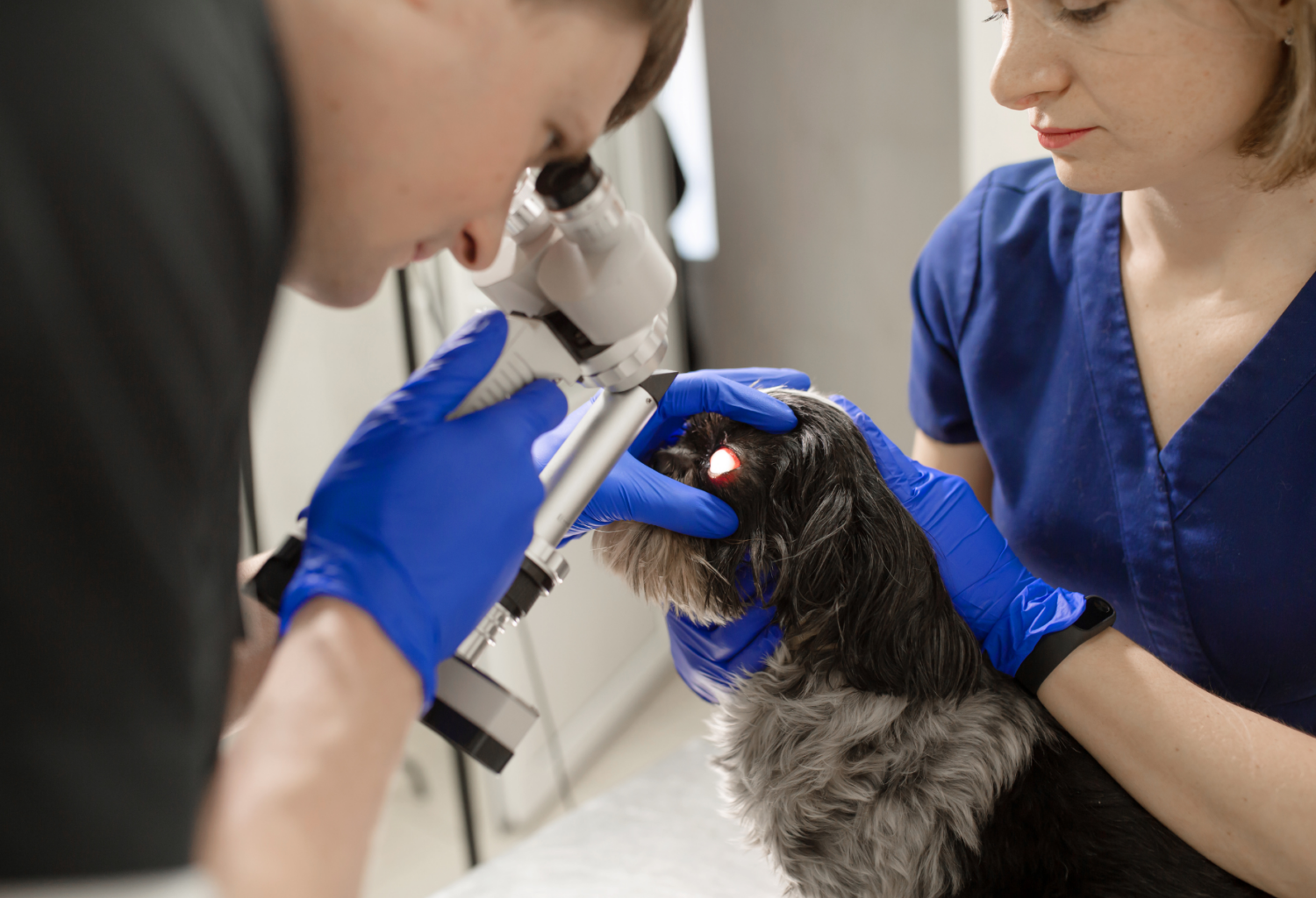
From understanding when and what cases to refer, to taking a deep dive into the latest advancements in the specialty, there’s a lot to keep an eye out for when it comes to seeing all the updates in veterinary ophthalmology.
Advertisement
In general practice, there might not always be a clear-cut line as to when to refer ophthalmology-related cases out. Additionally, when it comes to diagnoses and treatments for certain issues, like, cataracts, there may be a huge disconnect between what clients expect (based on their understanding of human ophthalmology) and what’s realistic for their pet.
Ron Ofri, DVM, PhD, is an ophthalmology specialist and a professor of veterinary ophthalmology at the Hebrew University of Jerusalem in Israel. When it comes to understanding the relationship between general practice and a specialty like veterinary ophthalmology, he says there’s a lot to keep in mind.
(For more insight into the referral process, we also recommend reading the 2025 AAHA Referral Guidelines, which house some great insights into how to maintain a well-ordered referral process.)
What general practitioners should know about veterinary ophthalmology
When it comes to working with the eyes, Ofri notes that there’s a uniqueness to it: everything is typically right in front of you. With some magnification and a source of bright lighting, you can see a very large percentage of any issues that might arise.
“The lesions, the diseases are in the eye, and you can see them. There is no need to interpret bloodwork or interpret ultrasound findings or ECG recordings,” he said. Everything is there in front of you. You just have to understand what you’re seeing.”
Ofri adds that textbooks serve as a great starting point. With pictures and descriptions, you can more easily determine what you may be dealing with and what to do about it.
However, he says it’s important to know your limitations.
The biggest mistake he sees general practitioners making is just that: not knowing when it’s time to refer.
“I know some people hesitate about referral because they say, ‘Oh my gosh, what will the client think of me?’ The client expects me to know everything. No, if it’s an intelligent client, they don’t expect you to know everything. In fact, they will respect you for recognizing your limits and knowing when to refer,” he said.
Caring for cataracts
Cataracts are common in both human and veterinary medicine, and Ofri says that there are a lot of supplements out there, marketed to clients, that claim to “cure” or “reverse” cataracts.
“On the internet, you can sell anything without any proof whatsoever,” he said. “And I want to stress this because, when you diagnose cataract in a patient, we say, ‘Listen, your dog has cataract. I’m going to refer you to doctor so-and-so, who operates on your dog for $5,000 or $8,000 or $10,000. And then the client goes online and says, I don’t need that surgery, I can buy these pills for $100.”
This is where communication with clients is so important. After all, why would they pay $5,000 to $10,000 for a surgery when they can buy a $100 pill online claiming to cure it?
The true “why” is simple, Ofri says.
“If someone were to find a magic pill that could treat cataract, they wouldn’t be selling it on the internet for $100. They’d be selling the patent for $1 billion dollars to buyers and sit at home waiting for a phone call from the Nobel Prize committee. So don’t let your clients go down that path. Cataract is a surgical case.”
When it’s time to refer, and what to keep an eye on
There are a couple diseases that Ofri says you should refer right away: Glaucoma and cataracts. Those two diseases are what veterinary ophthalmologists spend much of their careers working with. Glaucoma, as Ofri puts it, is a “very complex disease” that should be handled right away.
“We have lots of surgical options and medical options that may not be available to general practitioners,” said Ofri when talking about glaucoma. “And, yes, patients with glaucoma should be referred immediately or else they may become blind and painfully blind, meaning that we’d have to remove the eyes.”
Cataracts may not need referral in the early stages, when you just notice a small focal opacity, but if you see it progressing, that’s when you should refer.
The sooner the better, he added. “When they are easier to operate on, there are fewer post-operative complications.”
Ofri also noted how important it is to maintain communication with the specialist and client about post-operative care, especially in situations regarding something like cataracts.
“Really, the success rate of cataract surgery depends on the owner providing the post-operative treatment and showing up for rechecks,” he said. “If they don’t, their success rates go down dramatically. I’d say that coming out of surgery, 95% of dogs see after cataract surgery. But a year out? We may be down to 70% and even fewer further down the road. That’s because the owners neglect showing up for the rechecks. They neglect the post-operative medication. So really, as a general practitioner, when referring a cataract patient, you should stress to the owner that this is going to be a long-term affair or maybe even a lifelong affair.”
Diseases to start treating in general practice
For something like a corneal ulcer, he says a general practitioner can try treating themselves. Actually, he added that most corneal ulcers can and are being treated successfully by general practitioners.
“However, if you see that the ulcer is becoming contaminated or if it’s progressing, it’s become deeper, then you should refer it as an emergency. Remember, the cornea is only half a millimeter thick,” Ofri said. “So, there isn’t really too much of a safety margin. And if you see that you are not getting it to heal within a few days, then you should refer it.”
He noted that uveitis or intraocular inflammation can be successfully managed by general practitioners as well. Again, if you notice you’re unable to manage it, referral is the right option.
“The most important thing that you should keep in mind for uveitis is that really, it’s clinical sign. It’s not a diagnosis. Most cases of uveitis are due to systemic disease, and you should work up the patient for a systemic disease that is causing the uveitis,” he said.
Looking ahead at ophthalmology
When looking ahead, Ofri notes that the future of ophthalmology in veterinary medicine is exciting. The progress made in cataract surgery over the last 20-30 years is incredible, he said. “Our instrumentation has improved, our pre-operative examination and screening of patients has improved, and our techniques have improved.”
Additionally, patients with glaucoma can maintain their vision much longer than they used to, though there are still advances to be made in the field.
“I’d say the next challenge facing veterinary ophthalmology is really retinal diseases, especially retinal degeneration,” he added, saying that there are now people performing reattachment surgery for detached retinas. “That is wonderful because previously, we didn’t have any treatment option for dogs with detached retinas.”
He also added how while there has historically been no cure for retinal degeneration, an inherited disease in many dog breeds (and people for that matter), there’s a lot of exciting research being done in that area.
“[We’re] trying gene therapy, stem cell therapy, even artificial retinas, retinal prostheses, which sounds like science fiction,” he added. “I’d say this would be our next challenge the next 20, 30 years: treating retinal degeneration.”
Photo credit: Kateryna Kukota via iStock / Getty Images Plus
Disclaimer: Trends content is meant to inform, educate, and inspire by providing an array of diverse viewpoints. Any content published should not be viewed as an official stance, position, or endorsement by the American Animal Hospital Association (AAHA) or its Board of Directors.
