Clinical
Adding in some fun: Gamifying veterinary education
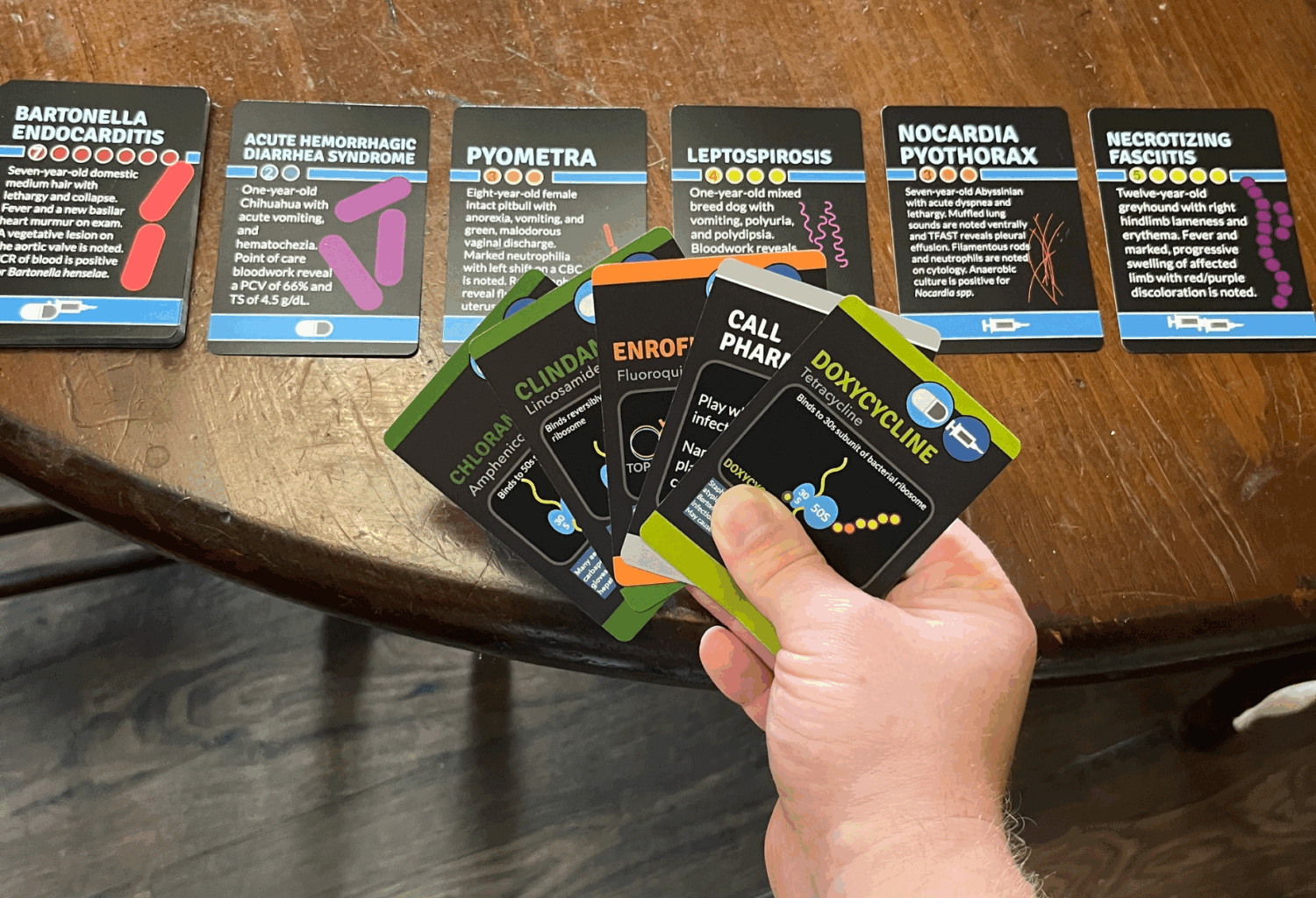
Care to play a game? It’s a question veterinary students might start to hear more regularly during their classes as new veterinary educational approaches, like veterinary card games, encourage active learning.
Walking around his classroom to evaluate the effectiveness of a new veterinary education teaching tool, Jacob Wolf, DVM, noticed something positive happening. There were lots of smiles and even laughter. Productive conversations flowed. The room had become a safe space to answer questions correctly—or not—and to learn from the process either way.
Watching the small groups interact, Wolf could readily see that his veterinary students were actively engaged with one another and the topic at hand. This was true even though the subject, appropriate antimicrobial treatments for various bacterial conditions, could be a notoriously difficult one to master.
Creating a game plan with a veterinary card game
There was a specific tool behind this new teaching approach: the Empiric Small Animal Veterinary Card Game. Wolf helped design the game in partnership with Michael Cosimini, MD, who had created an original version to help medical school students learn proper antibiotic treatments for common pediatric infections.
Sensing the approach could work for his students as well, Wolf, a clinical assistant professor at the University of Florida College of Veterinary Medicine, reached out to Cosimini about collaborating on a veterinary spinoff.
“Antimicrobials are one of the topics I think vet students find most challenging,” Wolf said. “I wanted to make a fun, approachable way for them to learn it.”
The result was powerful. After just one exposure to the veterinary game version, or roughly 30- to 45-minutes of play, Wolf’s students reported increased comfort and accuracy in selecting antimicrobial treatments for various clinical scenarios, a finding he outlined in a July 2025 article in Frontiers in Veterinary Science.
Wolf surveyed students about their familiarity with antimicrobials before they began the topic, following his introduction of the lessons using lectures and other traditional educational approaches, and then again following the game play. Results improved from the pre- to mid test, “proving that traditional methods work—which is good, since that’s what most of us employ,” Wolf said.
Importantly, though, scores improved even more after the card game, illustrating the effectiveness of integrating a game-based approach alongside lecture-based learning.
Availability and access
Wolf and Cosimini now sell their Empiric game at cost, forgoing profits to make the game as accessible as possible for other faculty to integrate into their lesson plans. They have also added a veterinary expansion pack, which includes scenarios featuring exotic pets.
“The most impactful part of the process, for me, was watching students work through these simulated scenarios on the cards and then commit to what antibiotic they were going to prescribe,” Wolf said. “Some of them really grappled with that decision, because they really did not want to be wrong. But the game allowed them to make those decisions in a safe environment, where they could get feedback—so that in a year or two when they graduate, they’ll have the confidence to make these sorts of decisions in a real-life scenario.”
The power of engagement
Wolf’s adoption of game-based learning is part of a growing trend in veterinary education, one that’s been repeatedly shown to yield positive results for students.
Previous research, for example, has outlined the effectiveness of a Chutes and Ladders-like board game (called Snouts and Tails) in helping vet students learn antibiotics for common swine disorders. Another study found that educational card game play helped veterinary students improve their ability to accurately interpret radiographic results for various renal conditions.
“I think we have so much research showing that active learning, in general, is a better form of learning than more passive methods,” said Wolf. Given the success of the Empiric game, Wolf plans to soon begin working with a colleague to develop a board game that will help teach veterinary students about fluids—including administration of crystalloid or colloid therapy for small animals with kidney disease, heart disease, or electrolyte imbalances.
Group work and game play
Jamie Perkins, DVM, a former veterinary faculty member at both the University of Arizona and Lincoln Memorial University and former director of education at Viticus Group, has been heavily involved in developing games for veterinary education for nearly a decade.
Like Wolf, Perkins believes deeply in the power of games as an educational tool. One of her products, Furbitten Words, operates similarly to the game Taboo, in that it asks students to get their partner to identify a veterinary diagnosis by describing it without using any of the “forbidden” clue words noted on the card.
“The diagnosis might be, for example, gastric dilation and volvulus (GDV), but you can’t say Doberman or heart emergency,” Perkins explained.
“What I love about the game is that it allowed me as a student, when I developed it—and, now, also other students, when I’ve watched them play—to share within a small group setting various tips, tricks, and mnemonics that everyone used to remember a disease or a medication,” Perkins said.
Lower stakes, high impact
Beyond just sharing handy study tips, having access to game-based, peer-based learning tools provides veterinary students a necessary space to learn that’s not grade-driven, Perkins said.
“The stakes are very high in vet school, and students can start having signs of burnout very early,” she said. “Everyone’s going through the trenches, and they need opportunities for safe learning conversations. Gamification can help so much with students’ mental health and also building a sense of collegiality among classmates.”
Game play also offers faculty an important tool to identify where their students are struggling before they fail a quiz or an exam, Perkins added.
Educator Cynthia Faux, PhD, has successfully used Furbitten Words in her veterinary medicine classes and has helped develop and fine-tune it in collaboration with Perkins over the past several years.
“Games provide a space for students to learn that is low stakes or no stakes—where they can engage with the material and potentially make mistakes, but it doesn’t matter,” Faux said. “Through games, students can engage with their peers and engage with the material without fear. Games are also great tools for helping students identify knowledge gaps they may not have even realized they had.”
Professional development opportunities
Beyond veterinary education, Perkins and her colleagues at DVMoms, a professional organization for veterinarians who are also mothers, are exploring integration of similar hands-on learning approaches for conferences and other professional development settings.
Ongoing training and AAHA standards
Did you know that AAHA’s Standards of Accreditation include continuing education and staff training requirements? For instance, AAHA encourages every team member to attend continual education opportunities. Pending the role, team members should seek to satisfy between five and 50 CE hours each year. There’s also a standard encouraging specialists to offer five hours of CE.
These are just a few of the ways the accreditation process helps member hospitals ensure that they (and their staff) are continuing on their journey toward excellence in veterinary medicine every day. Learn more about AAHA’s standards.
“We’ve made it a point of our conferences to try to make as many of the sessions as interactive as possible,” said Jordan Gesimondo, DVM, MPH, a relief veterinarian in Phoenix and DVMoms founder. “Sometimes, that may be a physical board game or card game focused on a specific topic, and sometimes it’s other activities, like coloring or embroidering tote bags, to stay actively engaged during presentations.”
“So many of us have come to realize that these approaches actually help us better retain the information that’s being presented than just passively listening,” Gesimondo added.
Perkins agrees that the tide is shifting in favor of active learning adoption among both veterinary students and professionals.
“I think there’s a lot more acceptance of new approaches to augment veterinary curricula today,” Perkins said. “And it’s not about throwing traditional approaches out the window, but instead asking, ‘What else can add to them?’”
Photo credit: Courtesy of Jacob Wolf, DVM
Disclaimer: Trends™ content is meant to inform, educate, and inspire by providing an array of diverse viewpoints. Any content published should not be viewed as an official stance, position, or endorsement by the American Animal Hospital Association (AAHA) or its Board of Directors.
