AI radiology tools in vet med: Risks, data sets, and what’s next
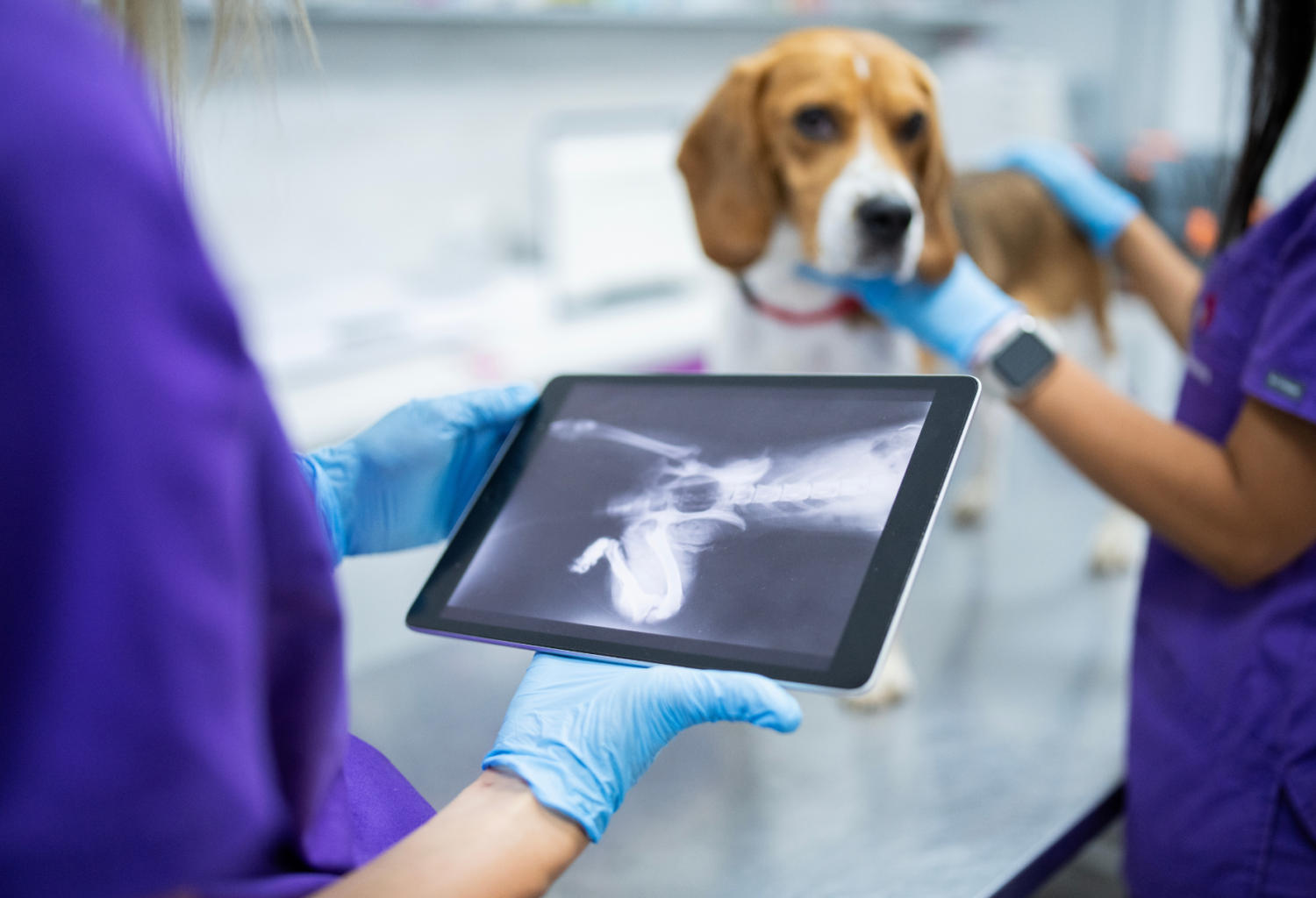
While the purpose of radiology-focused AI tools in veterinary medicine is to help understand detailed images more efficiently, behind some of these tools, the datasets the AI models are trained on are anything but clear.
Advertisement
As veterinary practices move to adopt AI technologies, a few specific areas have emerged as entryways for veterinary staff to use the technology in practice. Of the 39.2% of veterinary staff that use AI tools in practice, one of the top two use cases is for imaging and radiology (tied with tools used for record keeping and administrative tasks).
So, what with radiology and imaging AI tools tied for the top of the list, how we use, monitor, and understand the backend of these tools should be pretty standardized in vet med, right? Well, that’s not exactly the case. From the lack (or nonexistence) of premarket approval to the opaque nature of how some of these tools’ datasets are trained, there’s a lot you should consider when implementing these tools in day-to-day practice life.
The current landscape for AI radiology tools in vet med
Ryan Appleby, DVM, DACVR, is a veterinary radiologist and a faculty member at the Ontario Veterinary College. He’s also served as a council member for the American College of Veterinary Radiology (ACVR) and the past Chair (2023 and 2024) of the joint ACVR and European College of Veterinary Diagnostic Imaging (ECVDI) Artificial Intelligence Education and Development Committee. He and others released a special edition of the Journal of the American College of Veterinary Radiology detailing AI in radiology. Appleby also led the Veterinary Innovation Council’s subcommittee on AI in radiology.
In today’s landscape of AI tools for radiology, he notes while there are potential benefits, there are also some important risks and considerations. The larger topic he’s concerned about is the lack of oversight of how these tools are created for veterinary medicine, unlike in human medicine.
“One thing that we know about artificial intelligence systems is that, when they’re being used for image analysis, they are essentially acting as a diagnostic test. And because of the way in which these systems are created, there are very specific guidelines which should be followed,” Appleby said.
He points to the Transparency for Machine Learning-Enabled Medical Devices Guiding Principles set forth by a group including the FDA, partners with Health Canada, and the United Kingdom’s Medical Health and Regulatory Agency (MHRA). The guidelines outline 10 principles for good machine learning practice for the healthcare industry.
“Those are kind of foundational pieces which should guide the development and information sharing around AI tools as they relate to healthcare, including veterinary medicine,” he said. “The challenge that we face in the veterinary field is that there is no pre-market approval process for any product including artificial intelligence systems.”
That’s a concern for Appleby because it leaves the veterinarian to just “trust” the output of the system. He adds that there are really no underlying safety mechanisms that would ensure a certain standard of quality is met for the tool for it to be sold and used in practice. “It becomes very challenging and potentially dangerous to both pets and to veterinarians, from a liability perspective, to be using those products in practice,” he adds.
Understanding AI in radiology: datasets, accuracy, and more
When we talk about AI, we often use general terms that seemingly apply to the entire AI ecosystem. That’s not necessarily how we should be looking at it, especially in veterinary medicine. Appleby notes it’s like talking about computers as a whole.
“That’s going to include large computers, phones, everything. They’re not all the same. The same thing with AI,” he notes. “When we talk about AI for image analysis or image classification, it’s very different than other AI tools.”
Often, when we’re looking at the metrics of AI, accuracy is one of the first things companies will advertise. For example, an AI radiology tool might say it’s 98% effective. Sounds good, right? But there’s a lot more that goes into that, and accuracy is only one metric, Appleby said. That percentage can be deceiving and doesn’t always paint a clear picture about how that AI was trained.
Basic training
It’s important to remember that all these tools work with different datasets and are trained differently. So, in today’s current AI landscape around radiology tools, there are some basics to understand.
“When we are creating a classification system for imaging AI, we’re essentially teaching a computer system to recognize certain things in an image,” Appleby said. “A common example that I’ll talk about… is an AI designed to identify pulmonary nodules.”
Appleby says the AI in this example is trained on identifying the pulmonary nodules in images. After that AI is trained on those images, then that system is tested on a new set of images and works to identify any pulmonary nodules in that pool of images.
“Now, as part of the good machine learning practice, the way in which we actually set up that dataset, the way we label images, the number of images, the distribution of positives and negatives, the types of AI being used, and importantly, the separation of the training set and that testing and validation sets, those really need to be separate,” he adds.
In theory, he adds, this AI we’ve created could be altered to have higher accuracy. For example, if the training data (the photos we used originally to train this pulmonary nodule identifier) overlaps the testing sets (meaning the same photos exist in both the training data, and the testing set) the AI system will, in theory, already know what these answers are, which can artificially boost that accuracy percentage. Which is why it’s important to see those datasets.
Positives and negatives
The second thing that is important to see or understand is the number of positives and negatives within the dataset.
“If we don’t have a sufficient number, again, our metric values can be artificially elevated or even sometimes artificially decreased depending on how we’re presenting it,” Appleby said. “We really need to think about how we’re presenting that data and where that data is actually coming from.”
Appleby said that’s why it’s really important for the veterinary profession to start thinking about third party validation.
“That becomes a really complicated question, in part because we don’t know who should be performing that third party validation, and what should we be validating… So, we don’t have consensus within the profession of how we should be using AI and what things we should be looking for to be able to create validation models or validation data sets for that.”
Red flags to consider when choosing AI tools for radiology
RED FLAG: Look at who is involved in the product. If a radiologist is not involved in radiology AI, you might want to look for a different tool.
RED FLAG: The company does not share or show the datasets or how the AI was trained.
YELLOW FLAG: There is no clear way to monitor the performance of product in practice. Appleby adds that maybe this is not a red flag, but systems now don’t have post-implementation monitoring—and that is important to how the practice continues to use the tool in day-to-day operations over time.
The AI landscape ahead
As an industry, there are three “next steps” Appleby says can help us better understand how we interact with radiology tools (and AI tools in general) and the companies that created them.
The industry as a whole can start learning how AI looks and operates in practice.
Looking at what resources are out there to better understand how these AI tools operate is crucial, Appleby notes. Additionally, there are tools right now that may be used in practice that have AI elements, like some in-house lab analyzers which use similar image classification algorithms. “AI is permeating into lots of aspects of the profession, and veterinarians need to have a working understanding,” he adds.
Organizations release guidelines or set standards around best practices.
Appleby says there’s a real need for organizations to put forth best practices, which can help create consensus in the veterinary industry on how we appropriately use and vet these tools.
A third-party group validates and provides ongoing monitoring.
When it comes to what a third-party validator can do, there are a couple of different roles, he said. The first would be to look at how the AI works and is trained, the other would be to make sure the product continues to perform at the same level it was created at. “We can have something called model drift, where they change over time. They’re maybe not necessarily identifying to the same level as they were initially,” he added.
Questions to ask
Questions Appleby recommends asking companies that are selling you AI tools:
Who is involved?
What does the AI propose to answer?
What methods does the AI use?
How was the AI trained/tested?
How did the model perform, and how can we monitor the AI performance?
Final thoughts and informed consent
At the core of the AI conversation, it all comes down to transparency. Transparency of datasets, how the backend of the system works, and how to monitor the AI system over time—all those things are deeply important, Appleby said.
“Because veterinarians don’t have that information, there are people, including myself, who would argue that it’s impossible to get informed consent,” he added. “You could have consent, but you’re not providing enough information for a client to truly give informed consent on that. So, I think that becomes a really challenging ethical issue for practices as they think about implementing these.”
Resources:
Transparency for Machine Learning-Enabled Medical Devices Guiding Principles
Veterinary Radiology & Ultrasound: Volume 63, Issue S1: A Special Issue on Artificial Intelligence
AAHA Standards: Technology focused
CS05.1: The practice utilizes an electronic system to communicate with, educate, and remind clients about recommended care.
CS09: Client feedback is actively solicited. Such feedback might include focus groups, client surveys, evaluations, and client input discussed during client service meetings.
CS13.2: The practice creates and utilizes forms (copied, printed or electronic format) in a manner that maintains a professional appearance.
MR44: Electronic medical record systems provide confidentiality and integrity by preventing unauthorized viewing or editing. This can be accomplished when practice team members log out of the record or the medical record system automatically times out.
MR51: Peripheral, handheld and wireless computing devices are maintained with similar data security as the main server. All data contained in laptops, PCs or other wireless devices is secured using methods such as password protection, encryption, or restrictions on leaving premises.
MR57: Multi-parameter reports can be created across all patients allowing evaluation of relevant information such as disease incidence, identification of patients with specific demographics, common presenting problems and/or laboratory values outside specified levels.
MR58: Data extraction is supported within the software system. When authorized by the practice, other programs (for example, reference laboratories, telemedicine consultation, etc.) can access specific data and predetermined data field information for the purpose of sharing the information with the veterinary industry.
MR52: Any locally stored facility or patient data (on laptops, PCs, or other wireless devices) is backed up to the respective cloud-based or centralized service within 24 hours of receipt
MR50.1: The Practice Information Management Software (PIMS) utilizes role-based security, allowing practice team members, classified within various positions, different levels of access to viewing, adding to and/or altering information.
DG08: The practice has the ability to transmit digital images utilizing the DICOM standard, and other common formats that may be viewed in the absence of a proprietary software.
Photo credit: © ArtistGNDphotography via istock/Getty Images
Disclaimer: Trends content is meant to inform, educate, and inspire by providing an array of diverse viewpoints. Therefore, any content published should not be viewed as an official stance, position, or endorsement by the American Animal Hospital Association (AAHA) or its Board of Directors.
