Clinical
Dear Labby: Addressing a collaborative care conundrum with referral guidelines

Labby digs into a common, but tricky, situation. A general practice is seeing more and more cases in need of specialty care, but although they’d love to refer these cases out, there aren’t many specialists in the area. Fortunately, everyone’s favorite advice-giving Labrador was quick to fetch several paw-sible solutions!
Advertisement
Dear Labby,
We’ve seen more and more cases coming into our general practice that would really benefit from a referral to a specialist. The problem is, we don’t have many specialists nearby—and the specialty practices that are in the area are so busy that new patients can’t get an appointment for weeks, if not months. Other than referring them to a specialist who’s located several hours away, how can we best help these patients who need treatment quickly?
When pets like me need specialty care, you, as their primary care veterinarian, have a few options. Timely ruff-errals can make a huge difference in the survival time and quality of life of your patients—plus, when clients know you’re willing to send them to (or work with) specialists to give their pets the best care possible, it can improve their paw-ception of your practice. That’ll get tails wagging for everyone! Your patients get better care, and it can take a load off your practice. Even top dogs sometimes need a leg up (mmmmm, chicken legs…).
However, when there’s no appropriate veterinary specialist in the area—or the ones who are in the area are booked out for months—the referral process might not seem so simple.
2025 AAHA Referral Guidelines
AAHA recently released the 2025 AAHA Referral Guidelines to provide general practitioners and specialists alike with the insights and tools they need to make collaboration seamless. This ultimately benefits the general practice, the specialty practice, and, of course, the family.
Good news, though! You’ve got a few options, all of which depend on things like the patient’s diagnosis, what (if any) barriers to care the client might be experiencing, the particular specialist you work with—and, of course, the training, tools, and abilities of your own team.
To best understand these options, let’s break them down into a few common scenarios so you can put your best paw forward.
- Scenario 1: The patient needs to see a specialist who has an office nearby, but they can’t get an appointment in the near future.
- Scenario 2: The patient has a condition that would benefit from a specialist’s insight, but your team may be able to handle the treatment with a specialist’s advice.
- Scenario 3: The patient can travel a longer distance to see a specialist once, maybe twice, but cannot commit to follow-up appointments at that office.
Scenario 1: No available specialist appointments
Let’s start with the patients who need to see a specialist who happens to be in the area, but no appointments are available in the near future. That can be a ruff situation. How can you bridge that gap and provide a level of care that provides the support they need until they get into their specialty appointment?
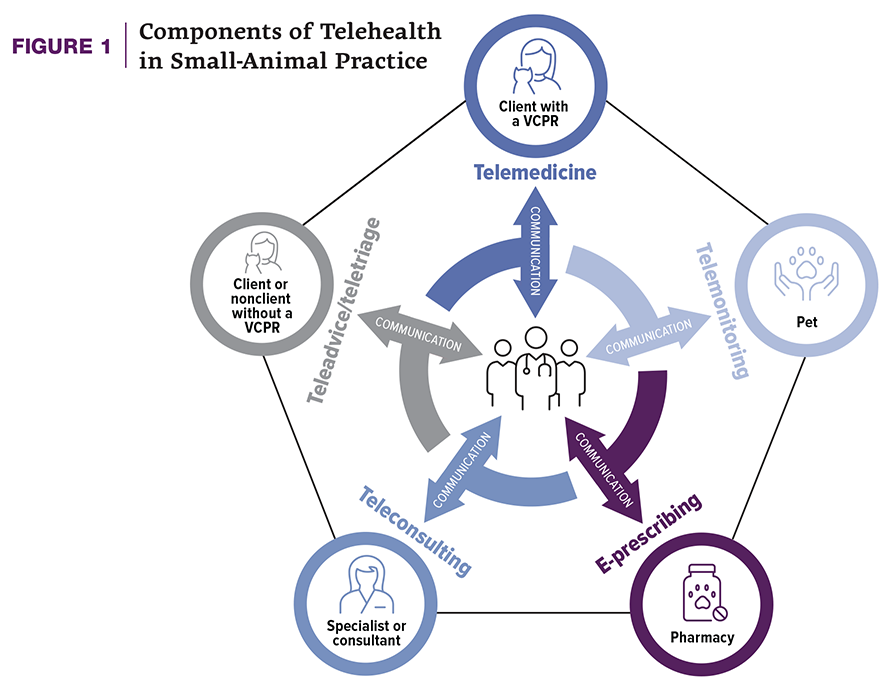
In this situation, humans can use their technological toys to buy some time and dig around for answers. One solution here is teleconsultation, which means that you, as the primary vet, consult (via phone, email, or another preferred method of communication) directly with a specialist. The VCPR remains with you, and you utilize the advice the specialist provides you to treat the patient until their appointment date arrives.
Once you’ve sniffed out a specialist, there are a couple of ways to go about this. For instance, if you’ve already established a relationship with that local specialist, you may be able to set up an informal teleconsultation with them. (In other words, give your specialist buddy a call and ask them what they think!)
If this is someone you know well, they might do this as a favor at no charge—especially if the patient has an appointment scheduled with them when they finally have an opening. Or they might charge a fee for their time; probably a good thing to clarify at the start, right? Time is kibble after all, for both you and the specialist.
But assuming you don’t have a close pal working in the specialty in question, a more formalized approach may be appropriate. Many specialists will provide a teleconsulting service to general practitioners for a reasonable fee, either through their own practice or through a platform like Vet Specialists on Demand, which facilitates both immediate and scheduled collaboration with specialists of all kinds. Pawing over a little cash could make a huge difference for your patient.
Scenario 2: You can handle, but need advice
Say you’ve got a patient with a gnarly looking eye (yelp!). Assuming they don’t require a surgical procedure you can’t do, you can treat it, but to make sure you’re taking the right approach, you’d really like to yap with a veterinary ophthalmologist so they can weigh in on the case.
Even if you do have a specialist in the area, teleconsultation could be the most affordable, lowest-stress option for the patient and client since it reduces the need for them to take another day to go to a new office. And why put clients and patients through more than necessary, right?
Bret Moore, DVM, PhD, DACVO, a member of the 2025 AAHA Referral Guidelines taskforce and assistant professor of ophthalmology at the University of Florida (UF), said in a prior Trends interview that he found around 65% of cases that were referred after hours and without a phone call to the UF Veterinary Hospital ophthalmology department were cases at the level of the fourth year graduating curriculum. Some of these families had to drive several hours and book a hotel to be seen, but, Moore said, they could’ve been manageable with a simple five- or 10-minute phone conversation with the primary veterinarian. So, a quick yelp for help can save time, energy, and resources for everyone (not to mention kennel time for traveling pets!).
Scenario 3: Following up on specialist care
Of course, many cases require a physical examination and at least some level of treatment from a specialist, assuming the family can manage the financial, time, and transportation aspects, at least for an appointment or two (plus extra treats and belly rubs for good boys and girls!).
Let’s say the specialist is located several hours from your town, and, while the family can commit to one or two appointments to figure out a care plan, it’s not paw-sible for them to go back every couple of weeks for the necessary follow-up appointments.
Because the client and patient have seen the specialist and developed a VCPR with them, telemedicine may be an appropriate option (depending on the laws where you live). And it’s undeniably less stressful for the patient!
During this time, it’s key that previously established lines of communication between the primary care provider and specialist remain open, including clearly articulating who will be responsible for follow up tests, etc. and when these should occur. By demonstrating that they are actively involved and updated on the case, the primary care veterinarian can continue to nurture their relationship with the client during the ongoing referral period. As a bonus, it demonstrates that your practice isn’t just handing off the leash—rather, you’re actively involved in the referral process.
Considering consultations as a regular part of your referral process can go a long way toward increasing access to care for more of your clients. Plus, it’s worth remembering that every time you consult with a specialist, you and your team have the opportunity to learn more about that area of medicine. Everyone needs to learn new tricks!
So whether it’s a disastrous feline dental case or a dog with a stubborn dermatological disease, making a connection via consultation can help build trust with your clients—and, even more importantly, improve outcomes for your patients, keeping their tails wagging and their toes a-tippy-tapping for years to come! And don’t forget to nose through the 2025 AAHA Referral Guidelines for more info.
Dear Labby is a monthly advice column that covers the tricky situations of vet med—from clinical to cultural and everything in between—with the help of Labby, the Labrador retriever who can sniff around for the best experts in the field. If you’d like to submit a question, email it to [email protected] with the subject line: Dear Labby. And keep it short! Labby’s attention span goes out the window after 200 words.
Photo credit: andreswd via Getty Images Plus
Disclaimer: Trends content is meant to inform, educate, and inspire by providing an array of diverse viewpoints. Any content published should not be viewed as an official stance, position, or endorsement by the American Animal Hospital Association (AAHA) or its Board of Directors.
