Clinical
Feeling ready? Scenario-based planning for HPAI H5N1 in small animal practice

The goal is to ensure your practice is ready for the day ahead and, in this situation, the unexpected feline HPAI H5N1 cases.You’ll need these two forms as well for the scenario: HPAI H5N1 Planning Scenario and HPAI H5N1 Planning Form.
Advertisement
You put on your scrubs, walk into work on a Monday morning, and- as you look at an overbooked schedule— you are wishing you had made that second cup of coffee. You are focusing on the job at hand: medicine, surgery, client communication, staff management, running a business, providing grief counseling… and the many other hats we wear as practitioners.
What if today ends up being the day the hooves you hear are zebras…not horses? Or, in this case, the “ADR” cats coming in at 10:00 AM have H5N1 HPAI. Are you ready?
Cassidy Rist, DVM, MPH, DACVPM, Associate Director of the Center for Public and Corporate Veterinary Medicine at Virginia-Maryland College of Veterinary Medicine shares, “Although we often think of food animal veterinarians as needing to be most prepared for foreign animal disease incursions, companion animal veterinarians are on the front lines for many emerging infectious diseases of veterinary and public health importance. Companion animal veterinarians often work in practices that see large numbers of the public and their pets every day. Although the potential for seeing a feline case of H5N1 is still low, being prepared to recognize a potential case and respond appropriately is the best way to keep you, your staff, your clients and patients safe. As the ultimate One Health practitioners, that is what veterinarians are trained to do.”
What is readiness?
The goal is to ensure your practice is ready for the day ahead and, in this situation, the unexpected feline HPAI H5N1 cases.
Readiness checklist:
- You know who to contact in your state’s public/animal health agency for mandatory reporting and guidance on diagnostic testing and case management
- Your clinic has a plan in place outlining roles and responsibilities for managing a suspect case—from initial presentation at reception to treatment, end-of-life decision-making, and handling of remains/cremation
- Your team has been trained and has practiced carrying out the plan
- Your team has talked through the “what ifs”
- You have an isolation area away from other patients available for suspect cases
- You have identified and secured the proper personal protective equipment (PPE) and disinfectants
- You have the correct sampling supplies and know which samples to take and where to submit the samples for diagnostic testing in your state
- You have a plan for ensuring other patients on the schedule are taken care of
- You have a plan for how to monitor for and address illness in an exposed staff member
- You have a risk-based, empathetic communication approach or document ready for your client
- You have a plan to debrief and update your plan after managing suspect and confirmed HPAI H5N1 cases
- …… (the list may go on, depending on your situation)
This may seem like a daunting list and task. But remember, you practice readiness every single day. Think about preparing for surgery: you are not only equipped with the right supplies, surgical suite, anesthesia plan, and monitoring tools. You and your staff also have protocols and contingency plans in place– for when the blood pressure drops, if a complication arises, and even for how you will share the good or not-so-good news with families. Veterinarians are, by training, primed to be emergency managers.
Readiness to HPAI H5N1: Emergency management approach
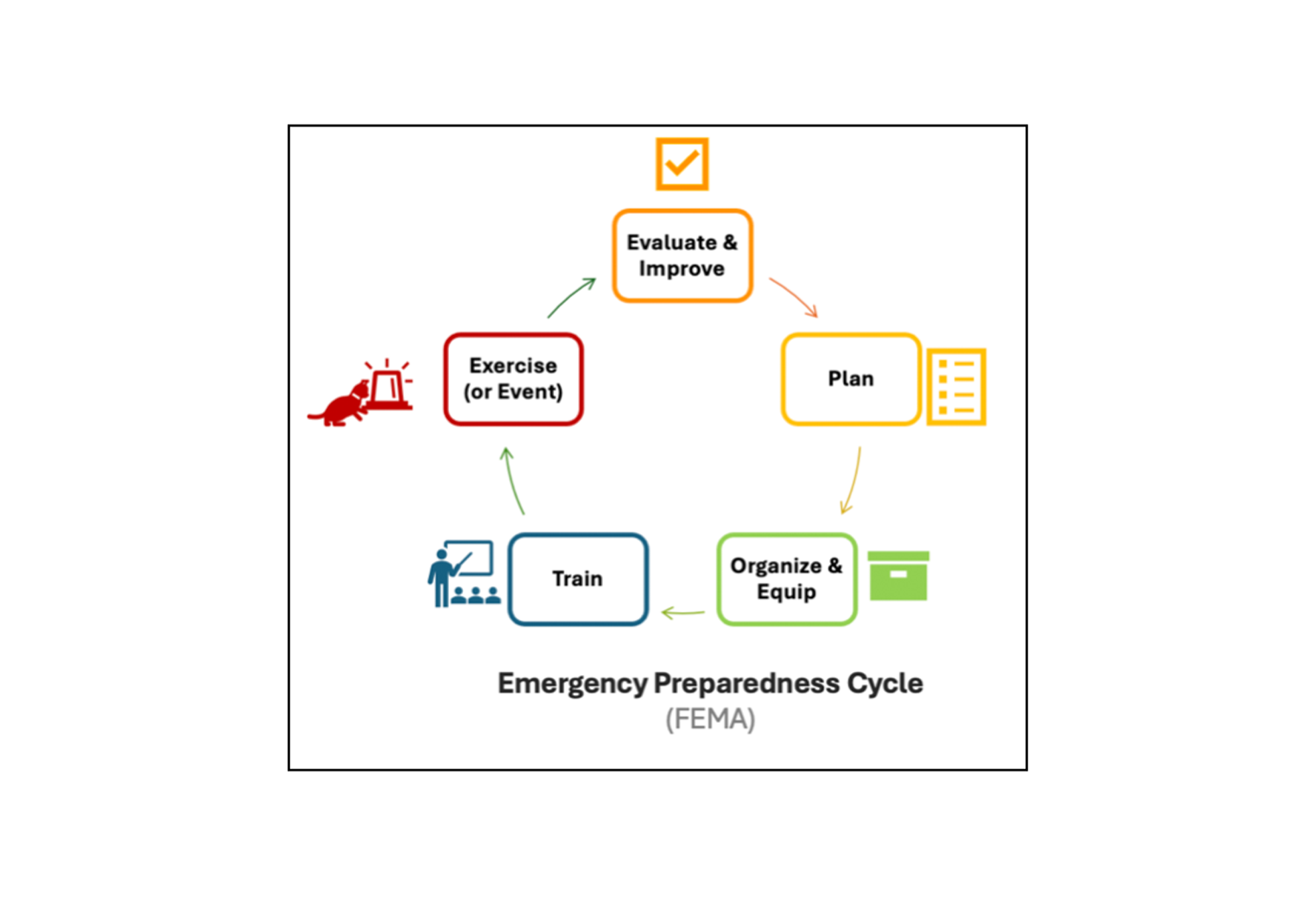
Whether getting ready for a flood, chemical spill, or HPAI H5N1, the steps to ensure readiness are the same and repeated in a cycle:
- Identify and develop needed plans
- Make sure you have the right equipment
- Train your staff on the plan
- Practice for the event (or live through it)
- Evaluate what went well and update plans/training/equipment based on lessons learned in an After Action Review.
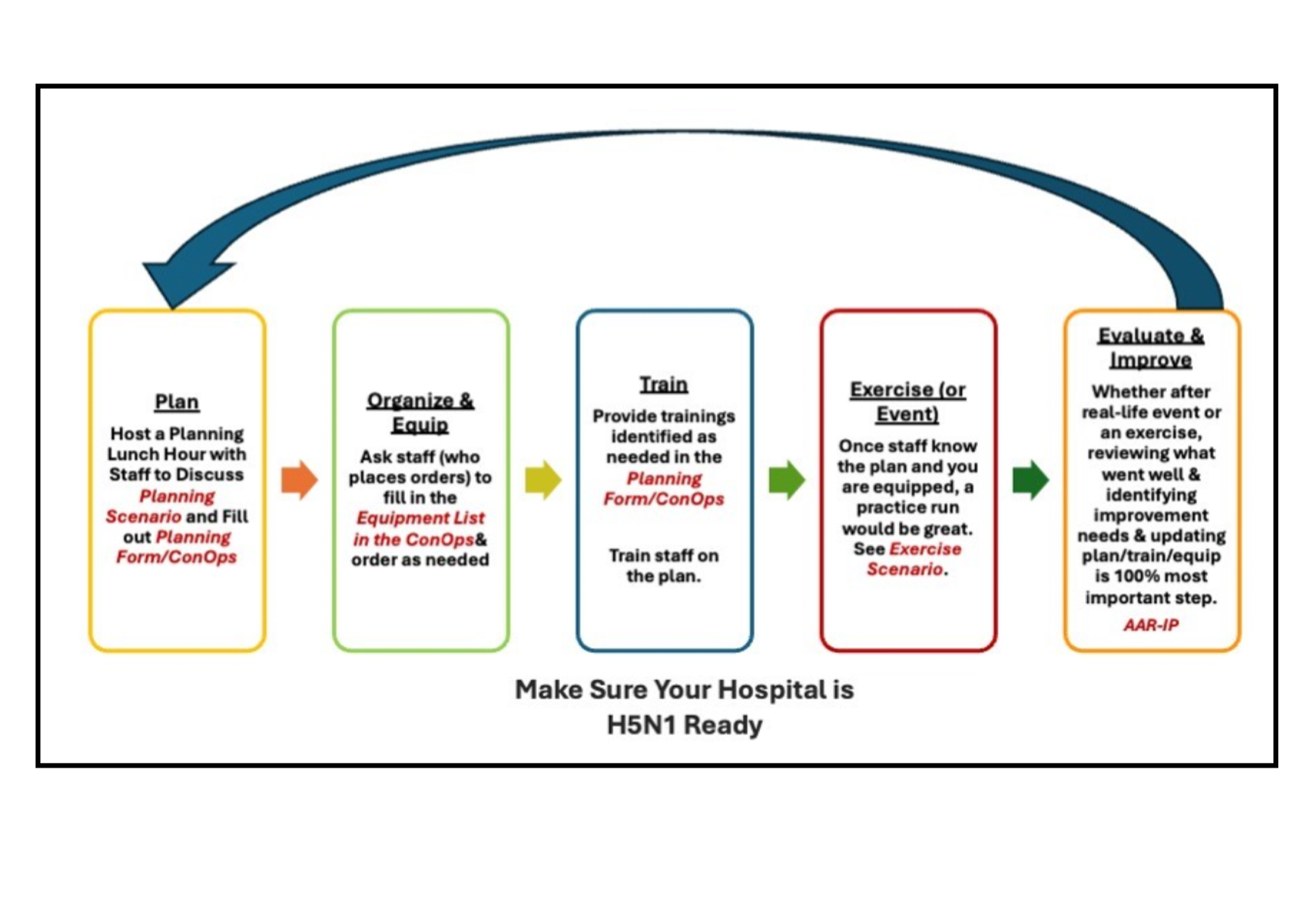
We have adapted this approach to provide your hospital a timely, scenario-based planning approach to prepare for H5N1. You and your team can work through the HPAI H5N1 Planning Scenario provided which will help you draft your own Concept of Operations plan using the HPAI H5N1 Planning Form for addressing a suspect case and then practice the plan.
Special thanks to Dr. Cassidy Rist for review of scenario and planning forms.
Citations and Resources:
- https://www.fema.gov/sites/default/files/2020-05/CPG_101_V2_30NOV2010_FINAL_508.pdf
- https://www.fema.gov/emergency-managers/national-preparedness/exercises/hseep
For those interested in emergency management:
- FEMA offers courses through https://training.fema.gov/ndemu/curriculum/.
- You may also want to look into joining the National Veterinary Response Teams https://aspr.hhs.gov/NDMS/Pages/nvrt.aspx, state or local response organizations such as the local Community Emergency Response Team (CERT).
- The World Organization for Animal Health also has resources on preparedness and response https://www.woah.org/en/what-we-offer/emergency-preparedness/.
| Species impacted: | Cases: | Where: | How is it transmitted/spread?* | What to look for: |
|---|---|---|---|---|
| Domestic cats | 137 in U.S. since 2022 | 23 states: CA, CO, IA, ID, IL, KS, LA, MI, MN, MT, NE, NJ, NM, NY, OH, OK, OR, PA, SD, TX, UT, WA, WY | •Eating infected birds & rodents
•Eating raw meat or poultry products/ commercial pet food or unpasteurized milk •Contact with infected cattle/poultry and their contaminated environments •Contact with infected people or contaminated clothing and/or infected people possible but not established |
•Anorexia
•Lethargy •Fever •Oculonasal discharge •Difficulty breathing •Neurologic signs (ataxia, circling, tremors, seizures, blindness). •Can be rapidly fatal; however, serosurveys have reported antibodies to H5 viruses in ~12% of apparently healthy stray cats |
| Dogs (companion) | 0 in U.S. | Canada
Washington study detected H5 and N1 antibodies in 2% of hunting dogs |
•Eating infected birds | •Anorexia
•Fever •Conjunctivitis •Cough •Difficulty breathing |
| Poultry (includes backyard chickens and ducks) | Detected in 1,693 flocks; > 169 million birds affected in U.S. since 2022 | 50 states & Puerto Rico (commercial and backyard flocks and live bird markets) | •Contact with infected poultry or wild birds
•Contact with contaminated equipment •Contact with infected people or contaminated clothing •Poultry trade promotes spread |
•Acute mortality
•Respiratory signs (sneezing, coughing, oculonasal discharge) •Edema of the face and cyanosis of combs and wattles •Diarrhea •Skin hemorrhages •Decrease in egg production •Neurological signs (tremors, stargazing, paralyzed wings) |
| Cattle | 1,048 since 2024 | 17 states: AZ, CA, CO, ID, IO, KS, MI, MN, OH, OK, NV, NM, NC, SD, UT, TX, WY | •Contact with infected animals
•Contact with contaminated milking equipment and clothing (large amounts of virus shed in the milk) •Exposure to infected wild birds (Nevada and Arizona)** |
•Many subclinical or mild infections (unlike poultry) making detection difficult
•Thickened, abnormal milk •Loss of appetite •Lethargy •Low-grade fever •Mild respiratory signs •Diarrhea (less common) |
| Swine | 2 cases since first detection in 2024 | 1 state: OR | •Contact with infected animals
•When infected by cows, unlikely to infect other swine •Fomites/contaminated equipment |
•Coughing
•Fever •Respiratory signs •Loss of appetite •Lethargy •Abortions |
| Sheep | 0 in U.S. | Reported case in England | •Exposure to infected birds | •Mastitis, with no other clinical signs, was reported in this case |
| Wildlife | > 500 species globally (485 avian and 48 mammalian species)
U.S. wildlife cases are reported by the USDA and U.S. Geological Survey |
50 states, Puerto Rico | •Consumption of sick prey (mammals and birds)
•Direct transmission & contact with contaminated environments (including virus in water) for wild avian flocks •Rare reports of transmission between wild mammals |
Clinical signs in sick wildlife are variable, but generally include neurologic and respiratory signs.
Sick wild birds can have: •Eye swelling •Change in color of iris •Respiratory signs (sneezing, coughing, oculonasal discharge) •Gastrointestinal signs (diarrhea) •Neurologic signs (tremors/seizures) The most common clinical signs in sick wild mammals are: •Neurologic signs (tremors/seizures and ataxia) •Respiratory signs (nasal and ocular discharge and dyspnea) |
| People | 70 cases in the U.S. in the past year | 13 states: CA, CO, IO, LA, MI, MO, NV, OH, OR, TX, WA, WI, WY | •No sustained human-human transmission
•Contact with sick cattle & poultry •One North American fatality had genotype primarily found in wild birds •CDC study detected H5N1 antibodies in 2% (3/150) of bovine veterinary practitioners |
•Conjunctivitis
•Fever •Cough •Sore throat •Runny or stuffy nose •Muscle aches •Fatigue •Shortness of breath or difficulty breathing •GI signs (diarrhea, nausea, vomiting - less common) •Seizures (less common) |
The numbers represent reported cases, not the actual number of affected individuals.
* Information on modes of transmission are suspected or verified based on reported evidence for each species. In general, avian influenza viruses can be transmitted through direct contact, indirect contact (e.g., contaminated surfaces), and inhalation.
**The HPAI virus initially detected in dairy cattle, H5N1 clade 2.3.4.4b genotype B3.13, was the only strain known to infect dairy cattle. However, in early 2025, two spillover events involving a different genotype circulating in migratory birds, D1.1, occurred in dairy cattle in Nevada and Arizona. Ongoing new introductions will complicate efforts to control the virus in dairy cattle, underscoring the importance of robust surveillance and prevention measures.
Photo credit: nazar_ab via Getty Images / E+
Disclaimer: Trends content is meant to inform, educate, and inspire by providing an array of diverse viewpoints. Any content published should not be viewed as an official stance, position, or endorsement by the American Animal Hospital Association (AAHA) or its Board of Directors.
