Clinical
Latest AHS heartworm incidence map shows troubling trends
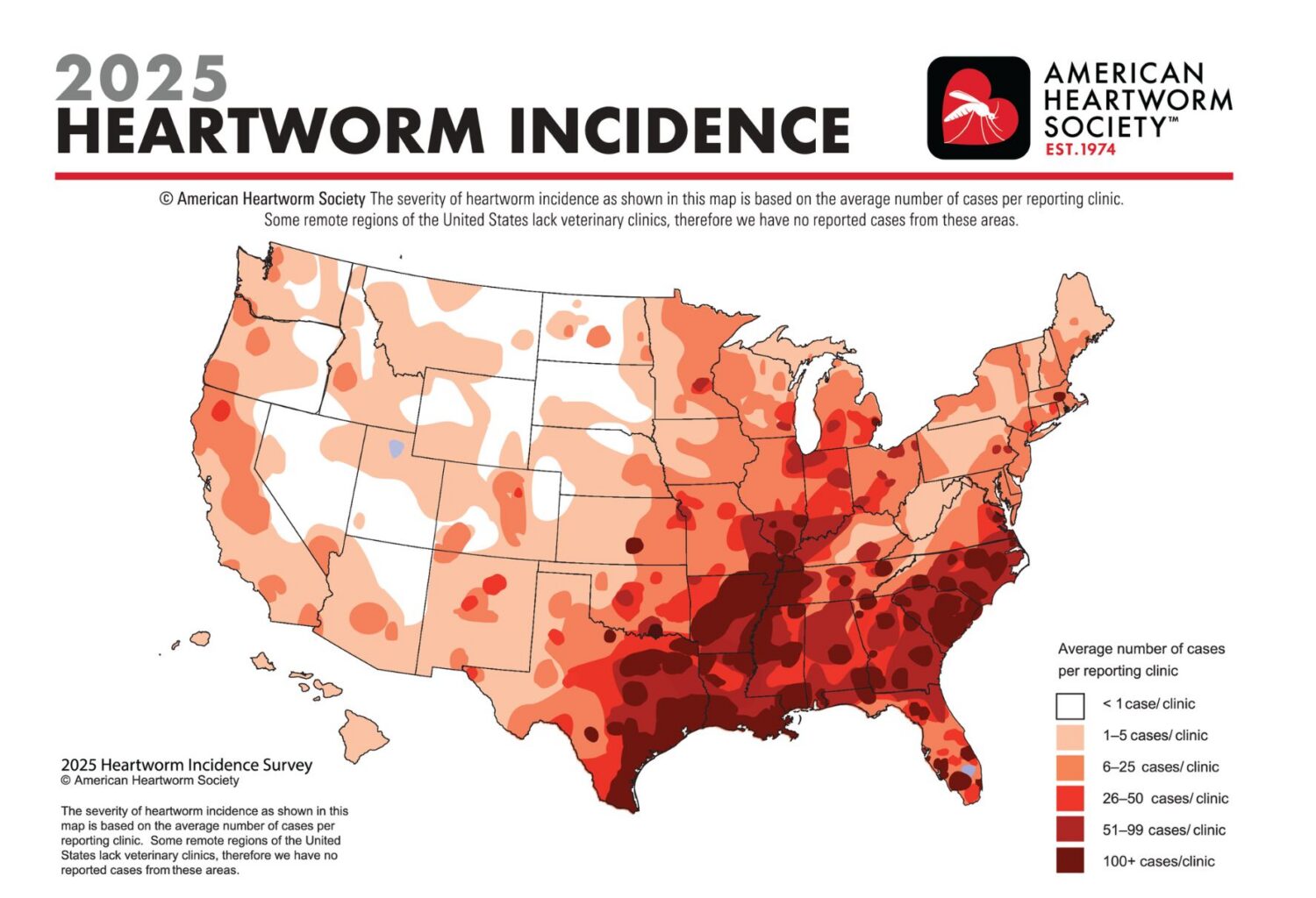
The latest American Heartworm Society heartworm incidence map is out, and it shows some concerning trends of increased heartworm infections areas beyond the traditional hot spots.
Advertisement
Every three years since 2001, the American Heartworm Society (AHS) creates a new heartworm incidence map using data from their heartworm incidence survey.
The 2026 survey, based on data collected from heartworm testing conducted in shelters and veterinary hospitals throughout 2025, showed some concerning trends, such as the fact that heartworm is being found in new “hot spots.” For instance, Texas hit the top of the list of leading states for heartworm incidence, which is a first. East Texas, the Florida Panhandle, southwest Florida, the central Carolinas, and southern Illinois—all places without a historically high incidence—all showed more than 100 cases diagnosed per clinic, indicating an increasing infection density.
All maps, including the 2026 version, can be downloaded and compared—and given these findings, it’s more important than ever for veterinary professionals to discuss heartworm prevention with clients, including barriers to care, financial constraints, risk assessment, and any safety concerns pet parents may have. To fully understand this data and how veterinary professionals can best use it to help their clients and protect their communities, we connected with AHS president Marisa Ames, DVM, DACVIM (Cardiology), who shared her thoughts on what this means for clinical protocols, client communication, and more.
Same recommendation, increasing urgency
AHS does not suggest any difference in clinical protocols between areas with a history of heartworm infection and those with new or growing incidence—but that’s because, since 2010, they’ve recommended year-round, nationwide heartworm prevention for pets, Ames said.
“We know from our surveys that heartworms are being diagnosed nationwide and not just in the southern and southeastern states where the numbers are highest,” she said, offering the following reasons why:
- The number of mosquito species known to be heartworm vectors has increased, with some of the most common species—for example, Aedes albopictus, which is the Asian tiger mosquito—migrating north and west from the southern U.S.
- Environmental and climatic changes—both natural and manmade—have created warmer and more humid conditions that help sustain mosquito populations and sustain them for longer periods of the year. The presence of microclimates in protected urban areas, where most of the human population is concentrated, means mosquitoes can also survive much longer in the fall and winter months than pet owners may realize.
- The relocation of heartworm-positive dogs due to both owner movement and the long-distance transport of dogs for adoption purposes has introduced heartworms to areas where infection was once considered rare or nonexistent.
- The widespread presence of heartworm infection in wild canids like coyotes, foxes and wolves that also serve as heartworm vectors means heartworm vectors remain present, even when heartworm rates in the dog population are low.
Ames notes that veterinarians largely agree with this recommendation, citing a summer 2025 survey of veterinarians across the country in which, “overall, 94% of their canine clients are given a recommendation for year-round prevention. There is some regional variation, but it’s clear that veterinarians nationwide see value in year-round prevention.”
She also emphasized the necessity of diagnostics in any heartworm protocol. “[A]nnual screening of dogs with both antigen and microfilaria testing is recommended, regardless of location,” she said. “Identifying heartworm-positive dogs early helps ensure better treatment outcomes and ensures that these animals will not serve as disease reservoirs in their area. While no adulticide treatment is available for cats, annual screening with antigen and antibody tests is also recommended to both assess the relative risk in the practice area and to provide supportive care and monitoring for cats infected with adult worms.”
The role of preventives and resistance
“Most heartworm infections in dogs who receive a preventive are attributable to lapses in compliance, like administration errors or missed doses, rather than resistance,” she said. There are strains of heartworms that are resistant to heartworm preventives (macrocyclic lactones), Ames said, but those strains have been mostly found in hyperendemic heartworm regions within the US.
That being said, understanding how resistant strains work and knowing where they tend to be located is important for veterinary teams everywhere.
“The third- and fourth-stage larvae of the heartworm are the life stages targeted by heartworm preventive drugs (macrocyclic lactones),” she said. “Resistance is one explanation of a loss of efficacy of a preventive or, in other words, heartworm infection despite use of heartworm preventives.”
The lower Mississippi River Valley is the region where most of those cases are seen, she continued. “The incidence of resistant isolates in the United States has not been evaluated, and more data are needed to surveil the frequency of resistant strains and improve our understanding of how resistance is affecting changes in heartworm incidence. Genetic markers can be used to surveil these resistant strains and one recent study suggests that resistant strains might be more widespread than the lower Mississippi River region.”
Bottom line? “All practitioners, regardless of location, should be aware of the possibility of resistance and ensure their clients are compliant with year-round heartworm prevention medications,” Ames said.
Communication, clients, and compliance
While the 2026 survey identified heartworm cases across the nation, that’s not new; this has been the case in previous surveys, too.
“We need to continually remind clients that whenever heartworm-positive dogs—as well as wild canids like coyotes, foxes and wolves—are present and mosquitoes are in the environment, there will be a risk of heartworm transmission,” Ames said. “It only takes one bite from an infected mosquito to transmit heartworms to an unprotected pet.”
Still, as those in clinical practice know, making clients aware of the risk is not the same thing as getting those clients to comply with the recommendation for year-round prevention medication. And that’s something the AHS has looked into.
“Noncompliance is a compilation of several different behaviors, and the veterinary survey mentioned above provided some insights,” Ames said.
They found that although veterinarians tend to align with AHS recommendations on year-round prevention, client failure to follow those recommendations is a major challenge.
“Some 70% of respondents cited client failure to give preventives year-round as a challenge, followed by 62% who cited client refusal to invest in any kind of heartworm prevention,” she said. “Almost half—45%—saw on-time preventive administration by clients and refusal to screen pets for heartworm as significant challenges.”
There are multiple reasons why clients might not comply, and Ames offered anecdotal evidence from what she’s heard from veterinarians in practice, including those serving on the AHS board.
“Reasons can range from not seeing the value of investing in heartworm prevention to assuming a pet’s so-called ‘indoor’ lifestyle negates the risk of heartworm transmission, to mistaken assumptions about the spectrum of activity a particular parasite preventive provides,” she said. For instance, pet owners often erroneously assume the flea-and-tick product they’re giving will also provide heartworm protection.
So, what can we do about it? In a word: Communicate.
“The only antidote to noncompliance is taking the time to talk to clients and making sure they understand the importance and the value of prevention,” Ames said. “When clients have objections, we also need to demonstrate that we are listening to them and are willing to work with them. Whether that means finding a less-expensive preventive option, allowing clients to buy prevention a month at a time or taking a few minutes to explain the risks associated with ‘seasonal’ vs. year-round prevention, education is vital.”
Photo credit: American Heartworm Society
Disclaimer: Trends™ content is meant to inform, educate, and inspire by providing an array of diverse viewpoints. Any content published should not be viewed as an official stance, position, or endorsement by the American Animal Hospital Association (AAHA) or its Board of Directors.
