Practice Management
Retention issues: Dear Labby…I’m having trouble keeping my team long-term

This month, Labby answers questions regarding a practice that’s having issues with retention and shares some actionable steps you can take sooner rather than later to start addressing those issues.
Advertisement
Dear Labby, I’m a practice owner and I’m having a tough time with keeping staff on long-term. While it’s specifically credentialed techs, I feel the turnover in general is high. I like to think we’re all working together well and no one has any major issues they’ve told me directly, but I’m pretty much willing to do anything at this point (within reason). Any ideas?
That’s a great question! Retention isn’t just about perks—it’s about connection. And dogs know a thing or two about loyalty! The fact that you’re aware of the issue and willing to start making changes to address it is already a wonderful sign. To help out, we fetched someone who knows an awful lot about retention. How? Well, because she was AAHA’s lead writer of Phase 1 & 2 of AAHA’s Stay, Please retention study which looks deeply at the needs of the veterinary team.
Understanding the issue
Stay, Please covers how to make your practice a place where tails wag, and team members sit and stay. Right off the bat, AAHA’s first white paper outlines a veterinary hierarchy of needs. That hierarchy breaks down what is important to each role in practice. Since you mentioned vet techs are an issue, it helps to identify what the base need is for those individuals.
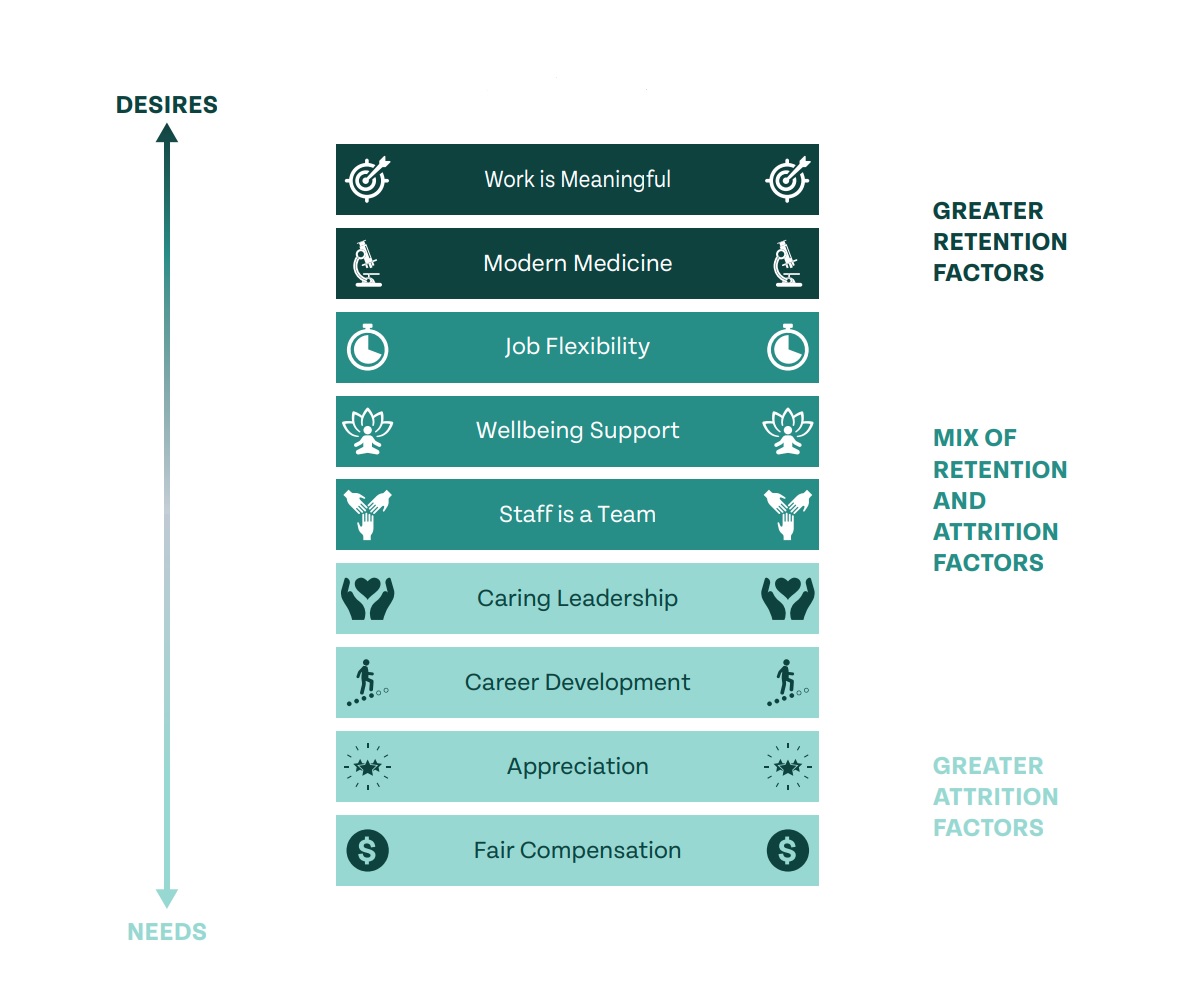
“Begin with the factors at the bottom; if the base of the pillar is shaky, it’s unlikely anything you do about the factors closer to the top will make much impact on retention,” said Seymour.
In this case, it’s clear that fair compensation is the driving retention factor for CrVts. So, let’s start there. A NAVTA survey from 2022 showed that about one-third of credentialed technicians worked a second job—and much of the time, that second job was a full-time gig. In other words, treats are great, but they’re not a replacement for kibble. And nobody wants to be chasing their tail after the workday is over to put food in their bowl.
“For CrVTs in particular, fair compensation is a HUGE deal,” said Seymour. “These are passionate professionals who want to work in veterinary medicine, but they also need to pay their bills.”
Where to start
Now that you’ve identified that fair compensation is what’s driving those techs out of practice (and frankly, just looking at the data, it seems to be what’s driving most non-owner roles out), you can dig in and get to work on retention in your practice. Seymour offers some advice on tools to use to take actionable steps forward. After all, it’s hard to wag your tail when your paycheck doesn’t cover the cost of your chew toys (or, you know, rent). Understanding those costs is key.
“The MIT Living Wage Calculator is a free, easy-to-use tool that will help you understand what a living wage in your neck of the woods actually looks like, and how that amount varies based on other household income and dependents,” she said.
Taking the time to go through your team’s pay and doing that analysis can give you a better understanding of meeting the team where they are. But what if you do that and you realize that everyone is getting underpaid? After all, if you want your team to sit, stay, and thrive, they need more than belly rubs in exchange for their hard work—but providing that can sometimes feel im-paw-sible.
“If you don’t feel you can afford to pay this role a living wage, it might be wise to take a fresh look at your practice to see how you can improve profitability. Things like overstocking inventory that doesn’t move or inappropriately pricing your goods and services are common ways to leave a lot of money on the table,” she added.
Personalize your plan
Of course, she notes that while the above scenarios are based on data, it may not be exactly what’s going on at your practice. That’s where the next helpful tool comes into play: surveying your team. This isn’t just barking—it’s about making sure your team members are seen and heard so they don’t go digging under the fence for new opportunities.
“To better understand what’s happening within your own team, start sending surveys that ask them specifically how they feel about things like compensation, appreciation, career development opportunities, leadership, teamwork, and more,” Seymour added.
Even the best leaders need to paws and listen.
But it doesn’t stop there—while a survey is all fine and dandy, it really means nothing if you don’t actually use the feedback you receive to make the changes that are impacting retention and driving those team members out of your practice (and sometimes, practice in general). Failure to do so can leave your pack feeling pretty ruff.
“Don’t be afraid to follow up and ask the team to provide their insights on how to best address the necessary changes. Even if you don’t take every suggestion, discussing the options with the team will help them feel greater buy-in,” she added. “Also, communicate with your team about what you’re hearing and what you plan to do. If the communication doesn’t go both ways, it won’t make the difference you’re looking for.”
Dear Labby is a monthly advice column that covers the tricky situations of vet med—from clinical to cultural and everything in between—with the help of Labby, the Labrador retriever who can sniff around for the best experts in the field. If you’d like to submit a question, email it to [email protected] with the subject line: Dear Labby. And keep it short! Labby’s attention span goes out the window after 200 words.
Photo credit: © AAHA
Disclaimer: Trends content is meant to inform, educate, and inspire by providing an array of diverse viewpoints. Any content published should not be viewed as an official stance, position, or endorsement by the American Animal Hospital Association (AAHA) or its Board of Directors.
