Culture and People
You otter know: Meet Splash, the search and recovery otter
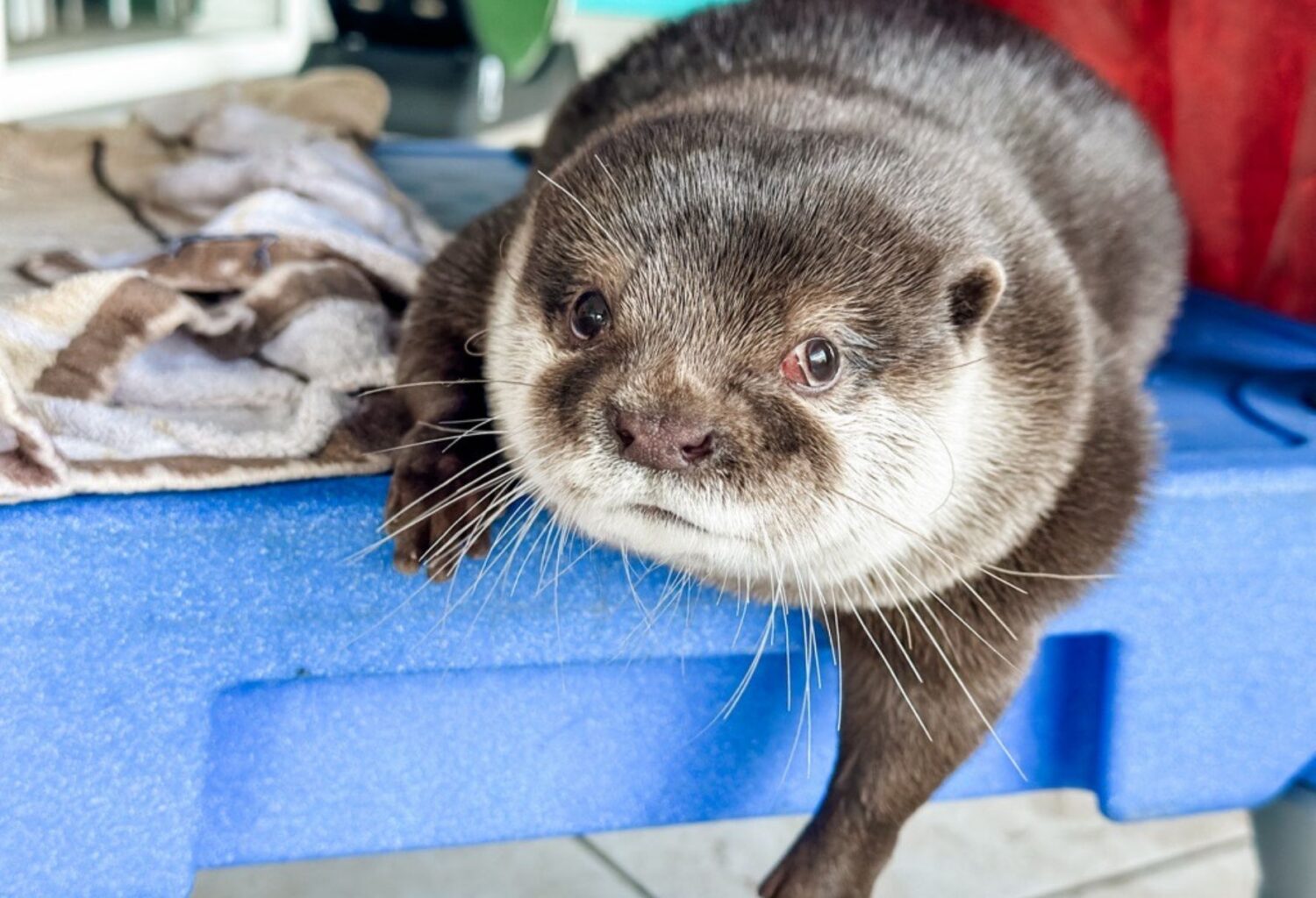
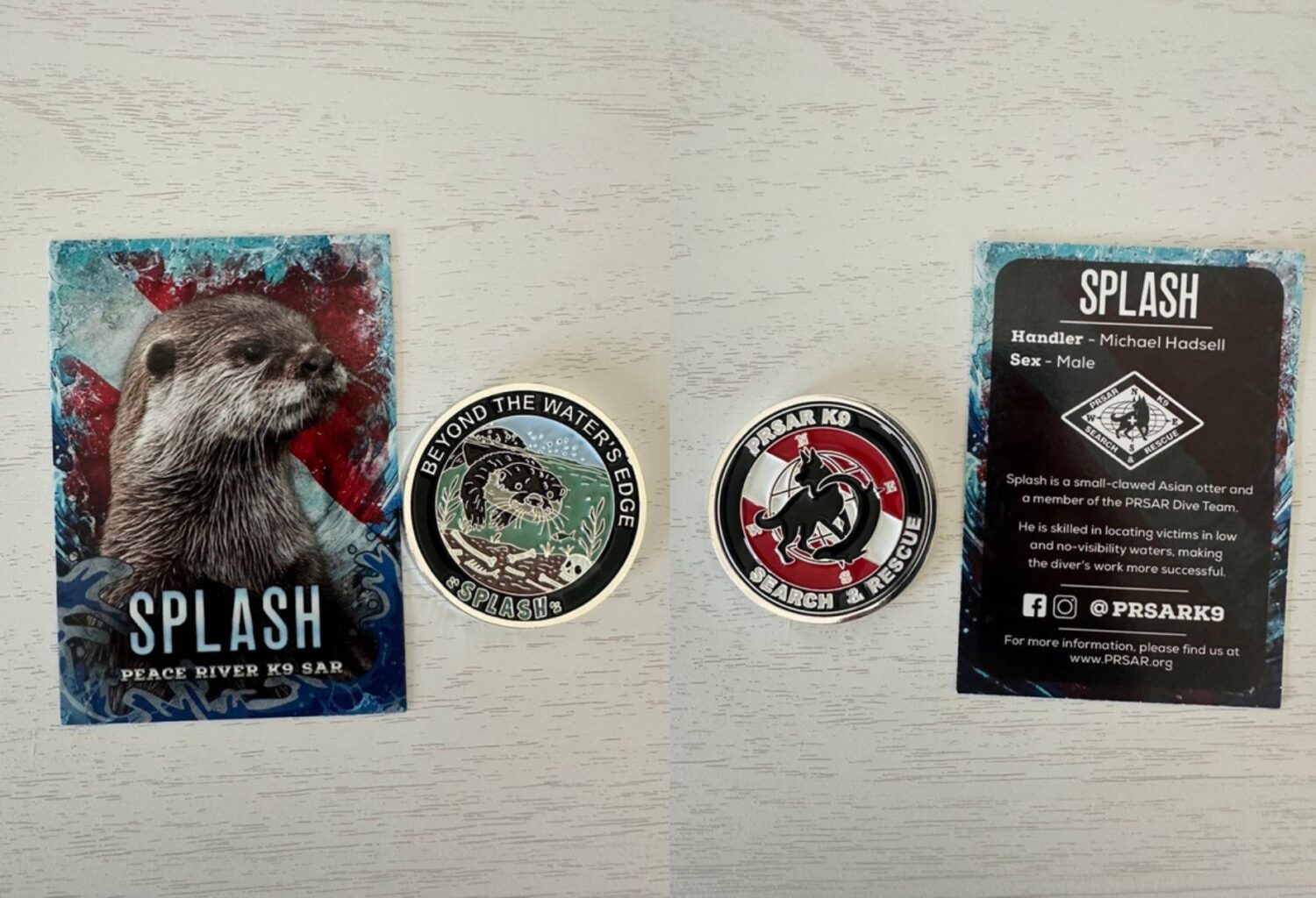
You’re familiar with working dogs and horses, but how about otters? Splash, the search and recovery otter, has made waves for his work finding remains underwater, and Trends had the opportunity to meet the otter and his handler to learn how the team carries out this important work.
Advertisement
Those who follow animal-related news have almost certainly heard about Splash, the search otter. Late last year, the small-clawed Asian otter and member of the Peace River K9 Search and Rescue (PRSARK9) Dive Team made national and international headlines after helping law enforcement officials locate human remains underwater.
But as exciting as it may be to picture an otter taking part in search and recovery efforts, we found ourselves wanting to know more than the short news clips provided. How, exactly, does Splash do this work? How was he trained? What does his daily routine look like? Does he like to cuddle?
Fortunately, Splash and his handler are based in Florida, not far from a Trends staffer, so we were able to get the full scoop, firsthand.
(It’s a tough job, but someone’s gotta do it.)
Recognizing a need
To understand Splash’s role in the search and recovery world, it’s helpful to understand the background of his handler, Michael Hadsell. Hadsell is president of PRSARK9, and he’s been in the search and rescue game for more than 45 years working with dogs, horses, and drones.
The nonprofit organization works with forensic specialists and law enforcement within Florida, also taking cases nationwide and internationally. Along with their K9 teams and mounted scent-trained horse team, they provide services like tracking and area searches, autistic and Alzheimer rescue, water recovery, and more.
As adept as his teams were, though, Hadsell recognized one area where they could stand to improve: underwater recovery with limited visibility, especially when searching for remains that may be partially or fully buried. With cold cases increasing in popularity due to advances in the science of DNA, those searches are in high demand.
Hadsell’s team had been working on a number of private cases with forensic anthropologist Arpad Vass, Ph.D. Vass is a well-known expert in the field, thanks to his work at the Law Enforcement Innovation Center at the University of Tennessee’s Institute for Public Service and his testimony in the Casey Anthony trial in 2011.
“We would do these searches, and run the dogs, and get to water edges, lakes, rivers, canals, whatever. And then I’d do the diving for them,” Hadsell said. I would go down and look for whatever the dogs were alerting, and I couldn’t find it. It was very frustrating.”
A splash of inspiration
Although Splash, at only a couple of years old, is quite new to the game, Hadsell first became aware of how trainable otters could be back in the early 1980s, when he was living in Thailand and saw how the locals worked with otters for fishing and finding things underwater.
It wasn’t until 2020, though, that he truly landed on the idea of training a cadaver otter.
“I was reading an article on a flight back from Los Angeles about otters and how they possibly can work odor underwater, and hunt underwater using odor and using their whiskers,” Hadsell recalled. “And I started thinking, well, if they can work odor underwater, then we can train them.”
Not long after reading the article, Hadsell visited Mote Marine and Aquarium in Sarasota, Florida, where he saw a trainer working with otters.
“The trainer had four log stumps, and the otters had to stay at each one of those stumps and she would throw the food to them. If they left the stump to come up to the front and try to get her, she would send them back. She had them do little tricks and then she would feed them,” he said. It was right in line with how he worked with his dogs.
When she finished, he introduced himself and asked if she had a few minutes to talk shop. “She was very gracious. I talked to her for about 20 minutes about the trainability of the otters, what they did and what they could do,” he said. “I realized at that point that, yeah, I think we can do this. We can make this happen. And so, we went to work.”
There was just one problem: Getting an otter.
Overcoming obstacles
One avenue is to go through exotic animal dealers, which is an area without much oversight. After Hadsell got a $15,000 quote, he decided to try another route.
“I put out an email to a lot of zoos that had otter programs,” he said, “and the Wildlife World Zoo in Phoenix, Arizona, contacted me. Morgan Brown, who’s the owner, said, ‘Is this real? Are you really trying to do this with the otters?’ I said, ‘Yeah, it’s very real. I just can’t afford the big price.’”
Fortunately, Brown was willing to donate an otter to Hadsell’s cause. “So I drove out there, picked him up, and brought him back,” he recalled. “And that was Splash.”
Challenging logistics
While that sounds like a simple exchange, the logistics were more involved. Because Splash is considered an exotic animal, Hadsell not only had to secure a permit to have an otter in his home—which required building fencing to create a primary and secondary containment area—but also transport permits for every state he drove through with Splash.
Even now, when he travels with Splash for cases, he has to get permission to bring him into any new state they enter. “If I don’t, they can refuse to let him come in,” he said—which is true even if he’s working with law enforcement in the area.
Driving is the go-to method of transportation, even though Hadsell has gone as far as the Arctic Circle to work cases with Splash. That’s due to otters’ unique physiology.
“They don’t do well in pressurized cabins because of their ear flaps, so the only way to transport them [by air] is to sedate them,” he said. But that brings with it other challenges, because otters’ body temperatures react to sedation.
“The moment we give him a sedative, his temperature spikes two to four degrees,” he said. So, they stick to driving, often grouping cases by geographical location to make the most of their time on the road.
Keeping Splash safe and healthy
Sedation is one of the logistics Hadsell addresses during vet visits, too.
When he first brought Splash home, he was fortunate to connect with a local veterinarian who’d served in the Army working with marine animals. “He took care of all their walruses and their dolphins that they used for security,” he said.
When that veterinarian moved up north, Splash’s care was transferred to John Gurland, DVM, at Lemon Bay Animal Hospital—an AAHA-accredited animal hospital in Englewood, Florida.
“Dr. John does a great job with him,” Hadsell said. “You have to use special meds, because he does get his distemper and rabies shots, but they have to be special shots made for exotic animals.”
And, while Splash is a friendly little guy at home (and yes, he does like to cuddle, under the right circumstances), to get those shots at the vet, sedation is necessary.
“He gets so upset, and he bites. I mean, he’s a first cousin to a wolverine, so he can be a little nasty.” Fortunately, the team at Lemon Bay understands how to work with him, and after a quick injection of sedative, they immediately have ice packs ready, and they get straight to work. “They’re giving him all the shots, they’re checking his teeth, they’re doing an x-ray,” Hadsell said.
That’s excellent news because otter health, as a whole, is a bit more delicate than most people realize.
“Probably [the otter’s] greatest weakness is that it doesn’t have much of an immune system for human diseases,” Hadsell said. “COVID, flu, stuff like that will kill otters. In fact, a lot of otters died during the COVID outbreak, and a lot of zoo otters died because their attendants would come in sick, and they would pick it up from them. It can just go through the whole colony—the whole romp of otters.”
This means that, while Hadsell brings Splash out for quite a few community events, he does so with caution and doesn’t allow anyone who’s under the weather to handle the otter.
On the job safety
Hadsell also has to set boundaries to protect Splash’s wellbeing while on the job.
“The search has to qualify for the otter, or we don’t use him,” he said. Even in perfectly clean water, they don’t allow Splash to go any deeper than 30 feet, and if the current is any stronger than eight knots, it’s a no-go. Then, of course, there are the predators to watch for—and in Florida’s waterways, that means gators.
“If there are 25 alligators in the area, I’m just not putting him in,” he said. His team doesn’t just do a visual sweep of the area but also uses sonar to check for gators hanging out on the bottom.
Birds of prey, like hawks and eagles, tend to be interested in Splash—but Hadsell’s team also has that covered. “I have folks on the team who wear shirts that say ‘Otter Spotter’ on them,” he said. “They watch for alligators and anything else, so they’re constantly keeping track of him so we know where he is and where the dangers are.”
Splash can work in any type of water—freshwater, saltwater, or brackish—but the level of contamination in the water is always a concern. Not only can dirty water make him sick, but also, washing an otter comes with consequences.
“When he gets into bad water, it’s a one-time deal for a couple of days, because when he comes out, we have to wash him down with Dawn dish soap, which washes all the oil right out of his fur,” Hadsell said. Normally, when Splash dives in, his fur gets wet and becomes sort of a “scuba suit,” which provides him with speed and buoyancy due to the oil in his fur.
But when he loses that oil? “He turns into a rock, basically,” Hadsell laughed. “He doesn’t swim well or anything. So he has to be out of the water for a couple of days to allow all the musk oil to start working its way back into the coat again. It could take a week until he’s back to himself.”
Working cases
Splash works closely with one of Hadsell’s dogs, Nova. Typically, if they get into a large lake area, the dog (or dogs) will deploy first and identify odors coming to the surface. Then, Splash will jump in, generally with a diver, to search below.
Hadsell’s work with Splash is solely search and recovery, meaning he’s deployed in cases where he’s searching for remains. (So no, you really don’t want to be in a position to have Splash come searching for you.)
Fortunately, Asian otters like Splash are remarkably well-suited for underwater search and recovery work due to their social, animated natures.
“When they get into odor, we want to see a change of behavior,” Hadsell said, noting that river otters, unlike Asian otters, are not terribly animated nor are they as friendly. “Splash is very dramatic. It’s obvious when he’s gotten into odor—and when he’s ready to get ‘paid,’ he becomes very chatty.” (Splash’s “pay” is salmon, and he goes through so much of it that he’s even gotten to meet the women who prepares his fish at the local grocer.)
The fact that they’re social and family-oriented is also an advantage. “They like to hunt in groups, so when we’re diving and working, he likes that because it’s his chance to hunt with everybody,” he said.
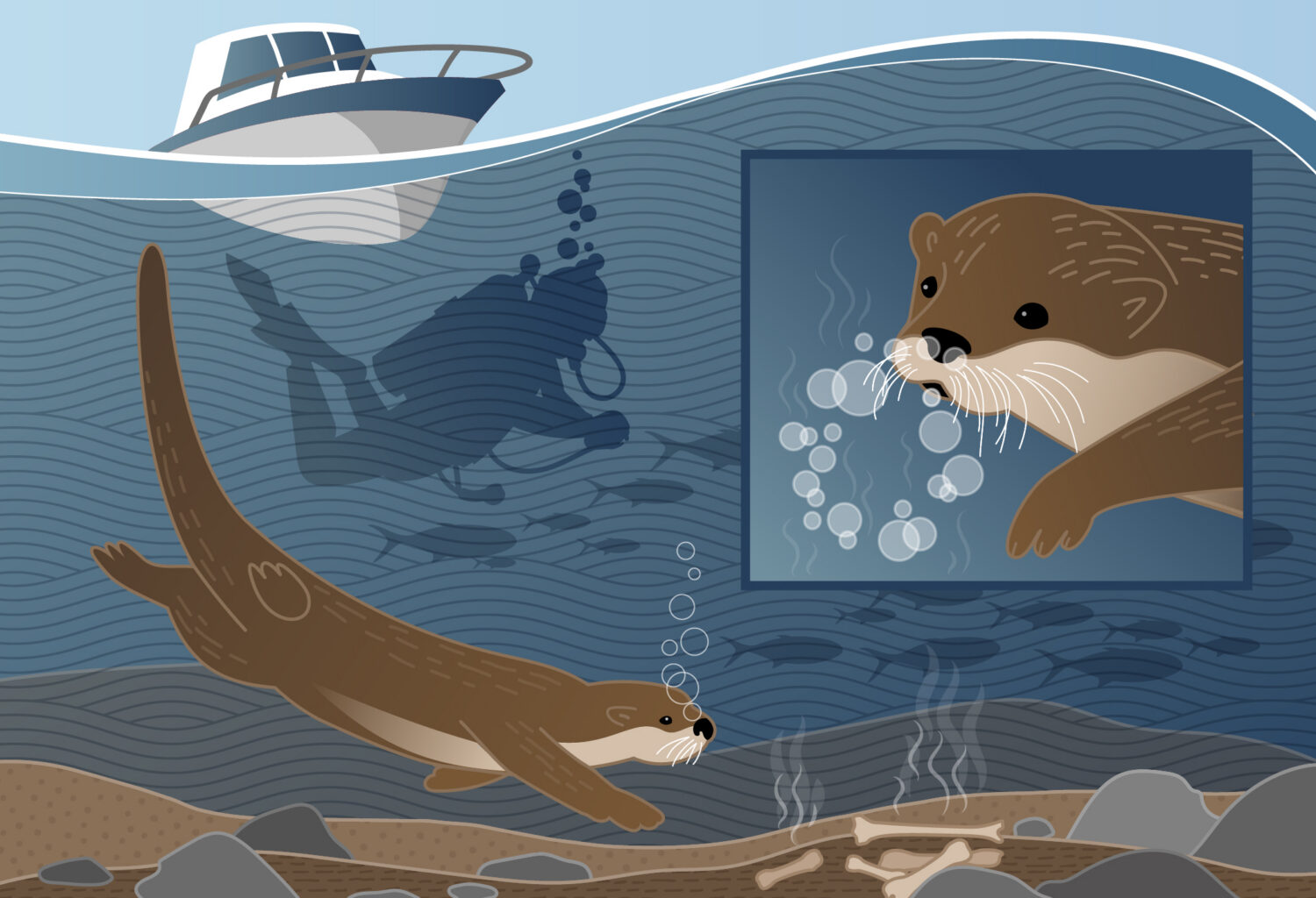
But what makes otters really stand out from the pack is the way they track and find scents. Hadsell trained Splash to alert on only human remains, which he does by using his whiskers to tune into magnetic fields, and his taste buds to “smell” underwater.
Human remains are on a different frequency than animal bones. “Otters can tell the difference in the frequency by using their whiskers as kind of a sonar system,” Hadsell explained, showing a video of Splash clearly tracking an odor underwater before bubbles appear. “If it was truly just odor that they were tracking, the bubbles would be out first; we wouldn’t see his head pop [in the direction of the source] until after he confirmed it with the bubbles. But what’s making his head turn every time he gets near the odor? That’s when we started playing around with magnetic fields.”
After tuning into the magnetic fields, Splash blows bubbles out of his nose, which capture the odor of the remains. He sips those bubbles into his mouth, essentially tasting the odor, and this allows him to narrow his search down to a remarkably precise location.
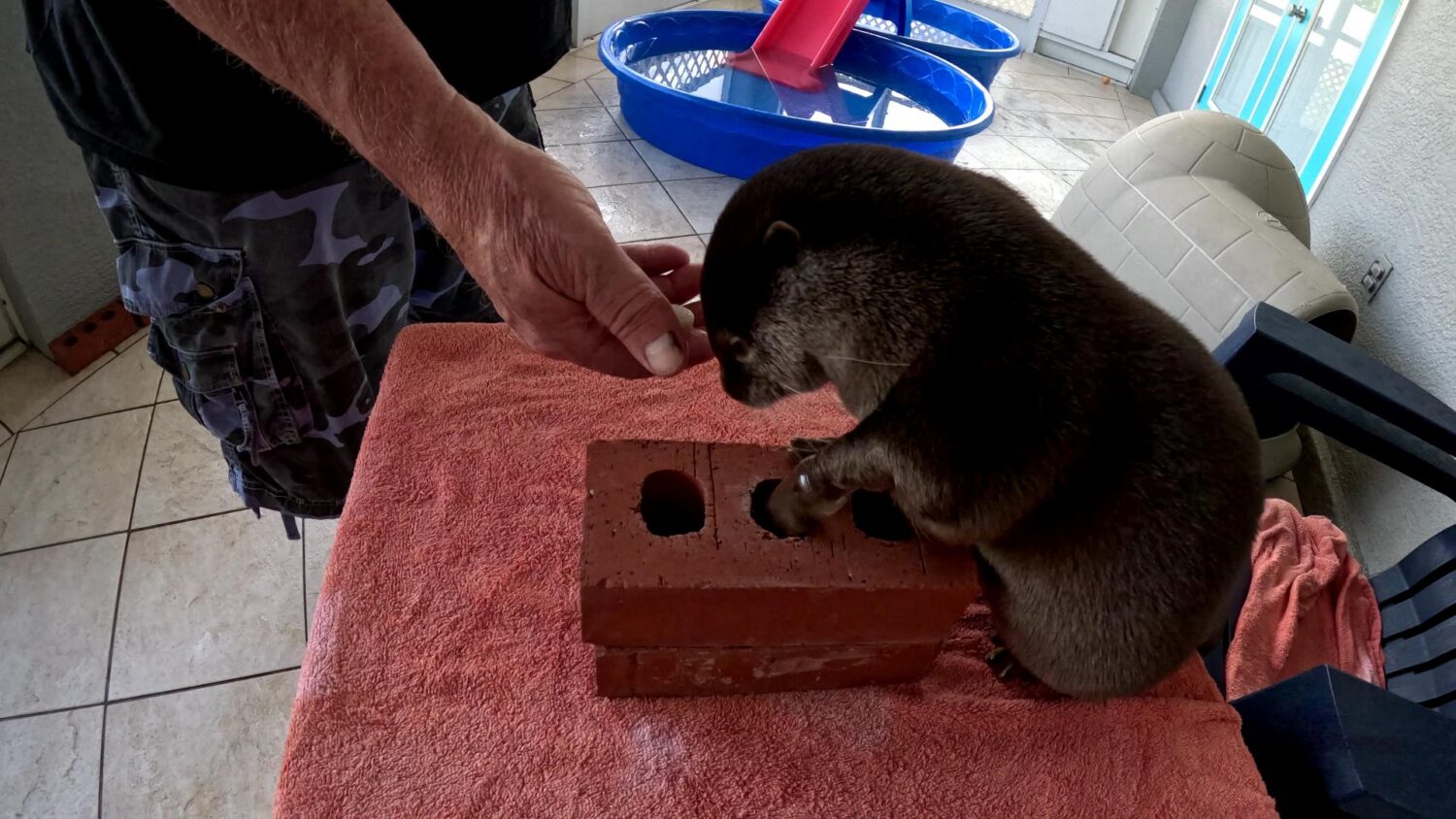
Once Splash was reliably alerting to human remains, Hadsell began testing his ability to stay on track by putting five rubber balls at the bottom of the pool; one had odor, the others did not. Splash consistently and quickly chose the right one—and just as quickly returned to Hadsell for his payment of salmon.
“Otters regulate their body temperature by eating; if they don’t eat, their body temperature gets too cold,” he said. This means a hungry otter is a very motivated otter, and that’s very clear when Splash finds something on a dive and sprints back to Hadsell to let him know.
“He comes up and starts grabbing my mask to tell me he’s got something, and he’s not going to let me get away until I start moving forward,” he said. When on a job, Splash wears a custom harness so that Hadsell can stick with him, even when there’s no visibility. Once Splash reaches the remains, he’ll lay on top of them so Hadsell can mark the precise spot to search.
In fact, training Splash to tolerate that harness was a tougher task than teaching him traditional obedience cues (sit, stay, come) and to be comfortable riding on different watercrafts and going off boats.
“We fought over harnesses since the first day I got him here. I had a little harness for him, and he would tear it up, chew the clasps off. I went through seven or eight of them, and it was so frustrating,” he said. Fortunately, a woman who’d made collars and harnesses for the K9 team worked with Hadsell to create a few different otter harnesses to meet Splash’s unique needs. (Not a lot of harnesses in the otter section of the local big box pet store, you know?)
“He’s swimming in it, so it can’t impede his swimming abilities, and dogs tend to have a little more chest, a larger rib cage,” Hadsell said. Additionally, Splash might be a little plump right after eating, but rail thin the next day, so the harness needs to be easy to adjust.
Achieving search success
Splash has now been featured in publications from as far away as Australia and Asia, but that attention all started with a request for an extra stop on a road trip.
Hadsell and Vass were driving back east from a search in Salt Lake City when a detective called with a request for them to divert their route to help with a cold case. They had the dogs, Splash, and all of their equipment, so they jumped in to help.
“We ended up tracking our subject’s murder victim to a lake, which was right behind the perpetrator’s house. The dogs were alerting like crazy, but we weren’t finding anything,” Hadsell said. That’s when Vass suggested sending in Splash.
Splash was only 8 months old at the time, and untested outside of controlled training environments. Although Hadsell was skeptical, he put on his gear and dove in with Splash.
“He started alerting this one area, right down at the bottom, so I marked it,” he said. After trawling the area, all they found a big, clay brick.
“The detective said, ‘I want that. Bring it to me,’” Hadsell recalled. “So we took the brick over to her, and she matched it up to the victim’s head. It fit right in where the guy had smashed him in the head with this brick.”
Authorities sent the brick to the lab and pulled human DNA from the remaining blood. While there was nobody left alive to prosecute, this provided closure to those affected.
Plus, Splash played his part perfectly, proving that his abilities could help the PRSARK9 dive team get more recoveries, even in situations that other people would consider impossible.
“After that, it was like, game on.”
And game on is right. Splash’s popularity means Hadsell is busier than ever—enough so that he’s considering adding another otter to the team to meet demand. But for the time being, he’s simply enjoying the experience of keeping Splash mission-ready.
“It’s a lot like with dogs, where you have to constantly come up with new ways to challenge them, to keep it interesting for them,” he said. “In the initial phases, we were training him pretty much daily, but now he’s at a point where we’re doing maintenance training—just training a couple days a week, and he really looks forward to the next training because it’s so stimulating for him.”
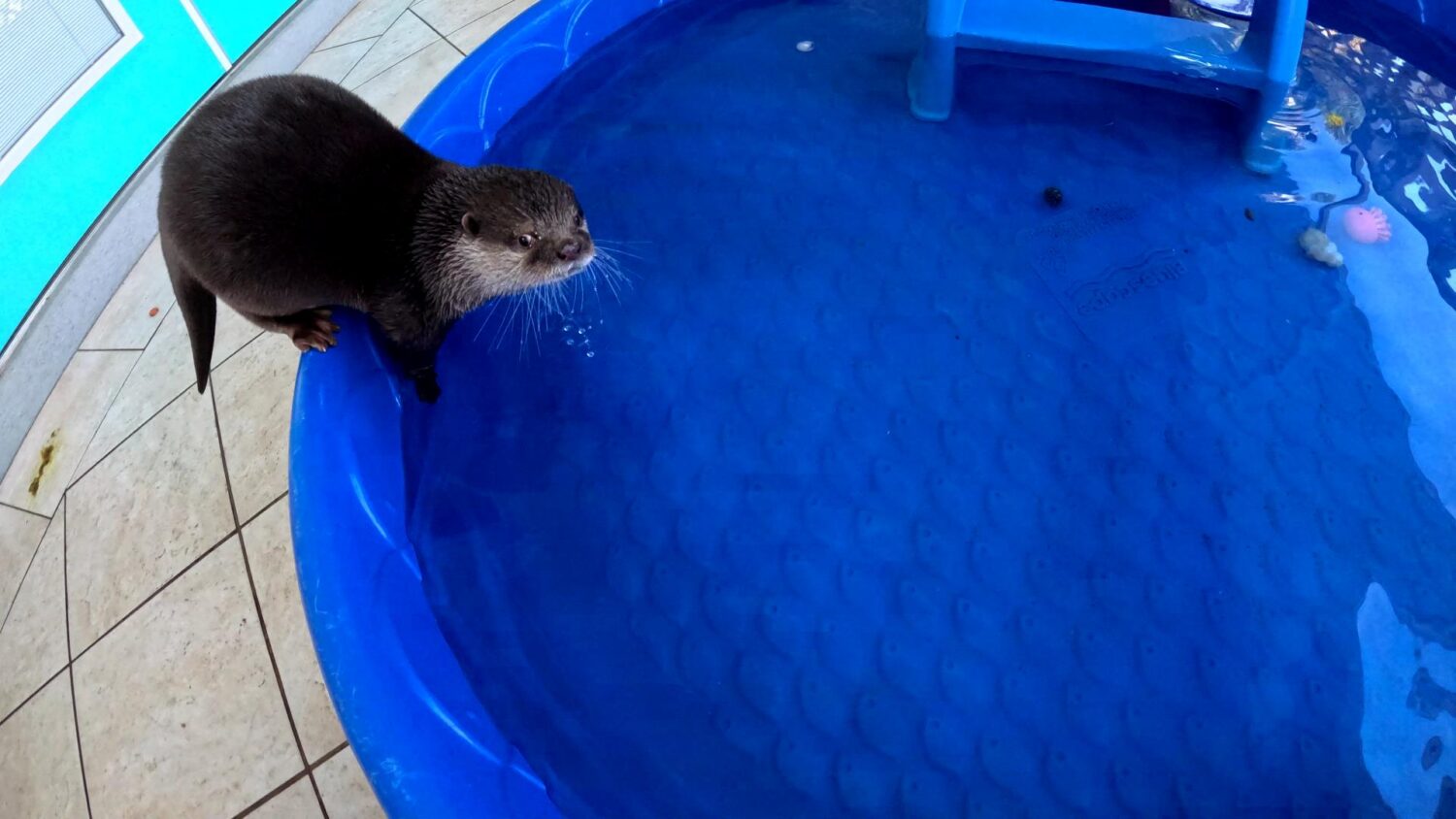
While Splash enjoys a bit of downtime at home, riding the Roomba (really), cuddling up on the couch, playing in his kiddie pool, and snoozing in his igloo, it only takes a couple of days for him to start getting antsy. “I think he’d have a really hard time with a boring lifestyle,” Hadsell said.
In fact, the moment Splash sees Hadsell put on his blue team shirt and grab his gear, he’s right there at the door with the dogs, running to the van and ready to go.
“He’s out there with the rest of them, wanting to do his thing,” Hadsell said. “He’s part of the team now.”
Photo credits: AAHA
Disclaimer: Trends™ content is meant to inform, educate, and inspire by providing an array of diverse viewpoints. Any content published should not be viewed as an official stance, position, or endorsement by the American Animal Hospital Association (AAHA) or its Board of Directors.
