Section 3: Grounding Principles of a One Health System
Top 3 Takeaways
- In a functional One Health system, human and veterinary health care teams collaborate to ensure the health and wellbeing of people and animals.
- Achievement of One Health goals requires strong interdisciplinary coordination and communication.
- Professional drivers and ethics likely differ among roles in One Health systems and will require proactive transparency and discussion to navigate points of possible role challenges.

Grounding Principles
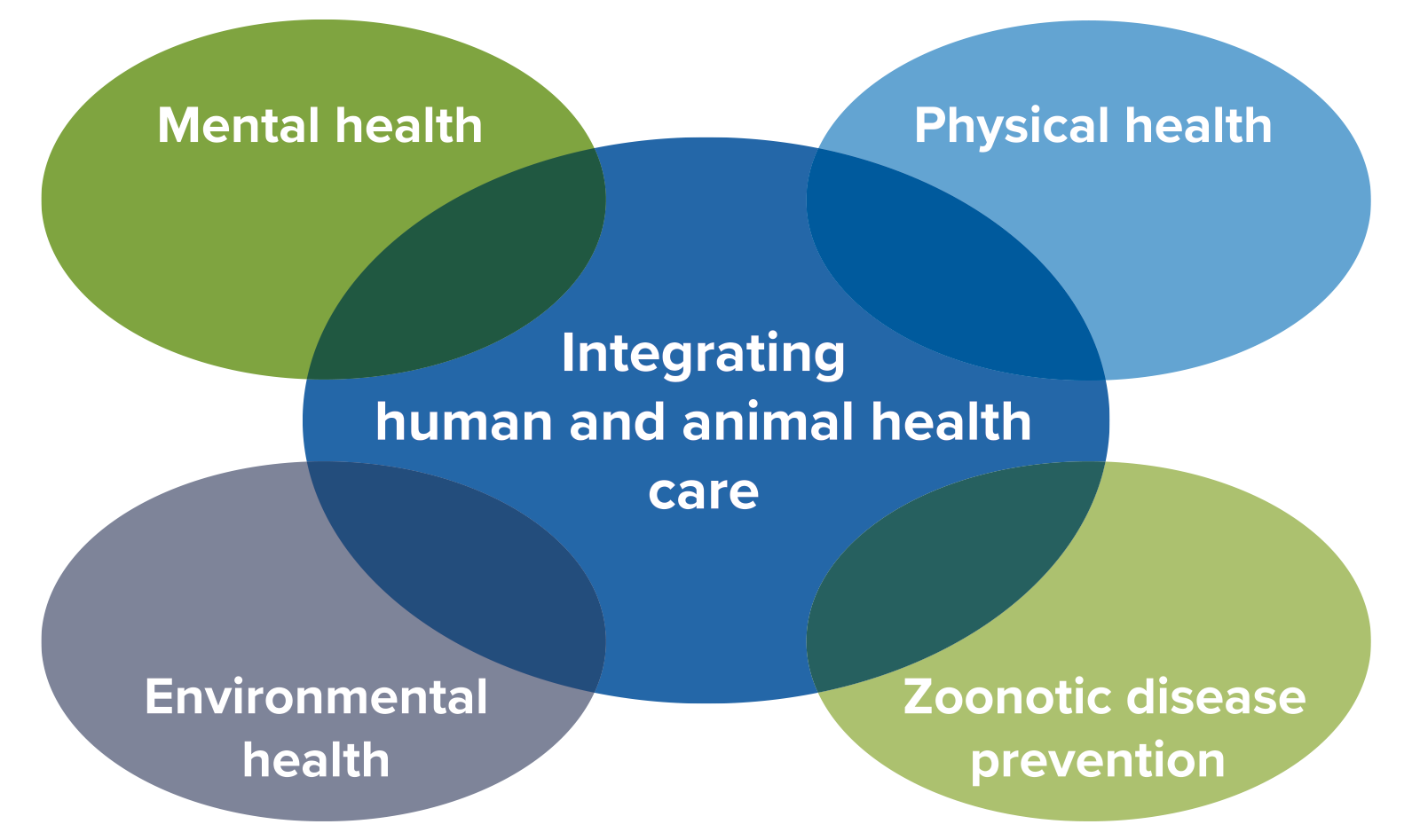
Principle 1—One Health System: A One Health system requires an interprofessional team approach to be successful. One Health encompasses the health of the animal, the person(s), and their home/external environment; this results in the need for different skill sets and professions depending on the context of the health challenge faced (Figure 3.1). Licensure, liability, and care regulations may limit the scope of how and when a professional may participate in addressing a One Health issue. As the One Health system expands beyond the scope of traditional veterinary and medical practice, certain roles may be missing—for example, a person prepared to address temporary housing and care for the pets of a hospitalized person.
FIGURE 3.1: Integrating Health Care in a One Health System
Principle 2—Collaborative Communication: Success in a One Health approach requires collaborative communication, whereby individuals from multiple professions communicate with one another in a seamless fashion as they work toward solutions.
Communication among disciplines needs to be respectful, proactive, multimodal (e.g., phone, fax, in-person), and appropriately timed. The development of strong networks within a community can facilitate collaborative communication. During network development, professionals can identify communication barriers and strategies to overcome them, including determining methods of communication to clients and communities to limit misinformation and provide resources. In developing a network, communication through a direct phone line, email, online platform, or text may facilitate timely and meaningful contact.
With the recognition that today’s complex health care problems demand such collaboration, a variety of health care professions now feature integrated education on interprofessional communication in their academic curricula.
Public health professionals can play an important role in facilitating communication between veterinary and other human health care professionals, especially during infectious disease outbreaks or public health emergencies. Public health officials can review clinical data on patients during investigations without HIPAA authorization (45 CFR 164.512(b), https://www.hhs.gov/hipaa/for-professionals/privacy/guidance/disclosures-public-health-activities/index.html).
Depending on clinical or other situations, veterinarians may opt to reach out to human health professionals either directly or via public health agencies. Depending on the situation and amount of case information discussed, some systems may require written authorization from the client, typically on a form provided by the human health provider’s organization.
As part of developing a One Health network, identifying key contacts within local public health jurisdictions is strongly recommended. Reach out and develop relationships with local public health officials such as epidemiologists, public health veterinarians, or zoonotic disease personnel. Veterinary teams do not need to wait until an urgent case occurs. Rather, reaching out to ask about rabies policies or leptospirosis in the area are good conversation starters. Inviting a public health official to the clinic to conduct a staff training is another good way to start a relationship and develop ongoing communication channels.
Subcompetency C2 of the Interprofessional Education Collaborative (IPEC) “Communication” competency states, “Use communication tools, techniques, and technologies to enhance team function, well-being, and health outcomes.” 1 Health care teams can leverage technology to support communication efforts such as electronic health care records tools that prompt professionals to ask One Health questions and communicate with one another when making certain diagnoses (e.g., zoonotic diseases).
Principle 3— Ethics and Drivers: Attention to values and ethics in One Health collaborative communication is important.
The four overarching principles put forth by Beauchamp and Childress in 1979 that influence the work of health and helping professions are (1) autonomy—the right to choose for oneself; (2) justice—fair treatment and allocation of resources; (3) beneficence—the intent to do good; and (4) nonmaleficence—the effort to do no harm in the process of caring. 2 In practice, these principles often conflict with each other. For instance, informed consent, truth-telling, and confidentiality ensure patient autonomy but can conflict with beneficence when a patient is unable to choose a beneficial course of treatment. In veterinary medicine and human health care disciplines like pediatrics, human surrogates make decisions for the patient, creating even more complexity in applying the four principles.
Conflicts can arise due to differences between the medical professional’s goals for care and the patient’s/surrogate’s goals for care. 3 Conflicts also can arise between professions that have an interest in a One Health approach to a health issue. For instance, a human medical practitioner may recommend a pet be removed from a home environment because of allergy or immunodeficiency; however, the veterinarian may be more driven to work with the client to find solutions for the family to keep the pet.
Other ethics-based conflicts vary by profession, such as social workers’ commitment to client self-determination, which can conflict with veterinarians’ commitment to reducing animal suffering. Ethical decisions in One Health systems also can feature both micro-level concerns such as individual patient care and macro-level population-based concerns such as zoonotic diseases that involve multiple animal host species.
Considering and balancing professional values and ethics, stakeholder interests (i.e., clients and communities), and ethical perspectives that influence each is paramount to effective One Health treatment decision-making and action.4 One IPEC subcompetency (VE7) within the Values and Ethics competency states, “Practice trust, empathy, respect, and compassion with persons, caregivers, health professionals, and populations.” 5 Putting this into action means asking others in the One Health system about the professional values and key interests that influence their perspective and decision-making when addressing the presenting issue.
Ideas for Developing Interdisciplinary Relationships
- Ask local veterinary medical associations, county public health departments, academic institutions, or industry groups to facilitate continuing education events that bring together experts from different professions to discuss One Health problems, such as emergency preparedness or zoonotic diseases. Attend multidisciplinary continuing education events and get involved in the broader academic community.
- Foster dialogue and open communication channels through discussions of specific One Health case scenarios.
- Reach out to human health care professionals and ask if they know of local organizations in their respective fields that may be interested in joint educational activities. Work with community organizations to establish local meet-and-greet activities for One Health purposes.
- Provide education on dog parks, community activities, and resources to increase health outcomes for people and pets.
- Consider offering clinic shadow days and/or clinic “open houses” for those from other professions.
- Establish a One Health journal club.
- Become involved in disaster preparedness for the community.
- Organize “Health Fairs” for people and pets to illustrate the One Health concept and encourage collaboration and discussion from both animal and human health sectors.
The AAHA One Health Guidelines are generously supported by Merck Animal Health.
Citations
- Interprofessional Education Collaborative. IPEC Core Competencies for Interprofessional Collaborative Practice: Version 3. Washington, DC: Interprofessional Education Collaborative; 2023.
- Beauchamp TL, Childress JF. Principles of biomedical ethics. Oxford, England: Oxford University Press; 1979.
- Varkey B. Principles of clinical ethics and their application to practice. Med Princ Pract 2021;30(1):17–28.
- Degeling C, Dawson A, Gilbert GL. The ethics of one health. In: Walton M, ed. One Planet, One Health. Sydney, Australia: Sydney University Press; 2019:65–84
- The Interprofessional Education Collaborative (IPEC) developed four core competencies for interprofessional collaborative practice [JS1] : Values and Ethics, Roles and Responsibilities, Communication, and Teams and Teamwork (2023). Within these are 33 subcompetency statements, which were endorsed by several professional organizations including the American Association of Veterinary Medical Colleges. The One Health task force supports the application of these statements to optimize professional collaboration. The statements include recommendations such as valuing diversity; maintaining professional competence; incorporating complementary expertise to meet health needs; practicing cultural humility in interprofessional teamwork; practicing active listening; and applying interprofessional conflict management methods. https://ipec.memberclicks.net/assets/core-competencies/IPEC_Core_Competencies_Version_3_2023.pdf