Section 4: One Health System Roadmap
The One Health System Roadmap (Figure 4.1) is a decision tree outlining
the steps for communication and coordination among veterinary
and human medical professionals within a One Health system.
Table 4.1 offers guidance on which professional to contact, depending
on the case and situation.

To illustrate the practical uses of the One Health System Roadmap, the guidelines provide common scenarios that may be seen in practice (e.g., zoonoses, disabilities, intimate partner violence) using the following questions:
- Is a One Health approach required for this case? Is outreach needed to a human health care provider, public health professional, or social worker?
- Who should be contacted and when? Is the situation urgent or emergent?
- How should contact be made?
- How should One Health outreach be documented?
- What follow-up is needed?
FIGURE 4.1 The One Health System Roadmap
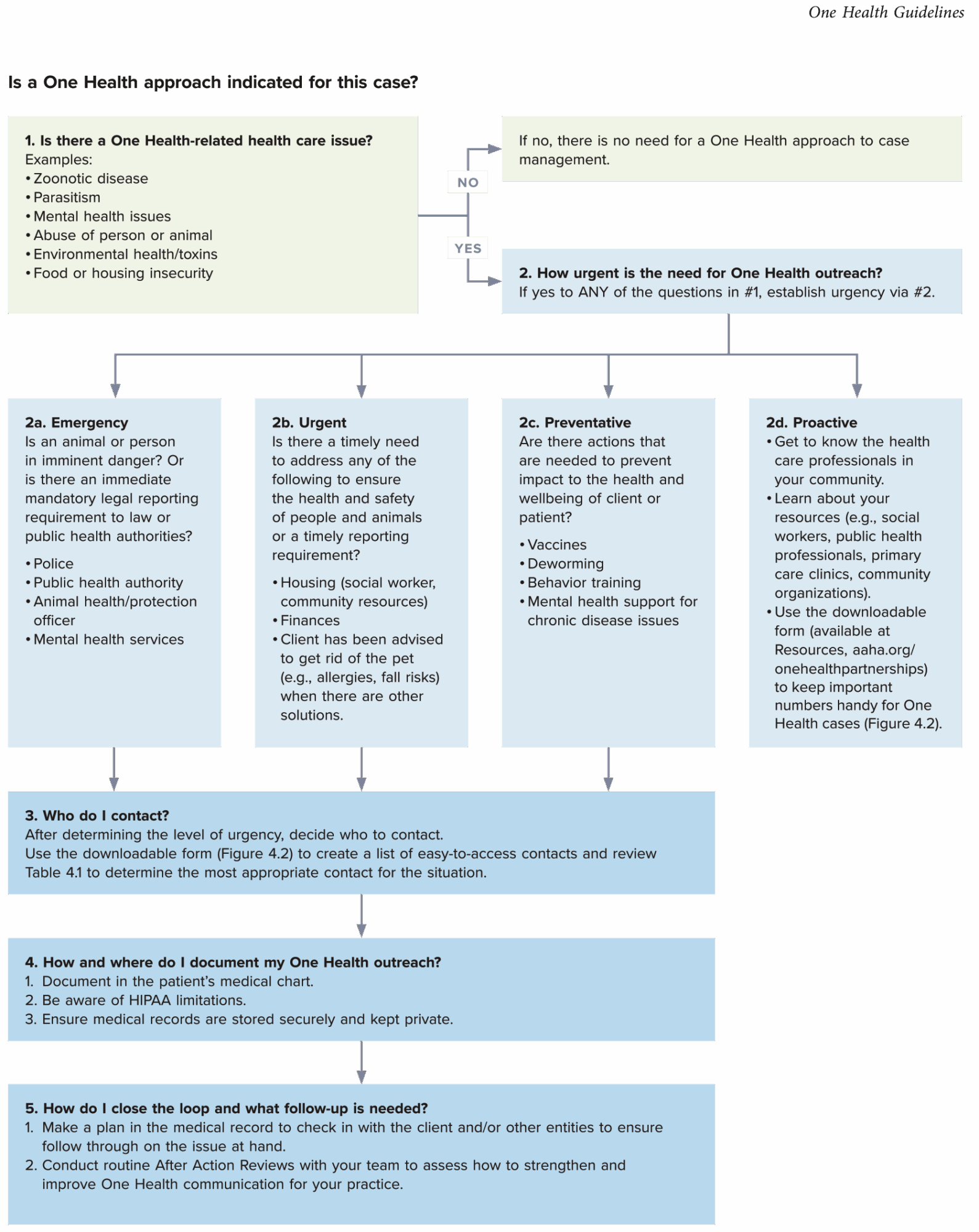
Figure 4.2: One Health Contact Sheet
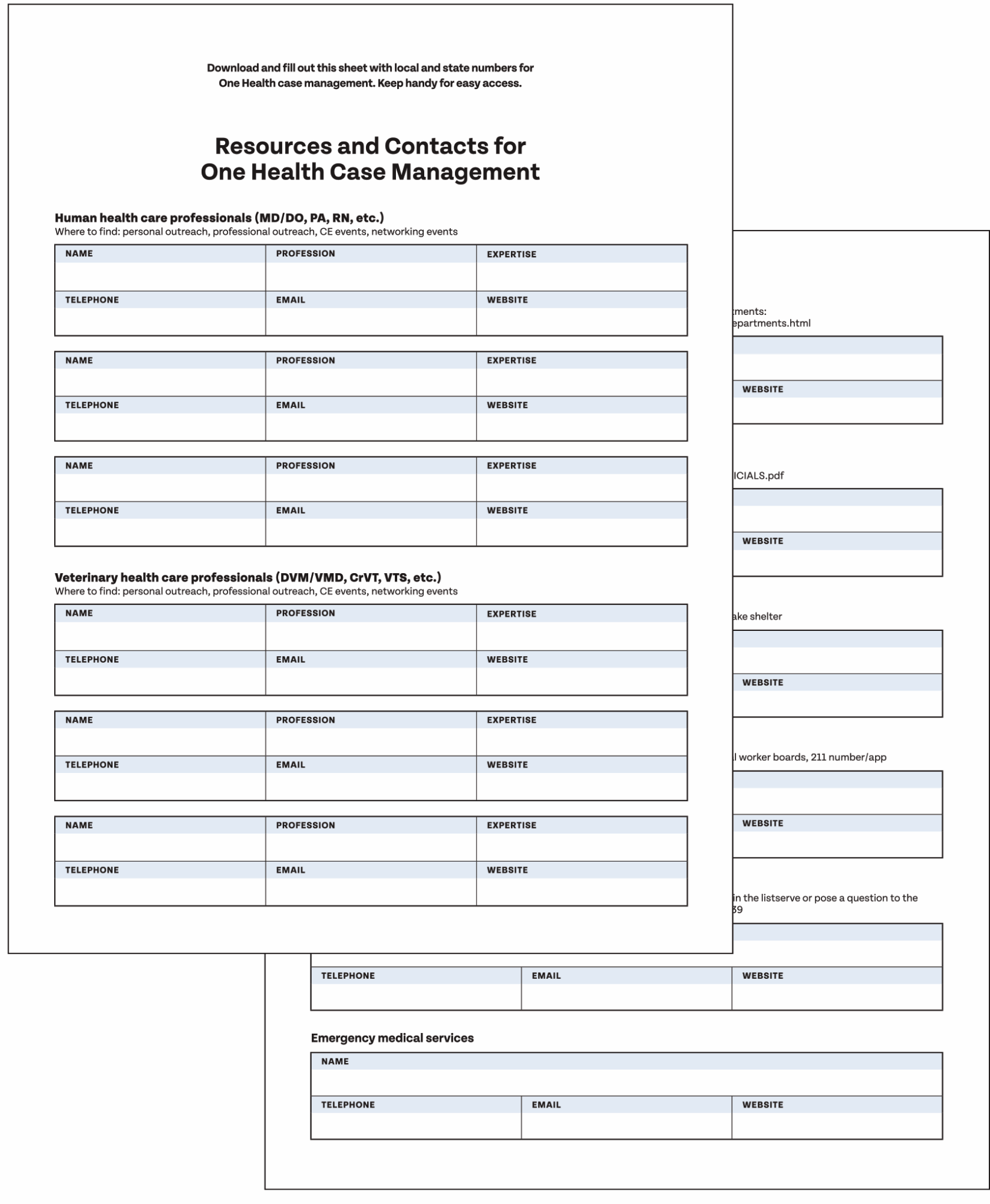
TABLE 4.1: One Health System Contacts
| Contact/Resource | Workplace | Scope of care | Contact recommendations | Special considerations |
|---|---|---|---|---|
| Human health care professionals (MD/DO, NP, PA, RN, LPN, etc.) | Clinics and hospitals |
|
Cases of zoonotic disease exposure, injury, or other illness where One Health management is indicated. | Obtain client consent before contacting. Be aware of HIPAA limitations on the sharing of medical information. |
| Local health jurisdictions | Local health departments |
|
Prevention and control of zoonotic diseases, animal bites, and other exposure to animals and animal products.2 | Contact information for county health departments by state can be found here: https://www.naccho.org/ membership/lhd-directory. In states with centralized public health, the state health department will be the primary contact. |
| State public health veterinarian (SPHV) | State health departments |
|
Prevention and control of zoonotic diseases, animal bites, and other exposure to animals and animal products.4 | Contact information for SPHVs can be found here: https://www.nasphv.org/Documents/ StatePublicHealthVeterinariansByState.pdf. |
| State veterinarian | State agriculture departments |
|
Reportable or zoonotic disease diagnosis, questions about animal transportation, and reporting sick or dead farmed animals, birds, or aquatics. | Contact information for state veterinarians by state can be found here: https://www.usaha.org/upload/ Federal%20and%20State%20Health/ STATE_ANIMAL_HEALTH_OFFICIALS.pdf
For a list of national reportable diseases, see: https://www.aphis.usda.gov/livestock -poultry-disease/surveillance/reportable-diseases For a list of state reportable diseases, consult your State Department of Agriculture website. |
| Local animal control officer and humane law enforcement officer | Animal care and control agencies and/or municipal shelters and/or humane societies |
|
Cases of suspected cruelty and/or neglect (if not immediately life-threatening), lost, abandoned, or dangerous animals, and housing for displaced animals during a disaster. | If the abuse is currently happening and/or an animal’s life is in danger, calling 911 or the police is indicated.
In some states, animal control laws and animal cruelty laws are managed by the municipal shelter; in other states, the animal cruelty laws are enforced by humane societies. Be aware of state mandatory reporting and immunity laws for veterinarians. For a table of laws by state, see https://www.animallaw.info/topic/table -veterinary-reporting- requirement-and-immunity-laws. |
| Human health care social worker | Hospitals and health care agencies, government agencies, schools, community outreach agencies, clinics, etc. |
|
Challenges with physical and/or mental health, disability, family and home life issues, unemployment, addiction, and other issues. | Obtain client consent before contacting, unless the person is a danger to self or others. Be aware of HIPAA limitations on the sharing of medical information. |
| Veterinary social worker | Veterinary hospitals and clinics, colleges of veterinary medicine, animal-assisted therapeutic programs |
|
Crisis support and intervention, ongoing counseling, education and training, conflict mediation, consultations on ethical decision making, liaison between family and veterinary team, end-of-life support and bereavement counseling.8,9 | Depending on the situation, may need to obtain client or staff member consent before contacting.
The Veterinary Social Workers community does not yet have a clearinghouse for information on how to locate a veterinary social worker in a given area. The Center for Veterinary Social Work has a listserv. Interested people can join the listserve or pose a question to the listserv, and they will post the question. Email: [email protected] Phone: 865-755-8839 |
| Police | City or county police stations, jails, etc. |
|
Imminent danger to a person’s or animal’s life. | For crises where someone’s life is not in danger or a law has not been broken, it may be best to contact community-based services or other health professionals. |
| Child Protective Services | State or county agencies |
|
Suspected child abuse and/or neglect. | Some states require anyone suspecting child abuse/neglect to report it. Some states may also require veterinarians to report suspected abuse.
For state and territory reporting information, see https://childcare.gov/ health-and-safety-reporting. For general information, see https://childcare.gov/consumer- education/child-protective-services. |
| Community-based alternatives to calling the police | N/a |
|
No imminent danger to a person’s or animal’s life. | If a person or animal is in danger, calling 911 or the police is indicated. Be aware of state mandatory reporting and immunity laws for veterinarians. |
| 211 number/app | N/a |
|
HIPAA Considerations for Veterinarians
The Health Insurance Portability and Accountability Act (HIPAA) limits human health care providers from disclosing protected health information (PHI), with a few exceptions, to anyone other than the patient and the patient’s authorized representatives without their consent. Certain states also have laws that require information regarding veterinary care be protected from disclosure. Veterinarians should review their state veterinary practice acts.
What is allowed under HIPAA?
- Patients can authorize the sharing of their health care information with anyone they choose, and with appropriate consent, sharing and/or exchange of information is possible.
- With client consent, veterinary and human health care teams can exchange information. Human health care teams cannot discuss or share patient health information without consent, and it is advised that veterinary health care teams follow this same procedure regardless of legal allowances.
- An authorization to communicate allows the human health care team to share PHI with another entity, for example, another clinic, family member, or lawyer. This is best achieved using a signed form.
- A release of information authorizes the human health care team to release documents to another facility. This can be achieved using either the requesting or releasing site’s form, as long as the form includes the following:
- Who is releasing the information
- Who is receiving the information
- What is being released and over what time frame
- The signature of the human patient or the pet’s caregiver
Veterinary health care teams should be aware of local laws surrounding confidentiality and disclosure of health care information to facilitate collaborative communication in a way that respects the privacy of all family members.
Veterinarians can also meet with other health care professionals in their community to discuss mechanisms that allow for legal exchange and documentation of health care information to promote One Health.
The AAHA One Health Guidelines are generously supported by Merck Animal Health.

Citations
- NASPHV. About State Public Health Veterinarians. nasphv.org. N.d. Available at: https://www.nasphv.org/aboutPHVs.html. Accessed November 7, 2024.
- NASPHV. About State Public Health Veterinarians. nasphv.org. N.d. Available at: https://www.nasphv.org/aboutPHVs.html. Accessed November 7, 2024.
- NASPHV. About State Public Health Veterinarians. nasphv.org. N.d. Available at: https://www.nasphv.org/aboutPHVs.html. Accessed November 7, 2024.
- NASPHV. About State Public Health Veterinarians. nasphv.org. N.d. Available at: https://www.nasphv.org/aboutPHVs.html. Accessed November 7, 2024.
- NASW. About Social Workers. socialworkers.org. N.d. Available at: https://www.socialworkers.org/News/Facts/Social- Workers#:~:text=Social%20workers%20help%20individuals%2C%20families,social%20and%20community%20service%20directors. Accessed November 7, 2024.
- Center for Veterinary Social Work. What is veterinary social work? vetsocialwork.tennessee.edu. N.d. Available at: https://vetsocialwork.tennessee.edu/. Accessed November 7, 2024.
- The Ohio State University. What is a veterinary social worker? vmc.vet.osu.edu. N.d. Available at: https://vmc.vet.osu.edu/resources/what-veterinary-social-worker. Accessed November 7, 2024.
- Center for Veterinary Social Work. What is veterinary social work? vetsocialwork.tennessee.edu. N.d. Available at: https://vetsocialwork.tennessee.edu/. Accessed November 7, 2024.
- The Ohio State University. What is a veterinary social worker? vmc.vet.osu.edu. N.d. Available at: https://vmc.vet.osu.edu/resources/what-veterinary-social-worker. Accessed November 7, 2024.