
Menu

AAHA Standards of Accreditation

AAHA-accredited practices voluntarily hold themselves to a higher standard. Pets are their passion and providing exceptional care is their top priority.

Advertisement

A Commitment to Excellence in Veterinary Medicine

Excellence in veterinary care starts with AAHA’s Standards of Accreditation, the evidence-based benchmarks that define the highest quality in companion animal medicine. These standards guide teams in delivering exceptional outcomes for patients, clients, and the profession.

AAHA is the only organization accrediting companion animal hospitals in the U.S. and Canada. Accreditation isn’t a one-time milestone; it’s an ongoing commitment. Accredited practices meet and maintain nearly 50 categories of standards that cover everything from pain management and anesthesia to client communication, medical recordkeeping, and team training.

Developed by veterinary experts and continuously updated to reflect the latest clinical best practices, AAHA Standards support continuous improvement, professional growth, and consistent, high-quality care.

AAHA standards at a glance

The Latest Evolution in Standards

In September 2025, AAHA announced the first comprehensive refresh of the Standards of Accreditation in the Association’s 90-year history. While the Standards have seen incremental updates over the years, this top-to-bottom review marks a historic milestone in our mission to elevate veterinary care.

New Standards Update

On July 22, 2025, the American Animal Hospital Association released four groundbreaking new Standards of Accreditation, marking a historic milestone in our ongoing mission to elevate the quality of veterinary care.

  • Microchipping: Accredited practices are now expected to initiate conversations about microchipping at a pet’s first visit and verify functionality and location annually.
  • Nontherapeutic Procedures: Practices are discouraged from performing or referring nontherapeutic procedures when not medically necessary, including:
    • Devocalization
    • Ear cropping
    • Feline declawing

These procedures should only be performed when a clear medical indication exists.

List of AAHA Standards

Members Exclusive: List of AAHA standards

AAHA Traditional Standards
Veterinary professionals examining a dog.

Member Exclusive

AAHA Standards of Accreditation

AAHA Traditional Standards

View AAHA’s standards of accreditation for general veterinary practices.

 

AAHA Referral Standards
One veterinary professional holding a cat while the other writes on a piece of paper attached to a clipboard.

Member Exclusive

AAHA Standards of Accreditation

AAHA Referral Standards

Designed for specialty practices, referral accreditation confidently confirms to general practitioners that specialists follow equally high standards and understand the importance of communication throughout the referral process.
End of Life Care Standards (EOLC)
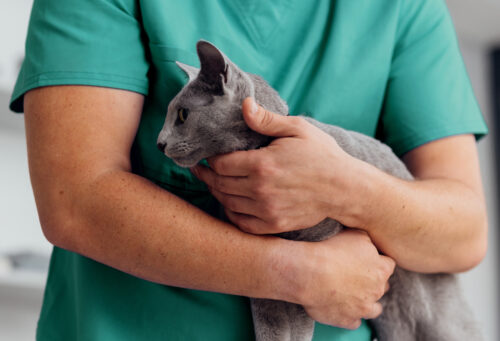
Veterinary professional holding a gray cat.

Member Exclusive

AAHA Standards of Accreditation

End of Life Care Standards (EOLC)

EOLC standards help veterinary practices elevate services for patients and clients who receive appropriate supportive and emotional care, further enhancing and strengthening the human-animal bond.
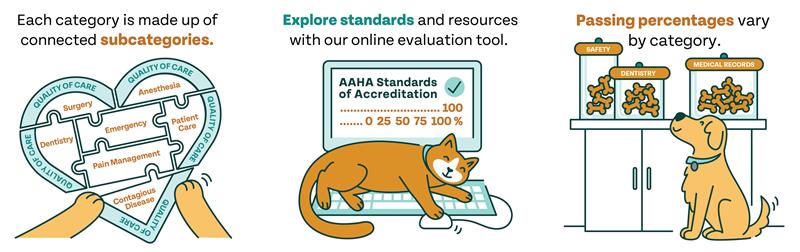
AAHA Standards of Accreditation At A Glance

AAHA’s Standards of Accreditation At A Glance

Quality of Care

  • Anesthesia
    • Sedation and anesthesia require extensive medical and equipment knowledge to offer patients the most desirable outcome. Though every situation is unique, our standards assure every anesthetist is prepared before administering the first medication.
  • Contagious Disease
    • Exposure to a pathogenic organism is highly likely whenever one enters a healthcare facility. As veterinary professionals, we must diligently educate, mitigate, and ideally prevent exposure as often as possible. AAHA’s Standards of Accreditation help to guide veterinary facilities towards successful disease prevention by limiting unintentional exposure to pathogens.
  • Dentistry
    • A pet’s oral health requires care within their home and the professional services a licensed veterinarian provides. This team approach is vital to a pet’s health, and at AAHA, our members are encouraged to create an environment that is:
      • Filled with resources for pet parents
      • Safe and inclusive of an aseptic environment for pets during dental procedures
      • Compatible with thorough and detail-oriented care (above and below the gumline)
  • Emergency
    • While it’s unreasonable to be prepared for every emergent situation, having the supplies and knowledge nearby helps to navigate the daunting uncertainties. Our member practices have recommendations and educational expectations to stabilize the most critical patients.
  • Pain Management
    • The consistent practice of preemptive pain management reduces the need for the former methodology of relying on retroactive attempts. This overlooked the discomfort associated with certain disease processes, surgical procedures, and the client’s role in intervention. AAHA’s Standards of Accreditation set the expectation that pain control is a team effort, requiring timely multimodal interventions. AAHA members accomplish this through effective communication, consistent pain scoring, and the age-old quote, “If you’re not ahead, you’re behind.”
  • Patient Care
    • When seeking medical care for a loved one, families want reassurance that their concerns are heard and thoroughly investigated. If diagnostics suggest that hospitalization will provide the best outcome, the same assurance should be offered to ensure trust is not lost in the family’s absence. Member practices are provided with guidance on how to guarantee that the patient and family are treated with the level of care we expect for ourselves.
  • Surgery
    • The “how” and “why” a surgery is performed is surgeon-dependent, but the “where” and “when” are determined based on the recommended level of sterility and asepsis. Establishing, maintaining, and guaranteeing sterility for the patients under our care requires the watchful eye and true tenacity of the entire team. AAHA’s Standards of Accreditation ensure sterility is never compromised.

Management

  • Client Services
    • Practices are often reminded of the ever-changing social climate and increasing reliance on technology. As we continue to shift into a more futuristic world, AAHA’s Client Service Standards aid in determining the methodologies that exist to reach the largest number of clients and how to best serve the local population.
  • Continuing Education
    • Licensed professionals must acquire a number of continuing education credits every renewal period, but this expectation should not be limited to specific roles. Every day, new and innovative ways of performing procedures and services are explored, and that creativity can inspire the next generation of standard practices. AAHA believes every team member contributes to successful patient outcomes.
  • Human Resources
    • The consistent and uniform enforcement of policies shields practices from litigation stemming from employee relations. Additionally, team members remain cognizant of their employee rights and any additional expectations unique to the individual facility. It is advisable to seek the opinion of an employment attorney whenever a policy is created, revised, or removed to ensure compliance with your area’s regulations.
  • Leadership
    • A team-centered approach to leadership promotes an environment rooted in trust and inclusive of a continual feedback loop. With this approach,  leaders and their team have greater access to one another, encouraging open communication, immediate responses to challenges, and higher employee engagement. AAHA’s Standards of Accreditation encourage this leadership style while allowing leaders to maintain a culture unique to their individual practices.
  • Referral
    • Developing, maintaining, and nourishing relationships requires effort and strong communication skills. These remain priorities when there is a shared responsibility between two separate entities.  The primary care team of a patient’s health often has to rely on specialty care teams to guide the decision-making process or even assume responsibility. How this is accomplished and when the transition occurs should be understood and mutually agreed upon.
  • Safety
    • The safety and security of clients, patients, staff, and sensitive data are a global responsibility. Though some risks may not be anticipated, protocols to prevent potentially compromising occurrences will be paramount in establishing a trustworthy environment.

Medical Records

  • Medical Records
    • While certain regulations may vary by jurisdiction, patient records should always be clear, concise, secure, and thoroughly documented. AAHA’s Standards of Accreditation set stringent expectations for the content and security of medical records, regardless of practice location.

Facility

  • Examination Facilities/Home Care/Satellite
    • Providing exceptional patient care can happen in many environments, and AAHA recognizes that many practices have found creativity in their adaptability. Whether creating a calm space in an unfamiliar building or entering a client’s home, our member hospitals have what it takes to remain efficient and effective in any landscape.
  • Housekeeping and Maintenance
    • AAHA’s Housekeeping and Maintenance Standards go beyond the general upkeep and sanitation of the practice. AAHA member hospitals must provide a welcoming environment that is free of apparent defects and offensive odors while adhering to stringent cleaning protocols. Our members exemplify the meaning of a warm and welcoming environment.

Diagnostics and Pharmacy

  • Diagnostic Imagining
    • Imaging services are intended to aid in diagnosing disease, but if performed incorrectly, they may pose a serious health risk to exposed individuals and patients. AAHA’s Standards of Accreditation help establish safe practices, continual education, and routes for practitioners to provide the highest quality of care.
  • Laboratory
    • Whether processed using point-of-care equipment or sent to a reference lab, patient samples must be handled with care and knowledgeable intent. Adequate training, accurate tracking methodologies, and properly calibrated equipment are all necessary to prioritize patient care and staff safety. AAHA’s Standards of Accreditation ensure member laboratories operate efficiently and effectively for the most desirable patient outcomes.
  • Pharmacy
    • From prescription label must-haves to chemotherapy handling best practices, AAHA ensures the distribution and administration of medications are a safe and compliant experience.

Optional

  • Mentoring
  • Internship
AAHA Standards graphics
New Standards FAQs

AAHA Standards FAQs

Why was the decision made to create Standards of Accreditation discouraging devocalization, ear crops, and feline declaws?

Since inception, the American Animal Hospital Association has promoted the practice of high-quality veterinary medicine, grounded in evidence-based and research-oriented best practices. While reviewing the association’s Position Statements, four were identified as actionable topics by AAHA’s Board of Directors.

As North America’s sole accrediting body for veterinary medicine, we believe the practice of high-quality medicine that prioritizes patient comfort and wellbeing as the top priority. With this, we are proud to confirm standards discouraging nontherapeutic canine ventriculocordectomies, canine otoplasties, and feline onychectomies.

Why was the decision made to create a Standard of Accreditation encouraging the implantation and monitoring of RFID microchips?

With the recent closure of Save This Life microchip registry, many pet parents were frozen in disbelief. Should their beloved pet be displaced, the potential of being reunited had become a distant dream.

AAHA staff and Board of Directors believe the creation of a Standard of Accreditation was the next feasible step. This standard is intended to encourage pet parents and practice team members to place, monitor, and update microchip data annually, or whenever a client’s contact information changes.

Advertisement

Close

What's Trending? Subscribe to Trendsetter to bring the news to you, twice weekly.