Cat training 101
Cats have a unique story of domestication. When humans transitioned from hunter-gatherers to agricultural settlers, stored grain attracted mice and rats. These rodents, in turn, attracted cats. Over time, cats that were less fearful of human proximity had a survival advantage, gradually leading to the domestic cats we know and love today.
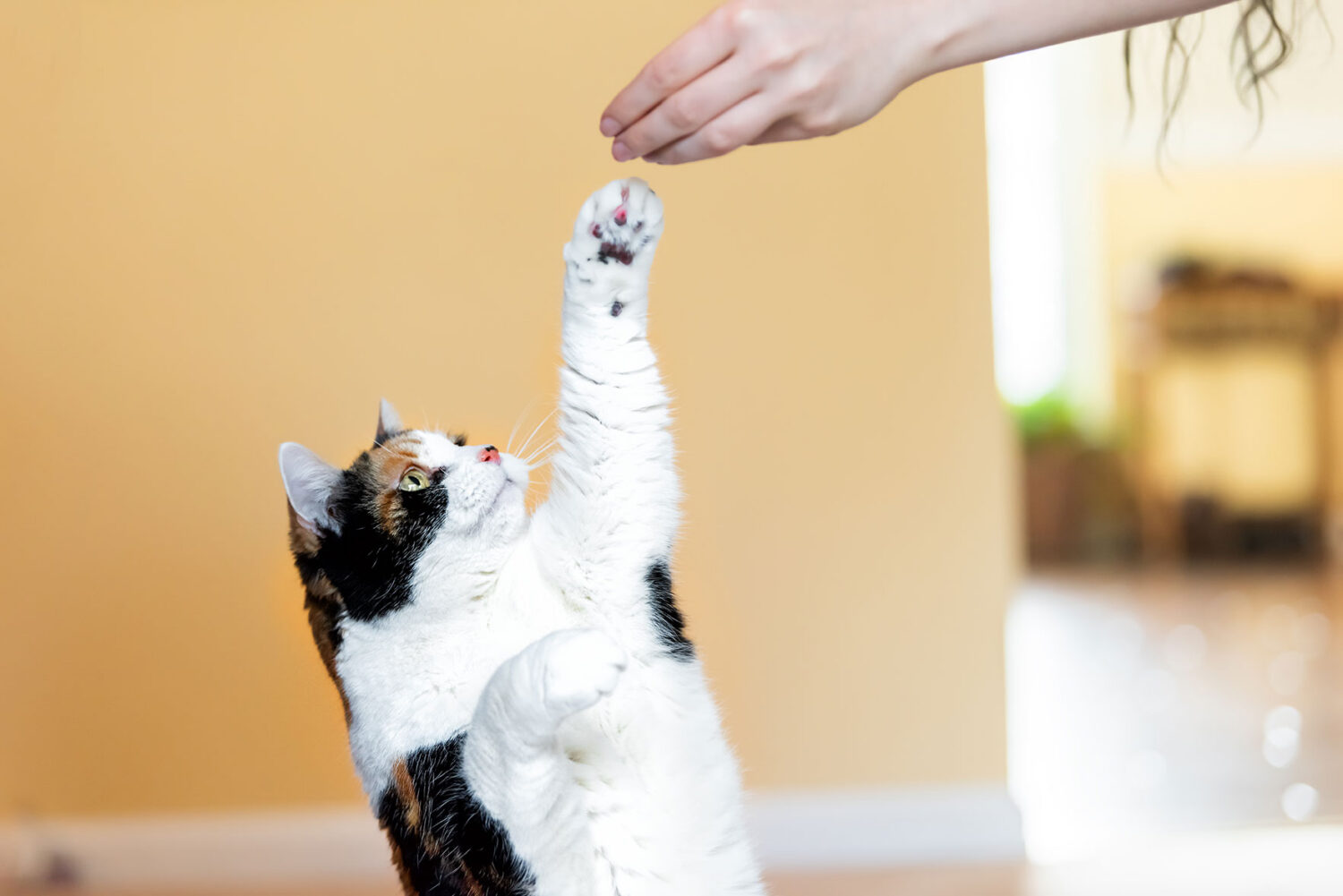
Because cats were domesticated relatively recently (approximately 3,000 to 5,000 years ago) they retain a strong connection to their wild ancestors. As a result, cats have specific environmental and emotional needs that must be met in order for them to thrive. These needs are outlined in what are known as the Five Pillars of a Healthy Feline Environment, which include:
- Providing safe spaces
- Providing multiple and visually separate resources
- Providing opportunities for play and predation
- Providing positive and consistent human interaction
- Providing an environment that respects all feline senses, especially smell
Today’s focus is on Pillar 4: positive and consistent human interaction, and how this pillar directly relates to training our cats.
Why Training Matters for Cats
An important rule of feline training is that cats should never be punished. Punishment increases stress and fear, often worsening the very behaviors guardians hope to eliminate (such as inappropriate urination or avoidance). It also places unnecessary strain on the human–animal bond.
Cats are highly trainable and capable of learning basic obedience behaviors, which serve as the foundation for behavioral modification—changing a cat’s emotional response to a situation or trigger. Training can also help reduce or prevent undesirable behaviors, such as jumping on countertops, by teaching cats what to do instead.
Identifying the Right Reward
The first step in training is identifying your individual cat’s preferred reward. While many cats enjoy food or treats, others are more motivated by:
- Petting
- Play
- Brushing
- Social interaction
Using the reward your cat values most is essential for effective learning.
Once the reward is identified, a marker is introduced. A marker is a word or sound (such as saying “yes” or using a clicker) that tells the cat the exact moment they did the right thing. The marker is always followed immediately by the reward.
To teach the marker:
- Say “yes” (or click)
- Immediately give the reward
- Repeat until the cat learns that the marker predicts something good
This allows for clear communication and faster learning.
Targeting
Targeting is one of the easiest and most useful behaviors to teach a cat. It involves teaching the cat to touch an object, such as a finger, pen, or stick with their nose.
To teach targeting:
- Hold out the target object a short distance from the cat (most cats will naturally investigate by touching it with their nose)
- The moment the nose touches the target, mark the behavior and reward
- Repeat until the cat reliably touches the target when it is presented
Targeting can be used to:
- Move a cat from one location to another (e.g. off of the counters)
- Guide a cat onto a scale, mat, or exam surface
- Reduce the need for lifting or restraint
Place
“Place” training teaches a cat to voluntarily go to and remain on a specific location, such as a mat, towel, bed, box, or scale. This behavior is also referred to as “stationing” and is a cornerstone of cooperative care (allowing pets to choose to participate in veterinary care).
Place training gives cats:
- Predictability
- A sense of choice and control
- A clear “job” during handling or procedures
To begin place training:
- Choose a flat, non-slip surface such as a towel or mat
- Place it on the floor and allow the cat to investigate on their own
- The moment the cat looks at, steps on, or interacts with the mat, mark and reward
Gradually:
- Reward for placing one paw on the mat
- Then two paws
- Then all four paws
Never place the cat onto the mat as choice is essential to learning.
Once the cat is reliably stepping onto the mat, begin rewarding for staying on it for short periods. Duration should be built slowly, always keeping sessions short and positive. Treats or rewards should be delivered while the cat remains on the mat to reinforce the behavior.
A verbal cue such as “place” can be added once the behavior is predictable, but cues should never be used to force compliance.
Sit
Cats are naturally problem-solvers and will often voluntarily offer behaviors in an effort to earn a desired reward. When training “sit,” patience and observation are key.
Begin by waiting for the cat to offer the behavior on their own. Many cats will naturally sit when they pause or settle during a training session. The moment the cat’s hindquarters touch the ground, mark the behavior and immediately provide the reward.
Once the cat is consistently offering the sit behavior, a verbal cue such as “sit” may be added. The same rules for adding cues apply: the cue should only be introduced once the behavior is predictable, and it should never be used to force compliance.
For cats that do not readily offer a sit, gentle guidance may be helpful. Slowly moving the reward slightly above the cat’s head often encourages the cat to shift their weight backward into a sitting position. As soon as the cat sits, mark and reward.
As with all feline training, sessions should remain short, positive, and voluntary. Ending on success helps maintain motivation and builds confidence.
Sponsored by:
