Community care
Putting family-centered care into practice

Family-centered care is a proven way to improve patient outcomes while acknowledging the needs and challenges of that pet’s family. Understanding exactly what family-centered care entails, though, can be difficult if you’re not familiar with the concept, so let’s break down some of the core strategies of this approach.
Advertisement
Family-centered care is at the heart of AAHA’s most recent—and soon-to-come—guidelines (Community Care, Referral, and One Health, coming August 27). If this concept is new to you, it might be challenging to understand exactly how shifting to a family-centered approach to veterinary care ties into these three different guidelines.
The key to comprehending this connection is to gain full understanding of the core strategies of family-centered practice, as outlined in the Community Care Guidelines. With that in mind, let’s break these core strategies down to see how they can work in real-life scenarios.
Core strategies of family-centered practice
Preventive care
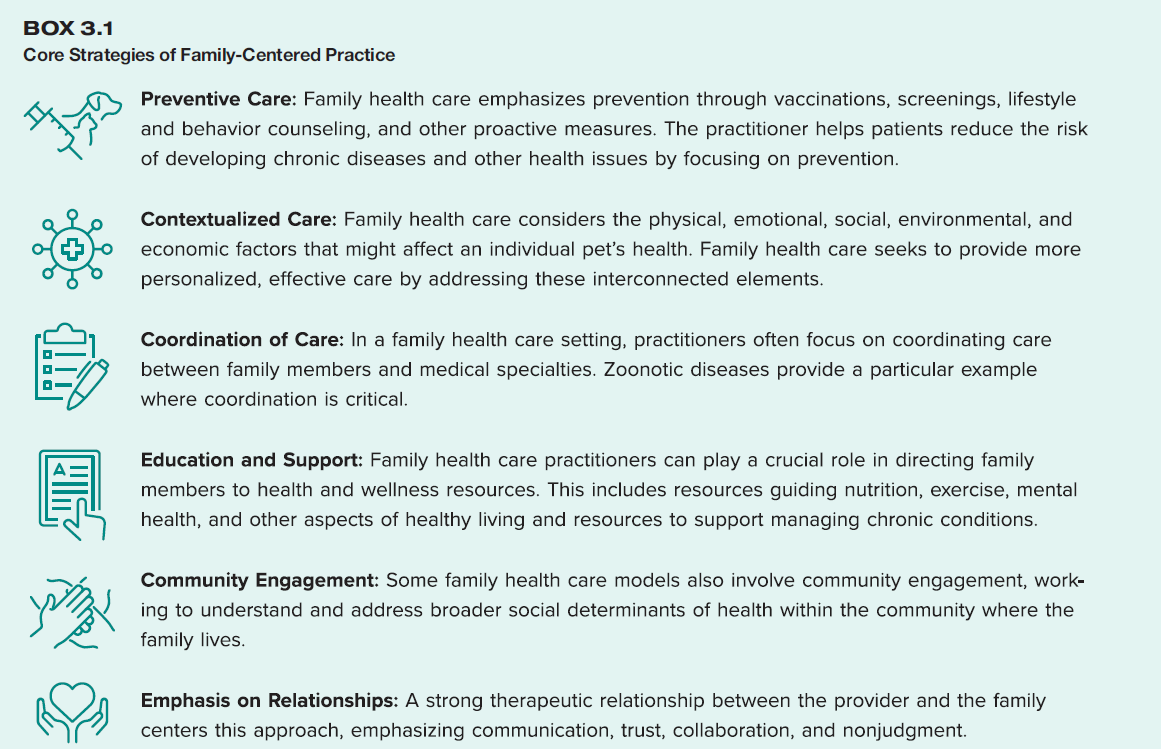
Family health care emphasizes prevention through vaccinations, screenings, lifestyle and behavior counseling, and other proactive measures. The practitioner helps patients reduce the risk of developing chronic diseases and other health issues by focusing on prevention.
In veterinary general practice, this begins with getting a thorough—but nonjudgmental—history to better understand the patient and family’s situation, including specifics. This not only helps to identify their current and future risk of preventable diseases but also enables the veterinary team to meet the family where they’re at, metaphorically. What are the family’s goals, concerns, and challenges, and how can the team provide support?
Gaining this information may mean that a first-time appointment needs to be scheduled with extra time to allow for this discussion. And, during subsequent visits, the team should always inquire about any potential changes that could affect the delivery of health care. It’s a multi-step process, but it’s one that helps veterinarians to be powerful advocates for pets; knowing the family dynamics and how the team can support that family puts the care team into an even better position to advocate for that pet.
An example of this could be in regard to vaccines. Instead of simply recommending core vaccines the patient needs without any further information, a family-centered approach might mean the care team talks to the family about the risks their pet faces if they opt out of any of these vaccines, and what lifestyle changes they might have to consider.
Perhaps a family has had a scary experience with a Bordetella vaccine in the past and wants to avoid it going forward. Hearing them out and addressing their specific fears allows you to meet them in a neutral place, free of condescension. Once they know you understand where they’re coming from, you can better explain the safety rates of today’s vaccines. It also allows you to explain what avoiding the Bordetella vaccine looks like—more danger at the dog park, increased difficulty finding boarding facilities, not to mention an increased risk for the pet overall.
Contextualized care
Family health care considers the physical, emotional, social, environmental, and economic factors that might affect an individual pet’s health. Family health care seeks to provide more personalized, effective care by addressing these interconnected elements.
Each of these aspects is important, but in veterinary medicine, economic factors are the most frequently-seen barrier to care. Helping families overcome that barrier begins with communication. Providing families with an opportunity to state how concerned they are about the cost of care, before they even set foot in the exam room, will help the technicians and veterinarians working with that family to better navigate those challenges. As with preventive care, this conversation must occur without judgment or condescension.
After all, even if the perfect treatment exists for a pet’s illness, it’s not the perfect treatment for that pet if their family simply can’t afford it. A less costly option that still addresses the issue would be better in that case.
Coordination of care
In a family health care setting, practitioners often focus on coordinating care between family members and medical specialties. Zoonotic diseases provide a particular example where coordination is critical.
Instituting a well-organized referral process is a fantastic way for general practitioners to meet a family’s coordination of care needs. Veterinary teams should know who to contact, how to communicate with those contacts, what information to share with the specialist—and, perhaps most importantly, what information the family needs to move forward with a referral.
In cases of zoonotic disease, this brings in the One Health aspect as well. For example, if a family brings in a pet with Rocky Mountain spotted fever or another tick-borne illness, the veterinary team must know to ask about how and where the pet may have contracted it as well as whether any other family members may have been exposed. The team can then work with the family to communicate these potential risks to their human healthcare team as needed.
Education and support
Family health care practitioners can play a crucial role in directing family members to health and wellness resources. This includes resources guiding nutrition, exercise, mental health, and other aspects of healthy living and resources to support managing chronic conditions.
Consider a family that’s just learned that their beloved golden retriever has an aggressive cancer. Simply hearing that news will be a lot for the family to handle; wrapping their heads around potential treatment (curative or palliative) options, medications, symptoms, lifestyle modifications, and more during that same appointment can be difficult or impossible, especially if given the compressed time frame of most examinations.
With a family-centered approach, news like this is, ideally, paired with an opportunity to provide the family with written (physical or digital) resources that they can look over at their own pace. A follow up call from a member of the team, or even a follow up appointment, would be scheduled to give the family time to process the news and figure out what questions they have. And, as needed, introductions or referrals to other professionals (oncologists, support groups, hospice or palliative care professionals and other end-of-life experts) would be made.
Community engagement
Some family health care models also involve community engagement, working to understand and address broader social determinants of health within the community where the family lives.
Pet-friendly housing is a great example of how veterinary professionals and community engagement tie into family-centered care. We know that, in many areas, renting a space that allows pets (let alone certain numbers of pets, sizes, and breeds) is a real problem. Veterinary teams are in a unique position to connect with housing authorities and other community housing resources to help identify pet-friendly options—and perhaps lobby for more in their area.
Emphasis on relationships
A strong therapeutic relationship between the provider and the family centers this approach, emphasizing communication, trust, collaboration, and nonjudgment.
At the end of the day, the family-centered approach truly comes down to building relationships. When you’ve gotten to know a client as a person with a life outside the exam room—and they’ve gotten to know you as a veterinary professional who cares deeply for your patients and clients—even difficult conversations occur from a place of trust and respect. This increases compliance and client retention, which ultimately helps more pets and their families to live happy, healthy lives.
When in doubt about how to integrate a family-centered approach with a client, consider how you’d want your family to be treated if you were in the client’s shoes. That requires getting to know them and learning a bit about them so you can make recommendations that work for them within the context of their situation—but doing so is an excellent way to build a bond with that family that can last nine lives (or more).
Photo credit: © SeventyFour via iStock/Getty Images Plus
Disclaimer: Trends content is meant to inform, educate, and inspire by providing an array of diverse viewpoints. Any content published should not be viewed as an official stance, position, or endorsement by the American Animal Hospital Association (AAHA) or its Board of Directors.
