Practice Management
Retention factors that push employees away (or inspire them to stay)

Knowing what factors matter most to those in clinical practice is an important first step, but to truly improve retention, leaders, owners, and other decision-makers must seek to understand how their team members define the factors that push them away or inspire them to stay. And that’s just what we did in Phase 2 of our Stay, Please retention study.
Advertisement
How would you define appreciation? What does it mean to you to have career development opportunities or caring leadership?
Phase 2 of AAHA’s Stay, Please retention study surveyed over 2700 veterinary professionals to ukmnderstand how they defined the nine key retention factors identified in Phase 1—and to learn whether those definitions differed by role.
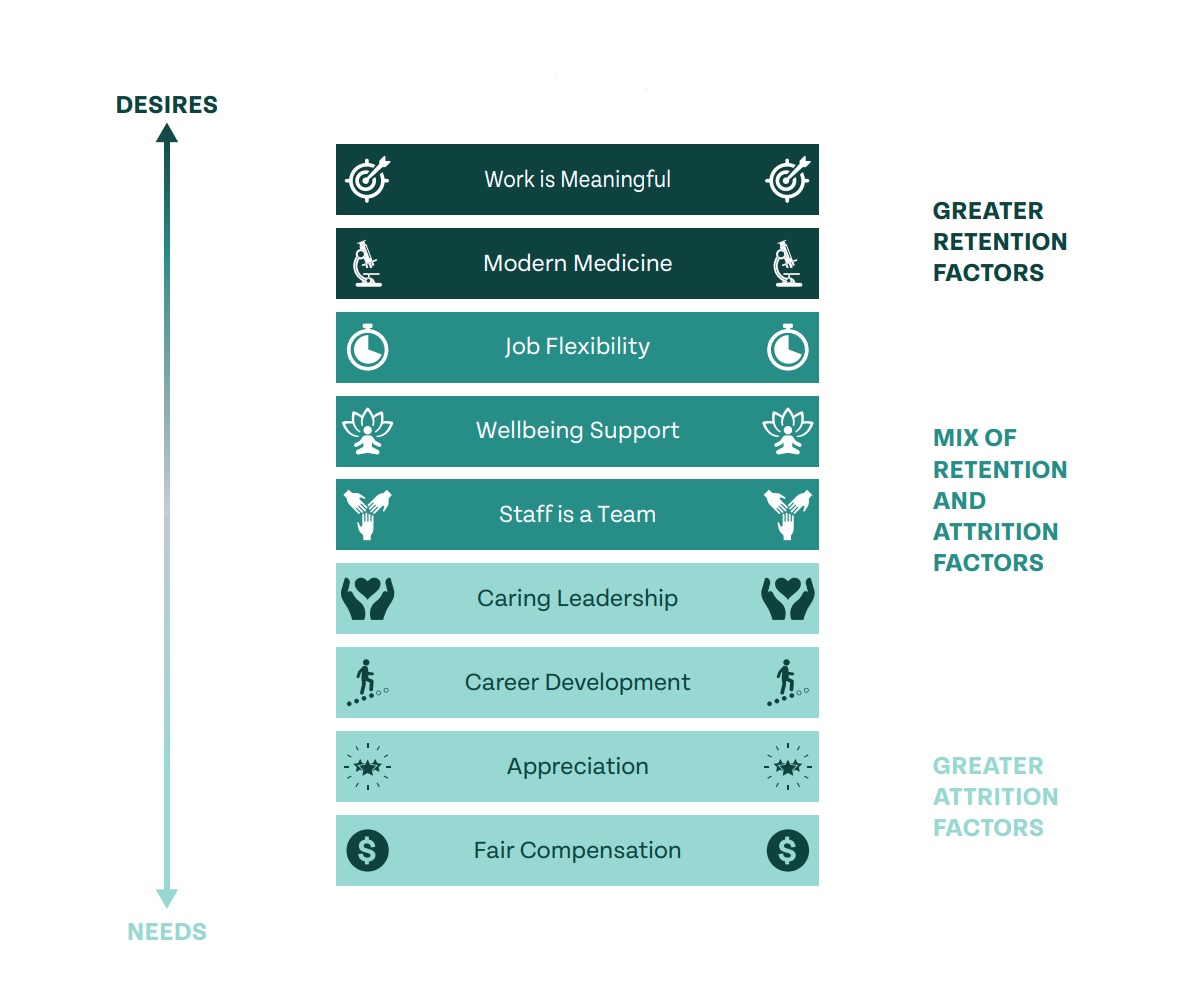
If you’ve already read the Phase 2 white paper, you know that some of the definitions did indeed vary by role. And the factors that saw this variation in definitions all had something in common: They were all stronger attrition drivers (meaning that when they’re done poorly, they have a tendency to drive employees away).
But that wasn’t the only notable trait they had in common. The bottom four factors on the pillar shown above also saw some interesting conflation of definitions. Definitions for caring leadership and career development were closely tied, and the definition for appreciation—for most roles—was inextricably linked to fair compensation.
Using this data to make a difference
With this in mind, let’s talk about attrition for a moment. We know that, when practices don’t appropriately address the staff’s needs relating to the factors at the bottom of that pillar, they’re unlikely to improve staff retention by addressing the factors at the top.
In other words, if your clinic is having trouble keeping great people and you want to make changes that matter, start with fair compensation and appreciation, not modern medicine or meaningful work. This does NOT mean these other factors aren’t important; all nine of these factors are key to retention. But for practices experiencing high turnover, the bottom factors must be made a priority in order to make an impact.
Of course, to properly address those factors, it’s important for decision-makers to understand how team members define the factors. Why? Based on the Stay, Please findings, the definitions selected by owners and leaders can be quite different than the definitions chosen by the team. Those differences are often especially pronounced the further the team member role is from the owner/leader on a traditional organizational hierarchy chart.
What, how, and who
So, what are the definitions for these retention factors—and who defines them that way?
Let’s begin with the stronger retention factors; these are the things that, when done poorly, might not push people away, but when they’re done well (and the attrition factors are in good shape), they inspire loyalty. These factors also saw strong agreement on the definitions across roles in the survey.
It’s important to note that Customer Service Representatives were included in the survey, but did not respond in large enough numbers for their data to be statistically significant. Therefore, the roles included in the findings below are owners/leaders, nonowner veterinarians, hospital administrators/practice managers, credentialed technicians, and veterinary assistants.
Work is meaningful:
Feeling that one’s work makes a significant difference in the lives of others.
Ability to practice modern and/or sound medicine:
Continuous updating of practices based on the latest research and evidence.
Flexibility in scheduling/job duties:
Flexible working hours that accommodate personal life and family needs.
Support for wellbeing:
Initiatives that promote a healthy work-life balance.
Staff functions as a team:
A culture where collaboration and mutual support are standard.
When it comes to the stronger attrition factors, definitions become a bit more complicated.
Caring/inspiring leadership:
Leaders who prioritize the wellbeing and professional growth of their team members. (All roles)

Decision-making that considers the impacts on staff and the quality of workplace life (all roles except admins)

Opportunities for career development:
Access to ongoing education and training programs to enhance skills. Continuing education stipend provided as a benefit. (All roles)
Clear and structured opportunities for upward mobility within the organization; transparency regarding skills and experience required for upward movement provided.
(Techs and assistants)

Work is appreciated:
Fair compensation and benefits reflecting the value the organization places on staff. (Everyone but owners)

Informal gestures of appreciation, such as thank you notes or small personal acknowledgements, which may include small tokens of appreciation such as gift cards or similar. (Owners)

Fair compensation:
Compensation that reflects one’s qualifications, experience, and workload. (All roles except assistants)

Compensation that allows for financial stability and personal growth outside of work. (Techs and assistants)
Compensation that is periodically reviewed and adjusted based on performance and inflation. (Assistants)

Combining for greater impact
Addressing all of these factors can feel like a lot, especially when you’ve got multiple definitions to consider for several factors. However, the good news is that the varying definitions for those bottom four factors—the attrition drivers—have enough overlap that we can confidently combine definitions, allowing for a simplified approach.
For starters, take caring leadership and career development.
Caring/inspiring leadership:
Leaders who prioritize the wellbeing and professional growth of their team members. (All roles)
Decision-making that considers the impacts on staff and the quality of workplace life (all roles except admins)
Opportunities for career development:
Access to ongoing education and training programs to enhance skills. Continuing education stipend provided as a benefit. (All roles)
Clear and structured opportunities for upward mobility within the organization; transparency regarding skills and experience required for upward movement provided.
(Techs and assistants)
All roles agreed on the first definition for caring or inspiring leadership, which specifically calls out the importance of professional growth. And, the top definitions for career development include access to ongoing training, and clear, structured opportunities for upward mobility, all of which is designed and provided by leadership.
Therefore, to address both of these factors in a way that meets the needs of all roles, we can use the following combined definition:
When it comes to fair compensation and appreciation, we can take a similar approach; however, it must be noted that, with appreciation, there is a significant and stark difference between the owner/leader role and all other roles surveyed.
Fair compensation and benefits reflecting the value the organization places on staff. (Everyone but owners)Informal gestures of appreciation, such as thank you notes or small personal acknowledgements, which may include small tokens of appreciation such as gift cards or similar. (Owners)
Fair compensation:
Compensation that reflects one’s qualifications, experience, and workload. (All roles except assistants)Compensation that allows for financial stability and personal growth outside of work. (Techs and assistants)Compensation that is periodically reviewed and adjusted based on performance and inflation. (Assistants)
While all roles other than owners/leaders believe that appreciation is best shown through fair compensation, those decision-making roles at the top take a very different view. With this insight, is it any wonder that employees become disgruntled when they receive a gift card for lunch when they believe they’ve earned a raise? And, on the other side of that same coin, of course, leadership is frustrated that they’re losing good people when they’re showing appreciation in a way that makes sense to them.
The takeaway from this, though, is that in cases where the definition chosen by leadership differs from the definition selected by team members, it is leadership who needs to adjust their approach if they want to keep their team around.
Now, what about that combo? The trick here is for leadership to be clear on what fair compensation looks like to their team, which isn’t entirely straightforward since we have three definitions to work with. However, if we boil each of those definitions down to their essence, we’re talking about compensation that reflects the work being done, provides a living wage, and is reviewed and adjusted periodically.
With that being said, we can combine those definitions to say:
If these findings have piqued your interest and you haven’t already done so, we encourage you to read our Stay, Please white papers (Phase 1 and Phase 2).
And in the meantime, we’d love to know: Do these definitions resonate with you? Do you think your team would agree? Let us know at [email protected].
Photo credit: © SeventyFour via istock/Getty Images
Disclaimer: Trends content is meant to inform, educate, and inspire by providing an array of diverse viewpoints. Therefore, any content published should not be viewed as an official stance, position, or endorsement by the American Animal Hospital Association (AAHA) or its Board of Directors.
