Culture and People
Stay, please: The curious case of the vanishing CrVTs

Having trouble keeping great employees in certain roles? Learn how the findings from Phase 2 of AAHA’s Stay, Please retention study can help you identify exactly what changes need to be made, as well as how to make sure you’re implementing them in a way that resonates with those team members.
Advertisement
Gather ‘round, readers. It’s story time!
Meet Jennifer Vetlyfe, DVM. She’s the owner of a multi-doctor small animal practice, and she’s found herself in a situation that might sound familiar to many of you.
Over the last few years, her practice has had a hard time keeping their credentialed technicians from leaving. Some are leaving to take positions in other practices, but others have decided to leave clinical practice completely.
Tto make matters worse, the turnover in that role seems to be leading to even more turnover. The technicians who do remain are clearly feeling the strain of having to cover for those missing positions, not to mention the emotional turmoil of watching colleague after colleague walk out that door.
At this point, morale is low (and continuing to plummet). Dr. Vetlyfe and her other practice leaders are desperate to find a way to turn this trend around—before they reach a point where they can’t sustain the level of service they currently offer. The problem is, they haven’t nailed down what’s going wrong.
The search for a solution
The story above is fictional, but the details are based on hard data and real experiences.
AAHA’s 2023 retention study, Stay Please (Phase 1) found that 30% of veterinary professionals were planning to leave their current jobs. That study identified the most important factors impacting turnover. It ranked them as attrition factors (meaning that, when they’re lacking or done poorly, they push people away) and retention factors (meaning that, when they’re done well, they make people want to stay right where they are).
Digging deeper
In the recently published Stay Please (Phase 2) white paper, we took those findings a step further. We asked how various practice roles defined those nine key factors, and how they said their daily reality of those factors matched up against the expectations they had of those factors when they entered the profession.
The white paper details the results by both practice role and the whole team. But for now, let’s go back to Dr. Vetlyfe and look at how these findings can help her practice better retain their credentialed technicians.
The curious case of the vanishing CrVTs
To improve retention of credentialed technicians, Dr. Vetlyfe first needs to figure out what’s driving them out. She can use the data from Phases 1 and 2 of Stay Please to answer three key questions that will guide her toward what needs to change to meet this role’s needs:
- What factors have the highest priority for this role?
- What factors score lowest for this role in expectation vs. reality?
- If we identify a factor with high priority and low expectation vs. reality score, how do credentialed technicians define that factor?
Question 1: What do techs prioritize?
While a number of factors are important, if the goal is to increase retention in a role with high turnover, we prioritize. To do this, we look at whether there are any factors that the role in question considers especially powerful as an attrition factor. In the case of technicians, it’s clear that a lack of fair compensation is the leading attrition driver—by a lot.
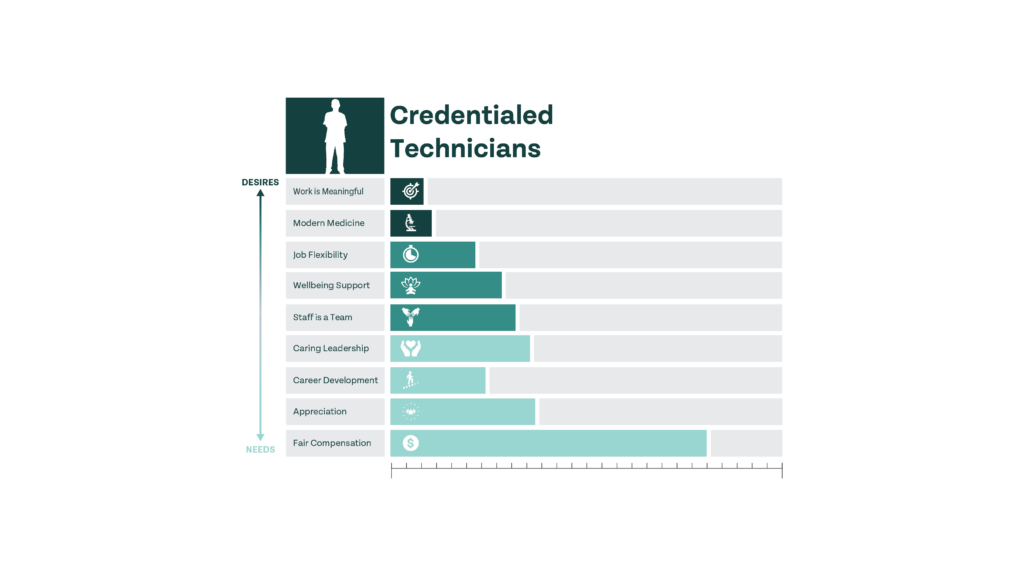
The length of the bars in this graphic indicate the strength of each factor as an attrition driver for this role. As we can see, fair compensation is about two times as powerful as any other factor here. If a practice is getting that factor wrong, it’s unlikely that any other changes will be enough to overcome that lack of fair compensation.
It’s worth noting that appreciation, caring leadership, and staff is a team are also prioritized; just not as highly as fair pay.
Question 2: How does reality match expectation?
Since fair compensation is a top priority for this role, it’s important to understand how their real-life experience compares to what they expected when they entered the field.
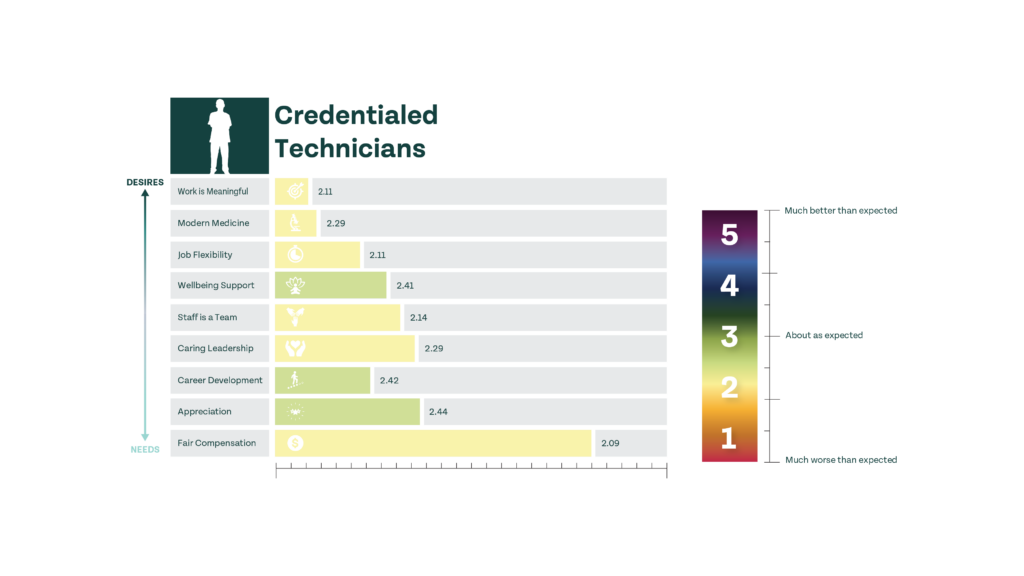
This chart shows us how each factor scores on the five-point expectation vs. reality scale, using both numbers and colors to show that score.
In this scale, a score of around 3 (about as expected) or higher is considered positive; it means that role’s expectations are being met. As you’ll see in the white paper, these scores vary drastically between owners/leaders and technicians.
Fair compensation isn’t only the highest priority for this role; it also has the lowest expectation vs. reality score out of all factors, coming close to a 2 (somewhat worse than expected). A number of these scores are alarmingly low, but if we want to focus on one change that needs to be made, the answer is clear: We must get fair compensation right.
Question 3: How do techs define fair compensation?
For some factors, all roles agreed on a definition. For others—particularly those that were, in general, stronger attrition drivers—there was more variation in the definitions selected. In the case of fair compensation, credentialed technicians chose two definitions:
Definition 1: Compensation that reflects one’s qualifications, experience, and workload. (All roles except assistants chose this one.)
Definition 2: Compensation that allows for financial stability and personal growth outside of work. (Only credentialed technicians and assistants selected this one.)
So, why might these two definitions resonate with technicians? Well, it’s easy to understand why someone in a job requiring skill, training, and experience would select the first definition. It makes sense that they’d like their compensation to reflect that effort and ability.
The second definition, which was only chosen by technicians and assistants (although there were not enough responses from customer service representatives to determine their vote), is essentially a request for a living wage. A 2022 National Association of Veterinary Technicians in America (NAVTA) demographic survey found that a third of credentialed technicians worked a second job—most often a full time one. These are working professionals with an impressive set of skills; they want to be able to pay basic bills through the career they’ve committed themselves to.
Take note that neither of these definitions considers how other practices in the area pay their technicians or how other roles in the same practice are paid.
What’s next?
Now that Dr. Vetlyfe understands the need to focus on fair compensation for credentialed technicians based on how that role experiences and defines it, she can begin taking steps to make sure her practice is getting it right. While there are several ways to determine what fair compensation might be for the folks in her practice (and we’ll get into that in a moment), perhaps the best—and simplest—first step is to communicate with the people in that role.
That sounds simple; in fact, Dr. Vetlyfe and her leadership team may feel that they’re already communicating with their staff. But is that communication going both ways? And if leadership is open to feedback, is that feedback being incorporated?
Survey says …
In our research for Stay, Please, we spoke to numerous practices with exceptional (>90%) retention, and the vast majority had one thing in common: Surveys. They surveyed their staff regularly, and they analyzed responses—every time—to better understand trends and determine if changes need made.
Surveys give leadership a chance to ask team members about specific topics—which, on its own, shows those team members that their leaders are thinking about those topics and care about how the team feels. But remember, that only remains a benefit if the responses from the team are acknowledged.
Now, this does not mean that leadership must make changes based on every response they receive, but it’s important to analyze those responses to identify trends (especially areas of discontent). Even when a suggestion can’t be implemented, it can still be part of a discussion—either with that team member or, perhaps, as part of a staff meeting.
Living up to a living wage
With the knowledge that fair compensation must at least mean a living wage, Dr. Vetlyfe may want to look at the MIT Living Wage calculator. This will show her what a living wage looks like in her area for people in different living situations (single or dual income, dependents, etc.).
Bottom line is, if her practice isn’t paying a wage that aligns with those findings, they will need to increase their pay. Otherwise, those technicians (or any other roles not earning a living wage) may not be able to afford to keep working for her, even if they love what they do.
But money doesn’t grow on trees…
The biggest question veterinary professionals have after learning about the importance of fair compensation is, “How do we find the money?”
And that’s a reasonable concern! After all, plenty of practices may feel like they’re paying their staff as much as they can afford. That’s why, over the last two years, we’ve talked to financial experts and practices with strong retention about how to find the money to pay employees a fair wage, and while the following is not an exhaustive list of ways to go about this, it’s a solid start.
Tiered pay
First, keep in mind that increasing pay doesn’t mean they need to give blanket raises across the board. Tying this to things like performance, responsibilities, new skills, or even attendance can help to boost the practice’s bottom line while giving these valuable team members a clear path toward improving their finances.
To take the idea a step further, incorporate all of this into a tiered structure (with pay connected to each tier) to provide transparency to employees regarding what they need to do to reach each level within their role.
Profitability
It’s also likely that the practice itself has room to increase its profitability (which, of course, makes it easier to provide those well-deserved pay increases). From taking a closer look at inventory (do they really need to keep all that prescription food on hand?) to examining how common products and services are priced, many practices will find they’re leaving money on the table.
Third party businesses and apps can help identify which areas have the greatest need for improvement in this space, and while that may require an investment of time and effort, the payoff can be incredible. (In one case study, a practice spent $7000 on software to better understand their pricing; that year, they increased their bottom line by $165,000.)
Technician utilization
Technician utilization (as outlined in the 2023 AAHA Technician Utilization Guidelines) is a clear way to accomplish all the above. By allowing and empowering technicians (rather than veterinarians) to handle the tasks they’re trained and legally able to do, practices not only increase job satisfaction for this role, but, on average, show a revenue increase of 36%.
A path to improved retention
Practices experiencing turnover in a specific role or two can use the Stay, Please Phase 2 white paper to better understand the priorities, experiences, and definitions for every role in practice. And over the course of the year, keep reading Trends—we’ll continue speaking to subject matter experts and practice leaders who have identified different strategies for implementing these critical factors in measurable and repeatable ways.
In the meantime, if you’d like to share how your practice is working to improve retention—either across the board or in specific roles—feel free to let us know at [email protected].
Photo credit: MartinPrescott on E+ via Getty Images
Disclaimer: Trends content is meant to inform, educate, and inspire by providing an array of diverse viewpoints. Any content published should not be viewed as an official stance, position, or endorsement by the American Animal Hospital Association (AAHA) or its Board of Directors.