Section 13: Glucose Monitoring
Top 3 Takeaways
- Glucose monitoring includes blood glucose curves (BGC) and continuous glucose monitoring (CGM). It identifies clinically undetectable hypoglycemia (thus the insulin dose can be decreased before clinical signs occur).
- Anytime DM signs recur, glucose monitoring is required to identify the root cause (low dose, short duration of action) and direct how to safely adjust (increase or decrease) an insulin dose or change insulin type.
- Situations when glucose monitoring should be performed include:
- At 5–14 days after starting insulin or following any dose change;
- Any time clinical signs recur in a previously controlled patient; and
- When hypoglycemia is suspected.
General Monitoring Considerations
Monitoring diabetic pets can be challenging. The algorithm in Figure 13.1 provides a quick reference for three types of DM patients receiving insulin or an SGLT2 inhibitor—newly diagnosed, previously diagnosed, and previously diagnosed but currently unregulated. Monitoring options include performing BGCs, placing a CGM, measuring fructosamine, and assessing clinical signs and weight. Occasionally, monitoring urinary glucose may be warranted, such as screening for hypoglycemia, but it is not a recommended routine monitoring tool. Results from different monitoring approaches may conflict.
FIGURE 13.1: Monitoring Glucose in Diabetic Cats on Insulin (Not on Basal Insulin)
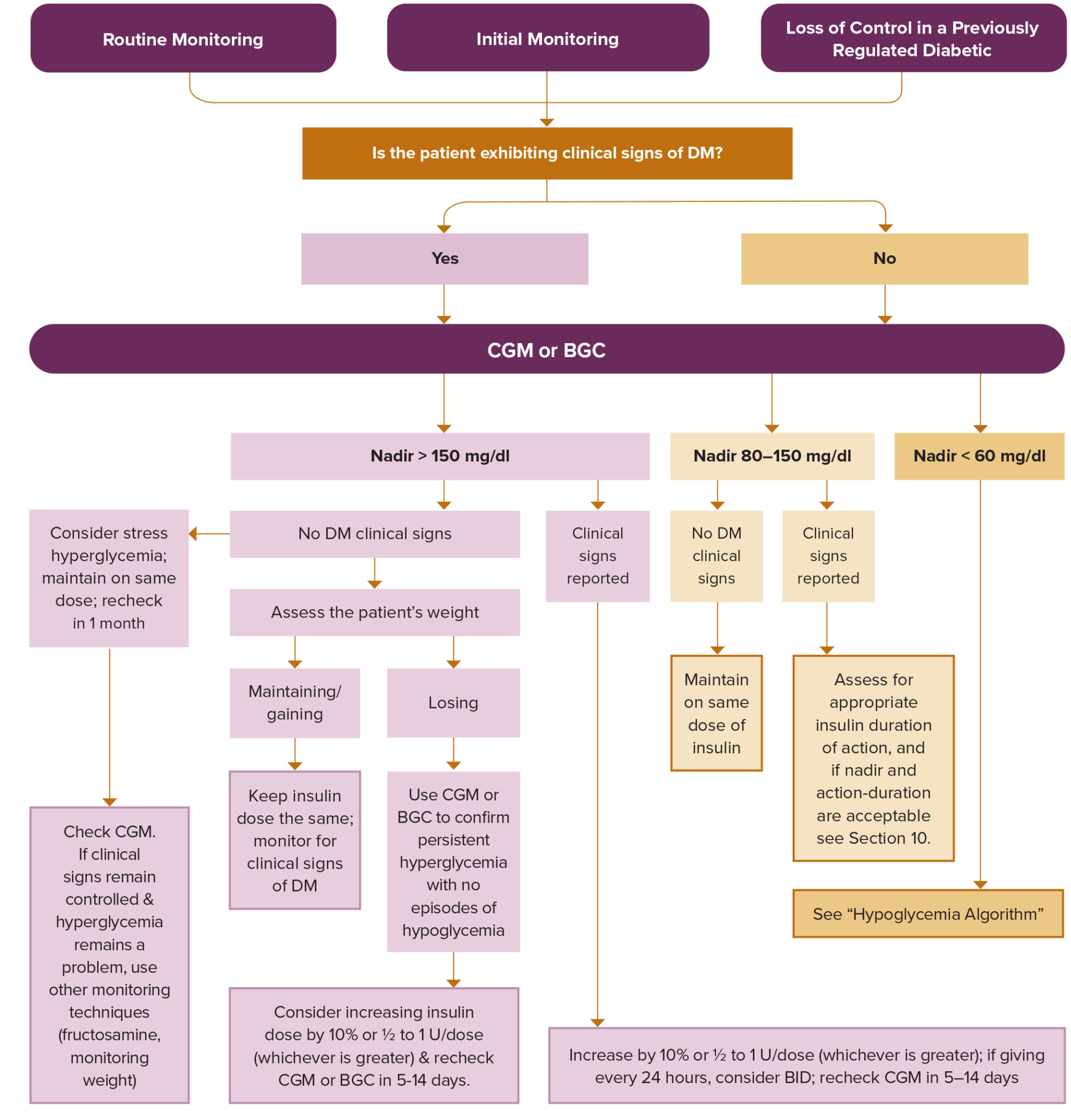
BID, twice daily; BGC, blood glucose curve; CGM, continuous glucose monitor; DM, diabetes mellitus; U, unit
Blood Glucose Curves
A BGC is typically performed by measuring BG using venous or capillary blood before (baseline, time 0) and then every 2 hr after feeding a normal-sized meal and administering the patient’s full insulin dose, for up to 10-12 hr.
A BGC should identify the lowest BG (i.e., the nadir) obtained, the duration of insulin action observed, and the range of BG fluctuation during the dosing interval. The ideal nadir is a BG of 80–150 mg/dL. As most insulin types are administered twice daily, an ideal duration of insulin effect is as close to 12 hr as possible. The BG readings should ideally range between 80 and 300 mg/dL during the BGC as long as the BG remains 200-250 mg/dL for most of the dosing interval assessed. Identifying these aspects of a BGC allows logical changes to be made to the patient’s dosing regimen as needed.
A glucometer calibrated for use in veterinary patients may be the most practical and accurate method to serially monitor the BG.1,2,3 Although glucometers designed for use in people are readily accessible to pet caregivers, the task force does not recommend their use owing to lack of veterinary-specific calibration, which can lead to inaccurate result reporting.
The first aim in regulating a diabetic is to achieve an acceptable nadir. If an acceptable nadir is not achieved, consider increasing the insulin dosage (Figure 13.1). An acceptable nadir with good clinical control may not be obtained if the insulin has a short duration of activity. Avoid prolonged (i.e., 1–2 hours) periods of hypoglycemia (BG <60 mg/dL) and consider reducing the insulin dose if noted or anytime a patient exhibits clinical signs of hypoglycemia. Once an acceptable nadir is achieved, duration of action—roughly defined as the amount of time BG is controlled (ideally 80-250 mg/dL)—can be determined. If either insufficient or excessive duration of insulin action is contributing to uncontrolled BG, change the frequency of insulin administration or, more commonly, transition to a new insulin type.
The Somogyi phenomenon, also called hypoglycemia-induced hyperglycemia, refers to hypoglycemia followed by marked hyperglycemia. It results from a physiological response when an insulin dose causes BG to be <60 mg/dL or when BG concentrations decrease rapidly over a short period of time. In either case, counter-regulatory hormones (e.g., cortisol, epinephrine, and glucagon) are released to increase BG. Rebound hyperglycemia usually occurs rapidly and can be followed by a period of sustained IR. If a Somogyi phenomenon is observed, decrease the insulin dose. Once the nadir is >60 mg/dL, counter-regulatory hormones will no longer interfere, and the true insulin effect will become apparent.4
Glucose curves are not perfect, so always interpret them in light of clinical signs and changes in body weight. Responses seen on a BGC vary from day to day and can be affected by deviation from the patient’s normal routine.5,6 Stress hyperglycemia can falsely elevate BG results and complicate BGC interpretation. See the AAHA Diabetes Management Guidelines resource center at aaha.org for examples of interpreting various glucose curves.
Transitioning to a new insulin type can occur several ways, and it is prudent to first review the time-action profile details of the new insulin to guide starting dose determination. The new insulin can be initiated at the specific recommended starting dose, keeping in mind that dose or administration frequency may differ between insulin types (such as switching from Vetsulin to PZI). When transitioning from a non-basal insulin to glargine U-300, initiating at either the recommended starting dose or at the same dose used with the previous insulin have been reported.a During transitions, monitor BG closely and consult with a specialist as needed.
a. Linari G, Fleeman L, Gilor C, Giacomelli L, Fracassi F. Insulin glargine 300 U/ml for the treatment of feline diabetes mellitus. J Feline Med Surg. 2022 Feb;24(2):168-176.
In-Hospital Blood Glucose Curves
In-hospital blood glucose curves are no longer recommended for routine diabetic monitoring in cats.
At-Home Blood Glucose Curves
Obtaining a BGC at home was the mainstay of feline diabetic monitoring for years prior to the introduction of CGMs, and this monitoring tool continues to be a helpful option in some cats. Not all clients are suited to the task of obtaining a home BGC. Clients frequently encounter problems such as needing more than one puncture to obtain a sufficient sample, inability to restrain a pet without help, and the pet’s resistance to blood sampling.7 Cats are susceptible to stress hyperglycemia at home for a BGC and the blood glucose values may reflect that.
Capillary blood is most suitable.8 Common blood collection sites are the lateral ear or non–weight-bearing or accessory foot pads. If using lancing devices designed for pricking human fingertips, choose one with a variable needle depth often ranging from 1.0-5.0 mm. Cats may require a 1.0-1.8mm lancing depth when sampling from the ear or paw pad. While some task force members report patients exhibit less pain responses when using lancets, a hypodermic needle can also be used for sampling.9 To ensure result accuracy, the lancing device must produce a droplet of blood sufficient for BG determination without requiring excessive manipulation of the pricked site, such as repeatedly squeezing the area to increase droplet size.
Even home BGCs can vary from day to day and must always be interpreted considering clinical signs and trends in the patient’s body weight.10 Refer to the AAHA Diabetes Management Guidelines resource center at aaha.org/diabetes-management-cats for more detailed information and resources for clients on at-home monitoring using BGCs.
Continuous Glucose Monitoring Systems
Standard BGCs have limitations, such as large day-to-day variation in insulin responses and the possibility of missing hypoglycemia during the night. CGMs record interstitial glucose readings continuously over multiple days, which can help identify problems and allow more comprehensive assessments of BG control. CGM sensors are easily placed—even in less cooperative patients—and are generally as affordable as a BGC. A CGM also provides more physiological information for interpretation as glycemic activity is monitored in the patient’s home environment and captures all aspects of their daily routine, such as meals, treats, and exercise.
The FreeStyle Libre (FSL) is a CGM system that reports an average interstitial glucose concentration every 15 min for up to 15 days. Successful use of the FSL has been reported in cats.11,12,13 A 2019 study also reported its use in hospitalized patients with diabetic ketoacidosis.14 Although not calibrated for veterinary patients, CGMs are typically used to follow BG trends over time and appear to be relatively accurate.15 However, there can be discrepancies between glucose results reported by the FSL and AlphaTrak in some patients, with FSL accuracy in reporting low glucose readings often warranting further confirmation.16 Training clients to confirm low FSL readings with a veterinary-calibrated PBGM, particularly when clinical signs of hypoglycemia are not evident, is recommended before making adjustments to therapy. A “Notes” feature in the FSL system allows clients to document timing of meals, insulin, exercise, or unexpected events (such as vomiting) to aid the veterinarian’s assessment.
Inform clients that the sensors do not always function or remain attached to the patient for the full 15 days, but the information gained from even a few days of reporting is usually more helpful than a standard BGC. Reinforcing the FSL sensor adhesive pad with adhesive wipes or tissue glue and/or using a commercial sensor cover, T-shirt, or stockinette may help prevent inadvertent sensor removal.
Clients with real-time access to their pet’s glycemic information can become noncompliant. For example, they may feel compelled to alter prescribed therapies based on glucose readings independent of veterinary guidance or seek frequent veterinary consultation by calling with every slightly abnormal reading. Additionally, clients can become preoccupied with the need to always know their pet’s glycemic status. These clients may want a CGM placed on the patient continuously, even when it is not medically necessary. Educating clients and setting proper expectations regarding CGM use can help mitigate these concerns.
The 2026 AAHA Diabetes Management Guidelines for Cats are generously supported by Adapet Medical, Boehringer Ingelheim, Dechra, and Merck Animal Health.




Citations
- Cohen TA, Nelson RW, Kass PH, et al. Evaluation of six portable blood glucose meters for measuring blood glucose concentration in dogs. J Am Vet Med Assoc 2009;235(3):276–80.
- AlphaTrak 3 [package insert.] Zoetis. Available at: https://www.zoetisus.com/content/_assets/docs/vmips/package-inserts/alphatrak-3-packageinsert.pdf. Accessed November 12, 2025.
- Behrend EN, Suchowersky ND, Carlson EA, et al. Comparison between glucose measurements in canine whole blood, serum, and plasma. J Vet Intern Med 2017;31:1271–2.
- Zini E, Salesov E, Dupont P, et al. Glucose concentrations after insulininduced hypoglycemia and glycemic variability in healthy and diabetic cats. J Vet Intern Med. 2018;32(3):978–985.
- Fleeman LM, Rand JS. Evaluation of day-to-day variability of serial blood glucose concentration curves in diabetic dogs. J Am Vet Med Assoc 2003;222(3):317–21.
- Ristic JM, Herrtage ME, Walti-Lauger SM, et al. Evaluation of a continuous glucose monitoring system in cats with diabetes mellitus. J Feline Med Surg 2005;7(3):153–62.
- Van de Maele I, Rogier N, Daminet S. Retrospective study of owners’ perception on home monitoring of blood glucose in diabetic dogs and cats. Can Vet J 2005;46(8):718–23.
- Casella M, Wess G, Hassig M, et al. Home monitoring of blood glucose concentration by owners of diabetic dogs. J Small Anim Pract 2003; 44(7):298–305.
-
Van de Maele I, Rogier N, Daminet S. Retrospective study of owners’ perception on home monitoring of blood glucose in diabetic dogs and cats. Can Vet J 2005;46(8):718–23.
- Alt N, Kley S, Haessig M, et al. Day-to-day variability of blood glucose concentration curves generated at home in cats with diabetes mellitus. J Am VetMed Assoc 2007;230(7):1011–7.
- Corradini S, Pilosio B, Dondi F, et al. Accuracy of a flash glucose monitoring system in diabetic dogs. J Vet Intern Med 2016;30(4): 983–8.
- Shoelson AM, Mahony OM, Pavlick M. Complications associated with a flash glucose monitoring system in diabetic cats. J Feline Med Surg 2021; 23(6):557–62.
- Shea EK, Hess RS. Validation of a flash glucose monitoring system in outpatient diabetic cats. J Vet Intern Med 2021;35(4):1703–12.
- Malerba E, Cattani C, Del Baldo F, et al. Accuracy of a flash glucose monitoring system in dogs with diabetic ketoacidosis. J Vet Intern Med 2020;34(1):83–91.
- Berg AS, Crews CD, Adin C, Alfonso-Castro A, Hill SB, Mott J, Gilor C. Assessment of the FreeStyle Libre 2 interstitial glucose monitor in hypoand euglycemic cats. J Vet InternMed 2023;37(5):1703–9.
- Corradini S, Pilosio B, Dondi F, et al. Accuracy of a flash glucose monitoring system in diabetic dogs. J Vet Intern Med 2016;30(4): 983–8.