Section 6: SGLT2 Inhibitor Treatment and Monitoring
Top 3 Takeaways
- SGLT2 inhibitors are only approved for newly diagnosed diabetic cats.
- Not all cats are suitable candidates for an SGLT2 inhibitor; thoroughly evaluate patients for comorbidities and start insulin in those with conditions that contraindicate SGLT2 inhibitor use.
- Monitor cats on SGLT2 inhibitors carefully for ketosis. Monitoring blood BHB is essential.

In the United States, two SGLT2 inhibitors are now licensed for use in newly diagnosed, otherwise healthy feline diabetics not previously treated with insulin and are an appropriate treatment option for a substantial proportion of patients.1,2,3 Bexagliflozin tablets and velagliflozin oral solution are administered once daily, either directly into the mouth or given with a small amount of food. Oral administration spares clients the challenges associated with injecting insulin and allows for more flexible care plans. Traditional oral hypoglycemic agents such as glipizide (a sulfonylurea) and metformin (a biguanide) are routinely prescribed for people with type 2 DM but are not consistently safe or effective in diabetic cats and therefore are not recommended.4,5
The SGLT2 inhibitors lower BG by blocking most reabsorption of glucose in the renal proximal convoluted tubules.6 This mitigates the clinical signs of DM (i.e., PU, PD, PP) while reversing glucose toxicity and allowing for beta cell recovery. SGLT2 inhibitors act independently of insulin, and there is minimal risk of clinical hypoglycemia due to increased SGLT1-mediated glucose reabsorption7,8,9 However, as endogenous insulin is needed to prevent ketosis, these drugs are an unsuitable choice for some cats (see below). Unfortunately, beta cell function cannot be reliably assessed in cats. An assay for quantifying C-peptide concentrations in cats is not currently commercially available.
Patient Selection
Consider an SGLT2 inhibitor for any newly diagnosed diabetic cat that is eating and well hydrated. SGLT2 inhibitors are contraindicated for cats with signs of systemic compromise such as vomiting, hyporexia, cachexia, or lethargy. Perform a thorough physical examination and diagnostic evaluation (CBC, chemistry panel, and urinalysis) for signs of comorbid conditions such as hepatopathy, significant chronic kidney disease (i.e., IRIS Stage 3), or hypercalcemia.10 Screen any cat older than 7 yr for hyperthyroidism (see the AAFP Guidelines for the Management of Feline Hyperthyroidism at catvets.com). As a general rule, insulin therapy is the appropriate treatment for diabetic patients who are not metabolically stable.
Screen for ketosis in every candidate for an SGLT2 inhibitor. BHB measurement is preferred over other methods for assessing ketosis. Inexpensive, handheld ketone meters provide quick and reliable quantification of blood BHB, and the task force considers BHB measurement an essential part of SGLT2 inhibitor drug monitoring. The only currently validated ketone meter for use in cats is the Precision Xtra (Abbott), although non-validated meters have been used anecdotally by some task force members.11 Alternatively, the acetoacetate concentration may be semi quantitatively assessed in plasma or urine using a standard ketone dipstick.12
The package insert states that bexagliflozin should not be initiated if the cat’s blood BHB is >3.6 mmol/L, or if BHB is >2.4 mmol/L and the cat has a history of acidosis or renal compromise.13 Also, the bexagliflozin and velagliflozin package inserts warn not to start these drugs if ketonuria is detected, and detecting ketonuria during treatment should prompt discontinuation of the drug and transition to insulin.14,15
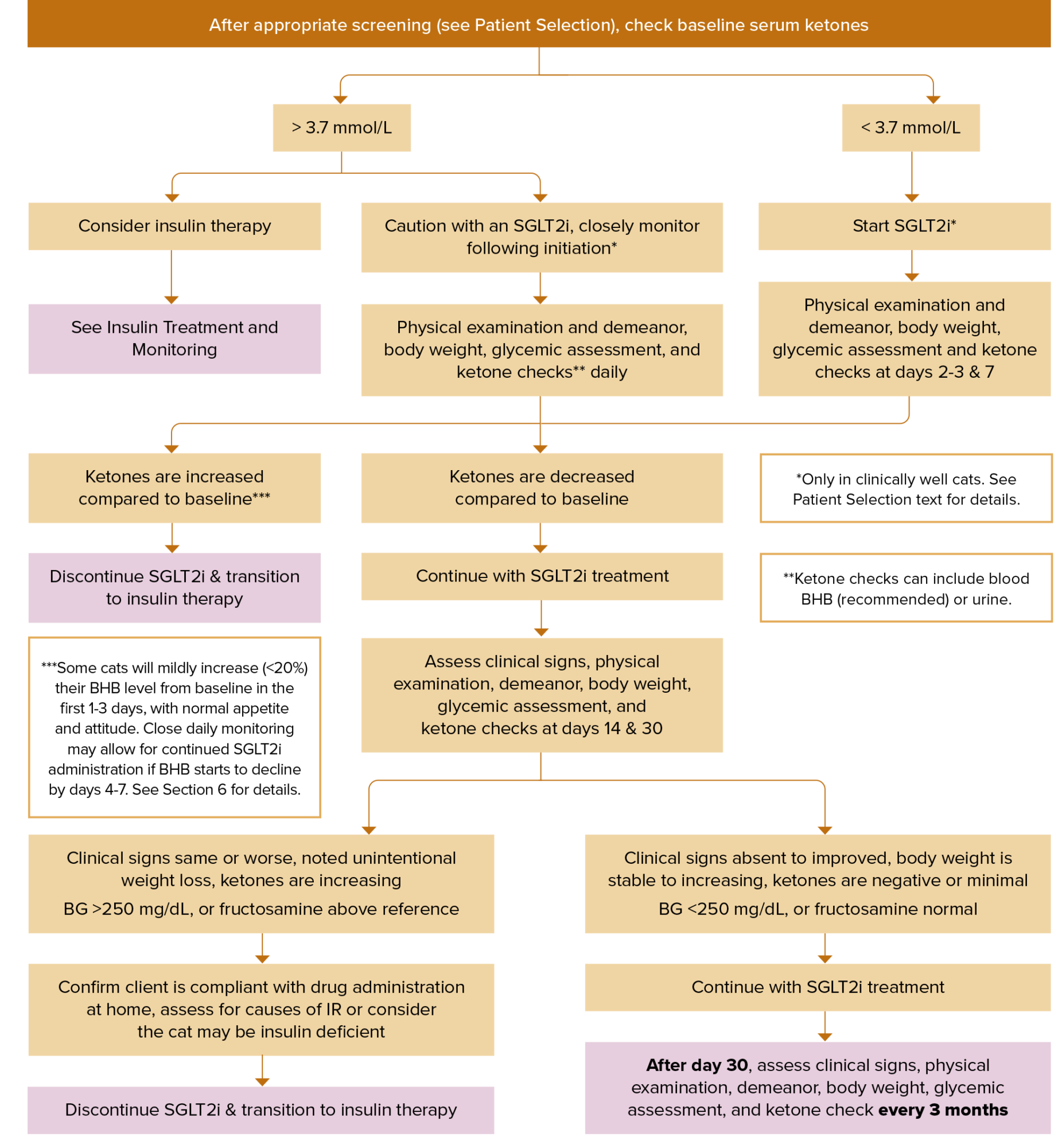
Since the original therapeutic recommendations were first released by the manufacturers of bexagliflozin and velagliflozin, the task force members have gained significant experience with this drug class in a variety of clinical situations. Clinicians should be aware of the published BHB recommendations and use them as guidelines. Clients should also be informed of and consent to any deviations from the FDA-approved guidelines, and this should be documented in the medical record. Some cats will mildly increase (<20%) their BHB level frombaseline during the first 1-3 days following treatment initiation, with appetite and attitude remaining normal. In these situations, close daily monitoring may allow for continued drug administration if the BHB starts to decline by days 4-7 following therapy initiation, suggesting endogenous insulin production is becoming more effective with the sustained resolution of hyperglycemia. Many cats with a BHB higher than the published guidelines (>3.6 mmol/L) are not clinically ill. In these cases, some task force members may still start an SGLT2 inhibitor with caution and closely monitor the cat (Figure 6.1). Monitoring includes daily BHB measurement and clinical assessment of patient status.
Diabetic cats with readily reversible causes of IR, such as recent depot steroid administration, are particularly suitable candidates for an SGLT2 inhibitor.16 These patients are more likely to go into remission after the cause of IR is removed and are therefore particularly vulnerable to hypoglycemia if treated with insulin.17 Cats with hypersomatotropism (acromegaly) may also be candidates for treatment with an SGLT2 inhibitor, but the ideal protocol is unknown. A recent study of eight cats with diabetes and concurrent hypersomatotropism reported that the addition of velagliflozin to insulin therapy improved clinical and glycemic control of diabetes in most cats.18 Ideally, clinicians should consult with a specialist before initiating SGLT2 inhibitor therapy in acromegalic cats as the risk for hypoglycemia is extremely high when used concurrently with exogenous insulin.19
FIGURE 6.1: SGLT2 Inhibitor Treatment in Cats
Dietary Considerations
Carbohydrate restriction is discouraged in people receiving an SGLT2 inhibitor,20 but no data in cats address this issue. Although food composition was not standardized in previous studies evaluating bexagliflozin and velagliflozin, some enrolled cats were fed diabetic prescription diets.21,22 The task force recommends continuing the cat’s usual diet for the first 2 wk of SGLT2 inhibitor treatment, and if the cat is doing well, then slowly introduce a low-carbohydrate diet.
Monitoring
Treatment goals for cats receiving SGLT2 inhibitors mirror those for patients receiving insulin, and monitoring is similarly focused on assessing glycemic control, body weight, and overall well-being. Because clinical hypoglycemia is rare, glucose curves and/or continuous glucose monitoring is usually unnecessary. However, carefully monitor for ketosis in cats on an SGLT2 inhibitor, particularly during the first 2 wk of treatment (Table 6.1), as DKA is most common during this period. It is substantially more important during this period to monitor blood BHB than BG.
In general, the blood BHB concentration should decrease from pretreatment values in most cats after starting an SGLT2 inhibitor. The bexagliflozin label suggests insulin is indicated if BHB increases from pretreatment values without providing specific BHB cutoffs, although clinicians have anecdotally applied previously reported values exceeding 2.4mmol/L as a cutoff for DKA diagnosis (see Table 6.1).
However, anecdotal experience with SGLT2 inhibitors suggests there may be off-label exceptions which allow for continued treatment in the face of a mild increase in BHB from baseline. Some task force members tolerate mild increases in BHB (<20% from baseline) during the first 3 days of therapy if the cat is clinically well, eating, and can be regularly monitored with a daily BHB assessment (see Table 6.1). Additionally, some task force members initiate SGLT2 inhibitor therapy in cats whose BHB is >3.6 mmol/L at diagnosis (see above, Patient Selection, and Figure 6.1) and therefore tolerate a recheck visit BHB above 2.4 mmol/L as long as levels are declining compared with the previous assessment. Continued use of an SGLT2 inhibitor in the presence of clinical signs of illness, persistently increasing BHB concentrations after the first 3 days of therapy, or a lack of appropriate BHB monitoring puts the patient at marked risk for DKA.
TABLE 6.1: Recommended Monitoring Schedule for Cats Receiving SGLT2 Inhibitors*
Days 2–3
Review history
Investigate poor appetite, vomiting, lethargy: Switch to insulin
Physical examination
Monitor attitude, body weight, hydration (See note a: 1-4 below)
- Blood BHB >2.4 mmol/L (25 mg/dL): Switch to insulin
- 1.0–2.4 mmol/L (10.4–25 mg/dL): Recheck in 2–3 days, sooner if ill (See note a: 1–4 below)
- Plasma acetoacetate (using plasma on urine dipstick) ≥1+: Switch to insulin
- Urine dipstick ≥Trace: Switch to insulin
Day 7
Review history and physical examination b
See above; review presence of clinical signs of DM b
Evaluate for ketosis c
See above c
Check BG
Spot check is sufficient
Day 14
Review history and physical examination
See above
Evaluate for ketosis
See above
Check BG
Expect to see BG <13.9 mmol/L (<250 mg/dL)
OK to continue SGTL2 inhibitor if cat otherwise doing well despite hyperglycemia
Day 30
Review history and physical examination
See above
Excessive weight loss (>8% from baseline): Switch to insulin
Evaluate for ketosis
See above
Check BG
Expect to see BG <13.9 mmol/L (<250 mg/dL)
BG >13.9 mmol/L (>250 mg/dL) with ongoing signs of DM: Switch to insulin
Fructosamine
Expect normalization or significant improvement from baseline
Not improved by >50 μmol/L from baseline and ongoing signs of DM: Switch to insulin
Every 3 months
As for Day 30
See above
BG, blood glucose; BHB, beta-hydroxybutyrate; DKA, diabetic ketoacidosis; DM, diabetes mellitus
*Reprinted from Cook AK, Behrend E. SGLT2 inhibitor use in the management of feline diabetes mellitus. J Vet Pharmacol Ther 2025;48 Suppl 1(Suppl 1):19–30.
Copyright info: © 2024 The Author(s). Journal of Veterinary Pharmacology and Therapeutics published by John Wiley & Sons Ltd. This is an open access article under the terms of the http://creativecommons.org/licenses/by-nc-nd/4.0/ License.
Task Force Recommendations
a 1–4
- Blood BHB has increased but the cat is eating/drinking normally: Proceed with caution and recheck daily.
Blood BHB is unchanged but <2.4 mmol/L (25 mg/dL): Recheck in 2 or 3 days, sooner if ill.
Blood BHB has decreased, and values are <1.0–2.4 mmol/L (10.4–25 mg/dL): Proceed to next recheck, sooner if ill. - Some cats show a mild BHB increase at their 2- or 3-day recheck but remain clinically stable. Drug discontinuation is not uniformly warranted, but BHB should be monitored every 1–2 days to ensure BHB eventually declines over the subsequent 2–5 days.
- If a cat’s BHB was >2.4 mmol/L before starting an SGLT2 inhibitor, the BHB at day 2–3 may be improved yet remain above the 2.4 mmol/L cutoff. In this circumstance, SGLT2 inhibitor therapy can be continued so long as the cat remains clinically stable and daily BHB monitoring shows continued improvement.
- Unintentional weight loss of >5% from baseline at this visit is associated with an increased risk of DKA by day 14.**
b Mild weight loss (<5%) may occur during the first week of therapy. However, significant unintentional weight loss after the first week is often an early indicator of a developing problem, such as possible DKA.
c Blood BHB has increased, is unchanged, or remains >2.4 mmol/L (25 mg/dL): Switch to insulin.
Blood BHB is normal or has further decreased to values <1.0–2.4 mmol/L (10.4–25 mg/dL): Proceed to next recheck, sooner if ill.
**(See Behrend EN, Ward CR, Chukwu V, Cook AK, Kroh C, Lathan P, May J, Schermerhorn T, Scott-Moncrieff JC, Voth R. Velagliflozin, a once daily, liquid, oral SGLT2 inhibitor, is effective as a stand-alone therapy for feline diabetes mellitus: the SENSATION study. J Am Vet Med Assoc 2024;262(10):1343–53.)
Response to Therapy
In most diabetic cats, BG improves within hours of administering an SGLT2 inhibitor, and serum fructosamine concentrations are routinely within the reference range after 8 wk.23,24,25 Despite persistent glucosuria, PU/PD also improves in most cats. Peripheral neuropathy improved in >75% of affected cats treated with velagliflozin.26 Current evidence suggests assessing overall clinical response after 1 mo, and if the cat is still hyperglycemic with clinical signs of DM, discontinue the drug and provide insulin therapy. The likelihood of diabetes remission in cats receiving an SGLT2 inhibitor is currently unknown, but remission is likely possible when mitigating factors are addressed and resolved (see Section 9, Diabetic Remission).
Side Effects and Adverse Events
Approximately 38-50% of cats have changes in stool consistency within the first 2 wk of SGLT2 inhibitor administration.27,28 This is likely due to mild cross-inhibition of sodium-glucose transporter 1 in the small intestine, which transports luminal glucose into enterocytes, with inhibition resulting in osmotic diarrhea. As such, antibiotic therapy is not indicated. In most cats, the effect is modest and self limiting and may be mitigated by a 25% dose reduction for several days or by switching to a low-carbohydrate or high-fiber diet in the experience of task force members. Other symptomatic therapies, such as pectin or kaolin, may also be helpful. Persistent or treatment resistant diarrhea may be an indication to stop therapy and transition to insulin. Vomiting is also commonly reported but tends to be sporadic.
If the cat is eating well and stable, both bexagliflozin and velagliflozin can be safely redosed if the cat vomits within 30 min of dosing.
Modest increases in serum total calcium have been reported in a small number of cats.29 The task force recommends monitoring ionized calcium concentrations in cats with a history of hypercalcemia, as SGLT2 inhibitor–induced changes in renal sodium handling and acid-base status may impact calcium homeostasis.30
The most serious complication with any diabetic cat, whether on insulin or an SGLT2 inhibitor, is DKA.31,32,33 While typical DKA can occur, SGLT2-inhibitor-treated cats more commonly develop DKA without hyperglycemia called euglycemic DKA (EDKA). If EDKA or DKA occurs, it usually develops within the first 2 wk of therapy. EDKA is diagnosed by identifying abnormalities expected in DKA (fluid, electrolyte, and acid-base derangements) in cats who remain euglycemic (i.e., BG <250 mg/dL). Reported incidence of EDKA in cats who have been treated with an SGLT2 inhibitor is the same (5–7%) as the incidence of DKA in cats treated with insulin 34,35,36 Cats previously treated with insulin appear to be predisposed.37 Affected cats are often hyporexic and lethargic; dehydration is variable but may be severe. Blood BHB is typically >2.4 mmol/L and acetoacetate will be detectable in urine in many, but not all, cases. Failure to promptly recognize and address this condition, especially in cats with unknown medical or medication histories, will result in significant progressive morbidity (see Figure 12.1).
Possible Risk Factors for DKA a
- Weight loss >5% from baseline to days 2–3
- Unintentional weight loss after day 7
- Progressive cholesterol or triglyceride elevation
- 10-fold increase in the triglyceride concentration
a. Behrend EN, Ward CR, Chukwu V, Cook AK, Kroh C, Lathan P, May J, Schermerhorn T, Scott-Moncrieff JC, Voth R. Velagliflozin, a once-daily, liquid, oral SGLT2 inhibitor, is effective as a standalone therapy for feline diabetes mellitus: the SENSATION study. J Am Vet Med Assoc 2024;262(10):1343–53.
Switching to Insulin
In nonresponder cats (i.e., BG >250 mg/dL), the SGLT2 inhibitor can be discontinued and insulin started the following day. If the cat is not hyperglycemic, it may take several days for the physiological effects of the SGLT2 inhibitor to abate and for BG to rise; in nonketotic cats, withhold insulin until hyperglycemia is documented.
The 2026 AAHA Diabetes Management Guidelines for Cats are generously supported by Adapet Medical, Boehringer Ingelheim, Dechra, and Merck Animal Health.




Citations
- Behrend EN, Ward CR, Chukwu V, et al. Velagliflozin, a once-daily, liquid, oral SGLT2 inhibitor, is effective as a stand-alone therapy for feline diabetes mellitus: the SENSATION study. J Am Vet Med Assoc 2024; 262(10):1343–53.
- Hadd MJ, Bienhoff SE, Little SE, et al. Safety and effectiveness of the sodium-glucose cotransporter inhibitor bexagliflozin in cats newly diagnosed with diabetes mellitus. J Vet Intern Med 2023;37(3):915–24.
- Niessen SJ, Kooistra HS, Forcada Y, et al. Efficacy and safety of once daily oral administration of sodium-glucose cotransporter-2 inhibitor velagliflozin compared with twice daily insulin injection in diabetic cats. J Vet Intern Med 2024;38(4):2099–119.
- Palm CA, Feldman EC. Oral hypoglycemics in cats with diabetes mellitus. Vet Clin North Am Small Anim Pract 2013;43(2):407–15.
- Romero-Vélez F, Rejas J, Ruiz de Gopegui R. Efficacy and Safety of Non-Insulin Antidiabetic Drugs in Cats: A Systematic Review. Animals (Basel). 2025;15(17):2561.
- Vallon V. The mechanisms and therapeutic potential of SGLT2 inhibitors in diabetes mellitus. Ann Rev Med 2015;66(1):255–70.
-
Behrend EN, Ward CR, Chukwu V, et al. Velagliflozin, a once-daily, liquid, oral SGLT2 inhibitor, is effective as a stand-alone therapy for feline diabetes mellitus: the SENSATION study. J Am Vet Med Assoc 2024; 262(10):1343–53.
-
Hadd MJ, Bienhoff SE, Little SE, et al. Safety and effectiveness of the sodium-glucose cotransporter inhibitor bexagliflozin in cats newly diagnosed with diabetes mellitus. J Vet Intern Med 2023;37(3):915–24.
-
Niessen SJ, Kooistra HS, Forcada Y, et al. Efficacy and safety of once daily oral administration of sodium-glucose cotransporter-2 inhibitor velagliflozin compared with twice daily insulin injection in diabetic cats. J Vet Intern Med 2024;38(4):2099–119.
- Cook AK, Behrend E. SGLT2 inhibitor use in the management of feline diabetes mellitus. J Vet Pharmacol Ther 2025;48(Suppl 1):19–30.
- Weingart C, Lotz F, Kohn B. Validation of a portable hand-held wholeblood ketone meter for use in cats. Vet Clin Pathol 2012;41(1):114–8.
- Zeugswetter F, Pagitz M. Ketone measurements using dipstick methodology in cats with diabetes mellitus. J Small Anim Pract 2009;50(1):4–8.
- Elanco. Bexacat (Bexaglifozin tablets) 15 mg flavored tablets Package insert. Available at: https://assets-us-01.kc-usercontent.com/e4748d51-2c24-00f7-fc54-65f3864ee8b1/5124bb3e-2756-4160-be3d-fc08b2256fef/PROMO_WEB_103742Asa_PA103742A_W1a_WS.pdf. Accessed June 9, 2025.
-
Elanco. Bexacat (Bexaglifozin tablets) 15 mg flavored tablets Package insert. Available at: https://assets-us-01.kc-usercontent.com/e4748d51-2c24-00f7-fc54-65f3864ee8b1/5124bb3e-2756-4160-be3d-fc08b2256fef/PROMO_WEB_103742Asa_PA103742A_W1a_WS.pdf. Accessed June 9, 2025.
- Boehringer Ingelheim. Senvelgo (velaglifozin oral solution) 15 mg/ml Package insert. Available at: https://docs.boehringer-ingelheim.com/SENVELGO_oral_solution_PI.pdf. Accessed June 9, 2025.
- Cook AK, Behrend E. SGLT2 inhibitor use in the management of feline diabetes mellitus. J Vet Pharmacol Ther 2025;48(Suppl 1):19–30.
- Gostelow R, Hazuchova K. Pathophysiology of prediabetes, diabetes, and diabetic remission in cats. Vet Clin North Am Small Anim Pract 2023; 53(3):511–29.
- Del Baldo F, Corsini A, Bresciani F, et al. Effects of velagliflozin in 8 cats with diabetes mellitus and hypersomatotropism. J Vet Intern Med 2025; 39(5):e70222.
- Del Baldo F, Corsini A, Bresciani F, et al. Effects of velagliflozin in 8 cats with diabetes mellitus and hypersomatotropism. J Vet Intern Med 2025; 39(5):e70222.
- Anthamatten A. Important dietary considerations for sodium-glucose cotransporter 2 inhibitors. JNP. 2023;19(3).
- Behrend EN, Ward CR, Chukwu V, et al. Velagliflozin, a once-daily, liquid, oral SGLT2 inhibitor, is effective as a stand-alone therapy for feline diabetes mellitus: the SENSATION study. J Am Vet Med Assoc 2024; 262(10):1343–53.
- Hadd MJ, Bienhoff SE, Little SE, et al. Safety and effectiveness of the sodium-glucose cotransporter inhibitor bexagliflozin in cats newly diagnosed with diabetes mellitus. J Vet Intern Med 2023;37(3):915–24.
- Behrend EN, Ward CR, Chukwu V, et al. Velagliflozin, a once-daily, liquid, oral SGLT2 inhibitor, is effective as a stand-alone therapy for feline diabetes mellitus: the SENSATION study. J Am Vet Med Assoc 2024; 262(10):1343–53.
- Hadd MJ, Bienhoff SE, Little SE, et al. Safety and effectiveness of the sodium-glucose cotransporter inhibitor bexagliflozin in cats newly diagnosed with diabetes mellitus. J Vet Intern Med 2023;37(3):915–24.
- Niessen SJ, Kooistra HS, Forcada Y, et al. Efficacy and safety of once daily oral administration of sodium-glucose cotransporter-2 inhibitor velagliflozin compared with twice daily insulin injection in diabetic cats. J Vet Intern Med 2024;38(4):2099–119.
- Behrend EN, Ward CR, Chukwu V, et al. Velagliflozin, a once-daily, liquid, oral SGLT2 inhibitor, is effective as a stand-alone therapy for feline diabetes mellitus: the SENSATION study. J Am Vet Med Assoc 2024; 262(10):1343–53.
- Behrend EN, Ward CR, Chukwu V, et al. Velagliflozin, a once-daily, liquid, oral SGLT2 inhibitor, is effective as a stand-alone therapy for feline diabetes mellitus: the SENSATION study. J Am Vet Med Assoc 2024; 262(10):1343–53.
-
Hadd MJ, Bienhoff SE, Little SE, et al. Safety and effectiveness of the sodium-glucose cotransporter inhibitor bexagliflozin in cats newly diagnosed with diabetes mellitus. J Vet Intern Med 2023;37(3):915–24.
- Behrend EN, Ward CR, Chukwu V, et al. Velagliflozin, a once-daily, liquid, oral SGLT2 inhibitor, is effective as a stand-alone therapy for feline diabetes mellitus: the SENSATION study. J Am Vet Med Assoc 2024; 262(10):1343–53.
- El Masri D, Jamil Y, Eid Fares J. Sodium-glucose co transporter protein 2 inhibitors induced hypercalcemia: a case series and literature review. AACE Clin Case Rep 2022;8(1):30–3.
- Behrend EN, Ward CR, Chukwu V, et al. Velagliflozin, a once-daily, liquid, oral SGLT2 inhibitor, is effective as a stand-alone therapy for feline diabetes mellitus: the SENSATION study. J Am Vet Med Assoc 2024; 262(10):1343–53.
-
Hadd MJ, Bienhoff SE, Little SE, et al. Safety and effectiveness of the sodium-glucose cotransporter inhibitor bexagliflozin in cats newly diagnosed with diabetes mellitus. J Vet Intern Med 2023;37(3):915–24.
-
Niessen SJ, Kooistra HS, Forcada Y, et al. Efficacy and safety of once daily oral administration of sodium-glucose cotransporter-2 inhibitor velagliflozin compared with twice daily insulin injection in diabetic cats. J Vet Intern Med 2024;38(4):2099–119.
- Behrend EN, Ward CR, Chukwu V, et al. Velagliflozin, a once-daily, liquid, oral SGLT2 inhibitor, is effective as a stand-alone therapy for feline diabetes mellitus: the SENSATION study. J Am Vet Med Assoc 2024; 262(10):1343–53.
- Hadd MJ, Bienhoff SE, Little SE, et al. Safety and effectiveness of the sodium-glucose cotransporter inhibitor bexagliflozin in cats newly diagnosed with diabetes mellitus. J Vet Intern Med 2023;37(3):915–24.
- Niessen SJ, Kooistra HS, Forcada Y, et al. Efficacy and safety of once daily oral administration of sodium-glucose cotransporter-2 inhibitor velagliflozin compared with twice daily insulin injection in diabetic cats. J Vet Intern Med 2024;38(4):2099–119.
- Behrend EN, Ward CR, Chukwu V, et al. Velagliflozin, a once-daily, liquid, oral SGLT2 inhibitor, is effective as a stand-alone therapy for feline diabetes mellitus: the SENSATION study. J Am Vet Med Assoc 2024; 262(10):1343–53.