Findings: Expectation vs. reality
Dive deeper into role-based retention factors by identifying the factors that are high priority and low in expectation vs. reality score for each role, then learning how that role defines that factor.
Jump to expectation vs. reality scores for:
Expectation vs. reality
First, we’ll review how the expectation vs. reality score works.
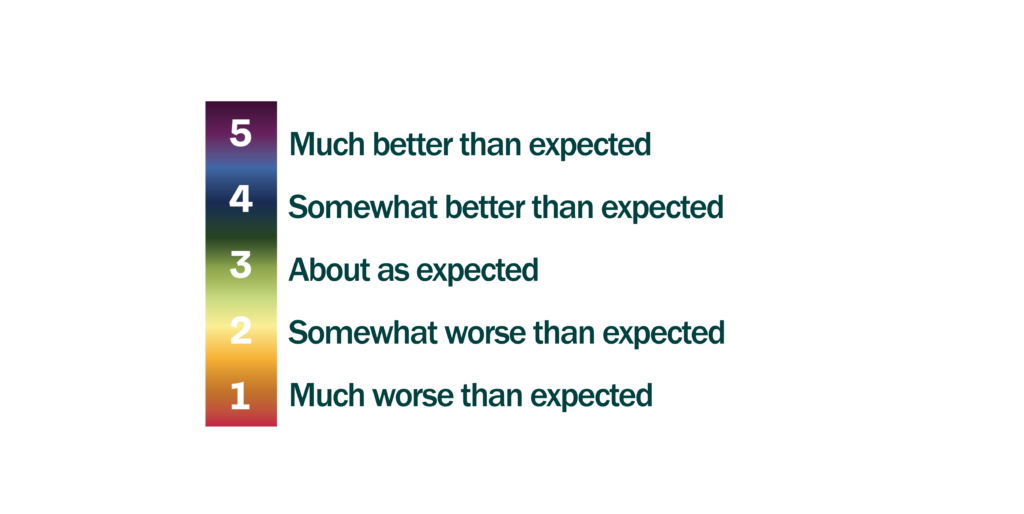
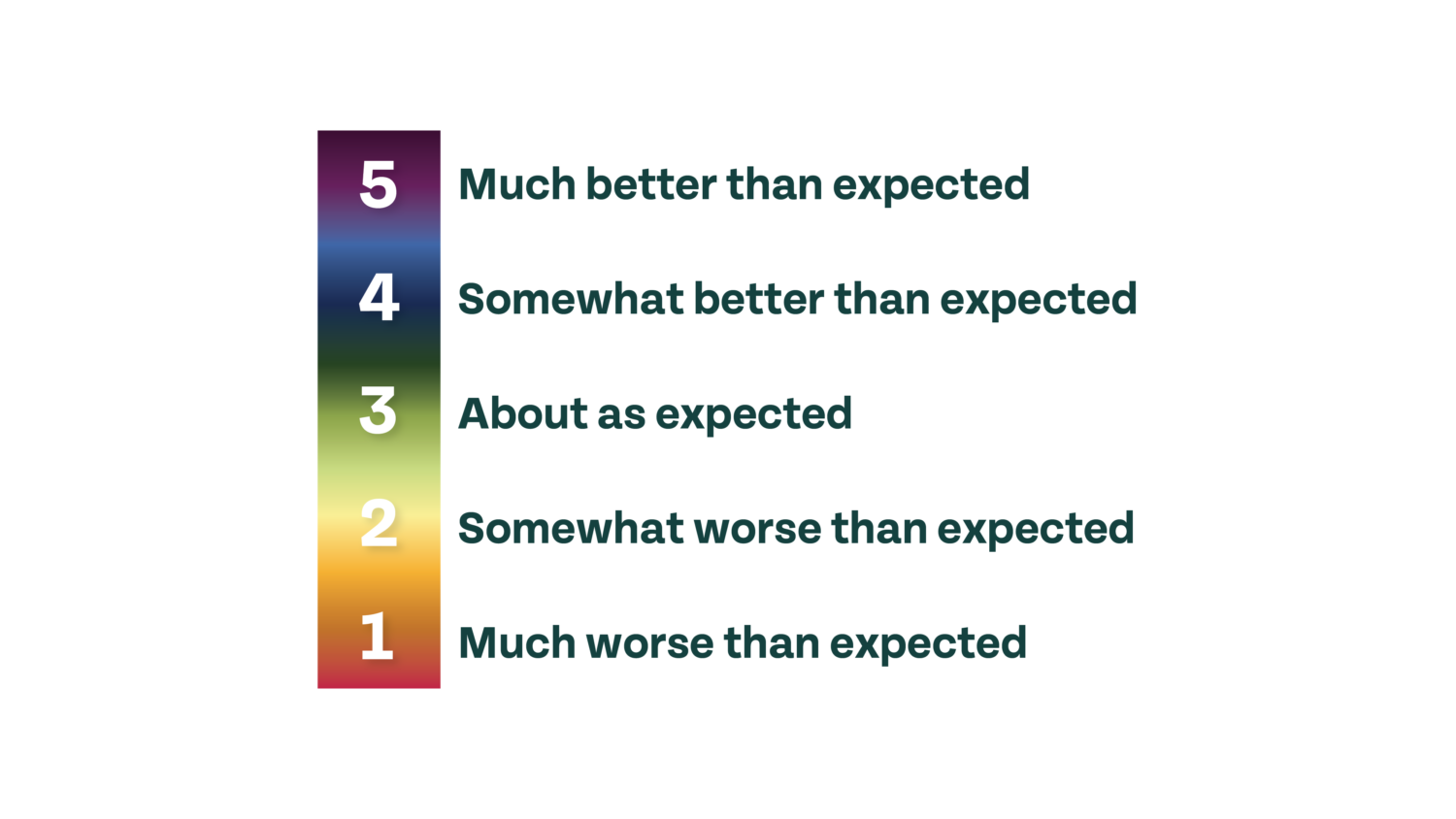
Any scores close to three or higher are considered positive. This indicates that expectations (regarding this factor, for the role in question) are being met.
The closer a score gets to two or lower, the further away that role’s daily experience of that factor is from what they expected when they entered the profession. This is considered negative; essentially, the reality (for the role in question with regard to that factor) is not stacking up to what they’d expected it to be like. And that means there’s an opportunity to make changes that could improve that role’s day-to-day experience.

Owners/Leaders
The factors that matter most as attrition drivers to the owners we surveyed are shown here by the length of the bars:
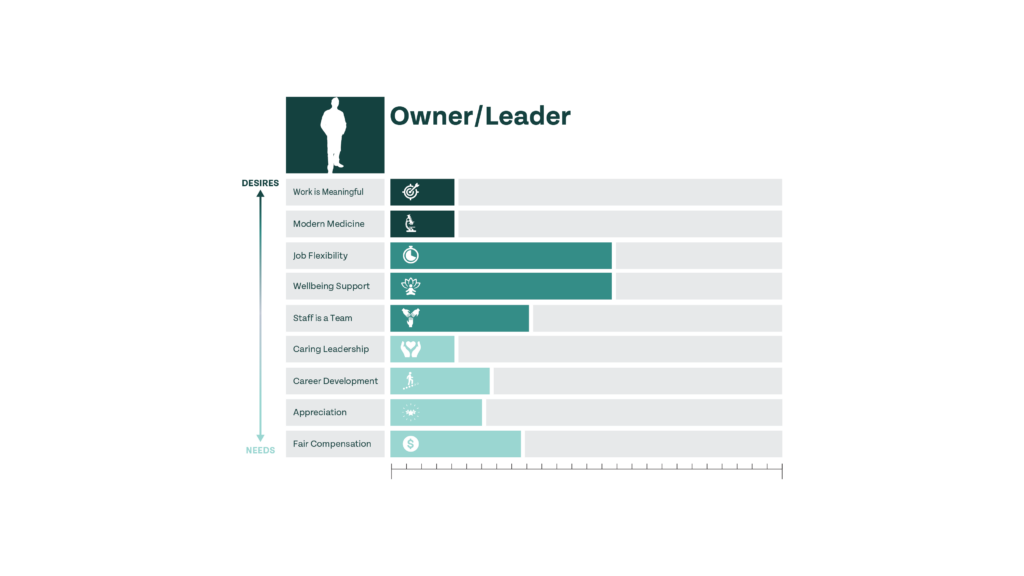
Job flexibility and wellbeing support rank higher than any other factors, so we’ll now look at whether either of those factors has a low expectation vs. reality score:
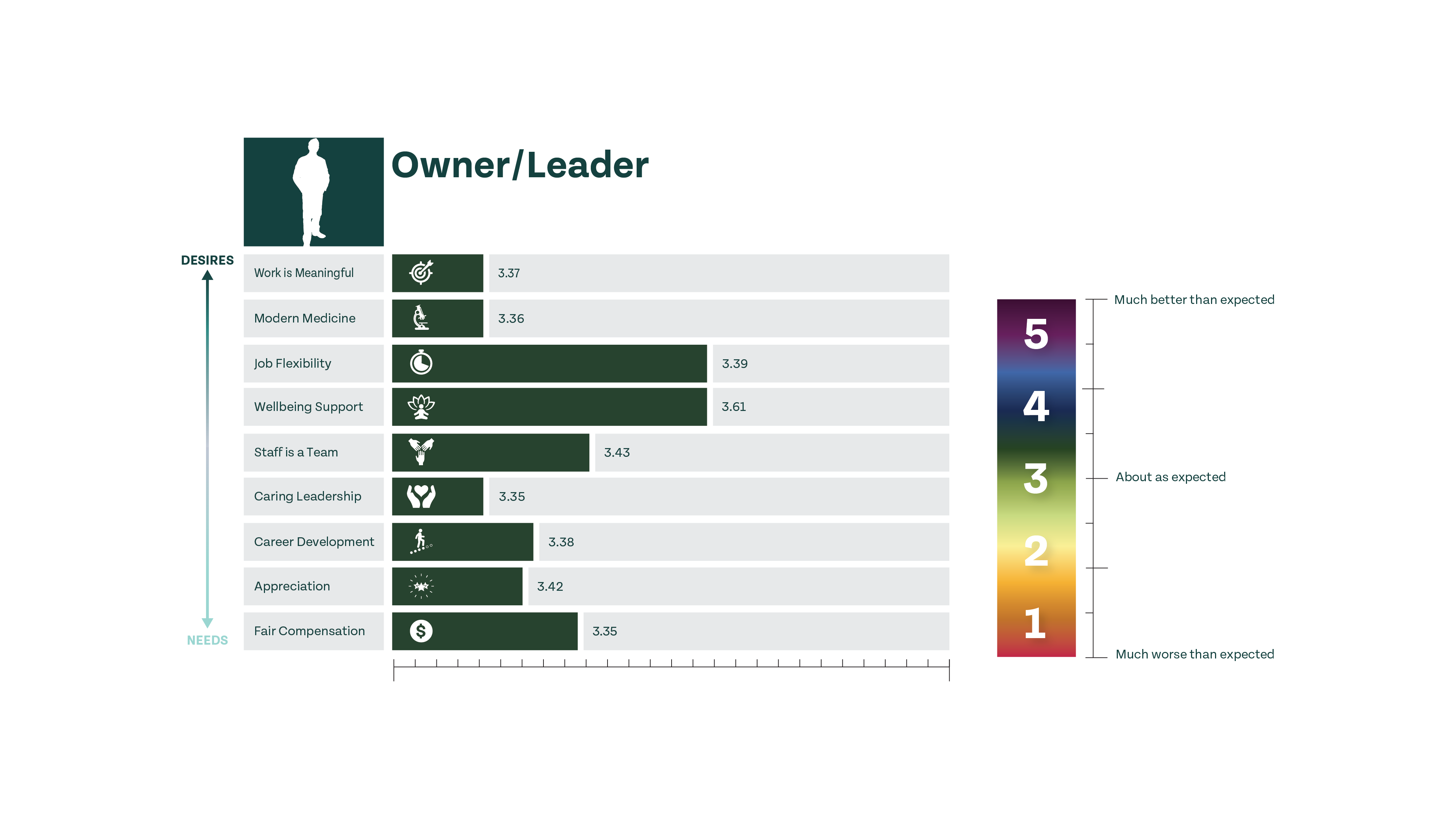
These scores are shown by both number and color in the chart above, and, as you can see, owners score very positively on all factors. This is not to say all owners, everywhere, are blissfully happy, but the data shows that, as a group, this is not a role that needs major changes made in order for their reality to meet their expectations. We can move on to other team members.
Nonowner veterinarians
When it comes to what nonowner veterinarians prioritize, we’ve got quite a few factors in the running. Fair compensation and job flexibility stand out a bit, but many others are strong enough to still be considered.
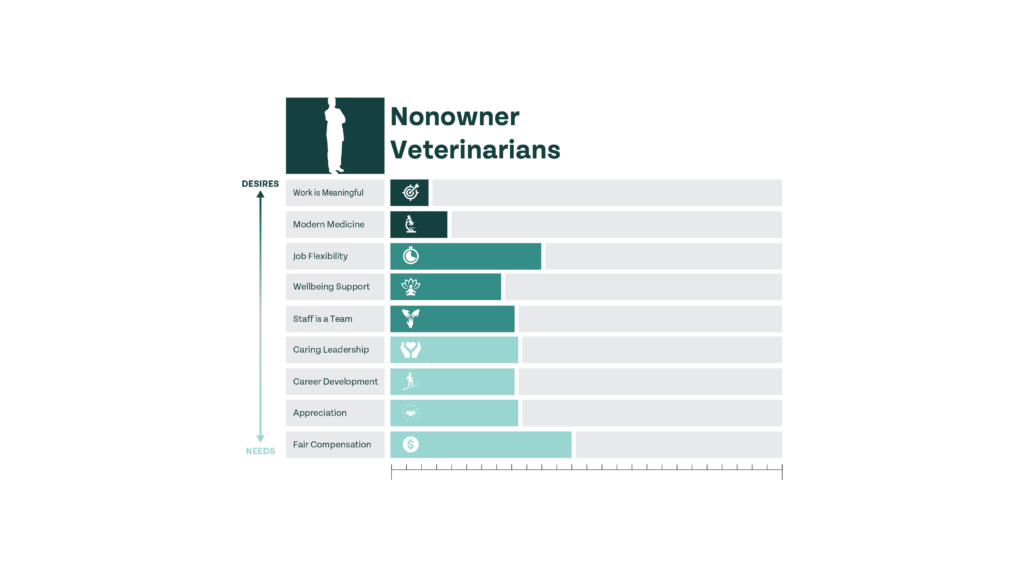
And so, let’s see if any of the factors that matter most to this role have a low expectation vs. reality score:
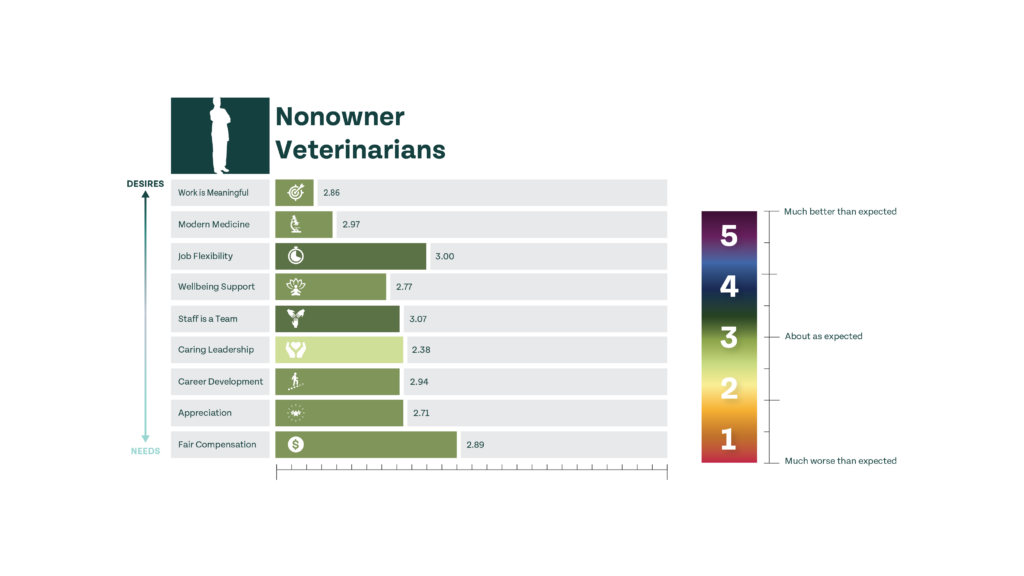
Although this chart looks rather different than the owner chart, this role’s expectations are—at least mostly—being met. There could be many reasons for this, including the fact that, in order to get to this point, they had to go through veterinary school, which means they’ve shadowed and talked to more experienced veterinarians and may have come in with a realistic view of what a day in the life of a clinician looks like. (This score might look very different for a veterinary student embarking on their first rotation.)
Appreciation is just a touch low, but fairly positive. The only outlier here is caring leadership—so let’s take a look at how nonowner veterinarians tended to define that factor to better understand what they may feel is lacking.
Caring leadership:
There are two definitions for this factor that are generally agreed upon by most roles, and nonowner veterinarians selected both those definitions.
Definition 1 (all roles): Leaders who prioritize the wellbeing and professional growth of their team members.
Definition 2 (all roles except for admins): Decision-making that considers the impacts on staff and the quality of workplace life.
Essentially, they’re looking for leaders to prioritize their wellbeing and professional growth, and for leaders who keep the staff in mind as decisions are made.
Why might caring leadership rank lower than other factors for these nonowner vets?
This role can be tasked with a lot of responsibility, but they don’t always have a great deal of input regarding the big decisions that impact those responsibilities. Associates may be the ones who feel unprepared to treat a certain ailment because they haven’t had a chance to brush up on the necessary techniques with recent CE, for example, or because the practice lacks the latest technology used for that treatment. But, when leadership is drawing up the budget for the coming year, that same vet may not have the opportunity to make a case for investing in the appropriate CE or updated tech—or if they do have the chance to speak up, they may not feel heard.
What can you do about it?
Providing opportunities for your associates to express their needs, then taking that feedback into consideration when making decisions, can go a long way. This is true in terms of wellbeing and professional growth as well as matters regarding the practice itself. From there, communication is key. Not every request can be approved, of course, but even the denial of a request could lead to a conversation about why that decision has been made—and, potentially, what the practice might be able to greenlight instead to address the need.
Administrators
This group, which included practice managers, hospital administrators, and others in management or administrative roles, prioritized factors rather differently than we’ve seen thus far:
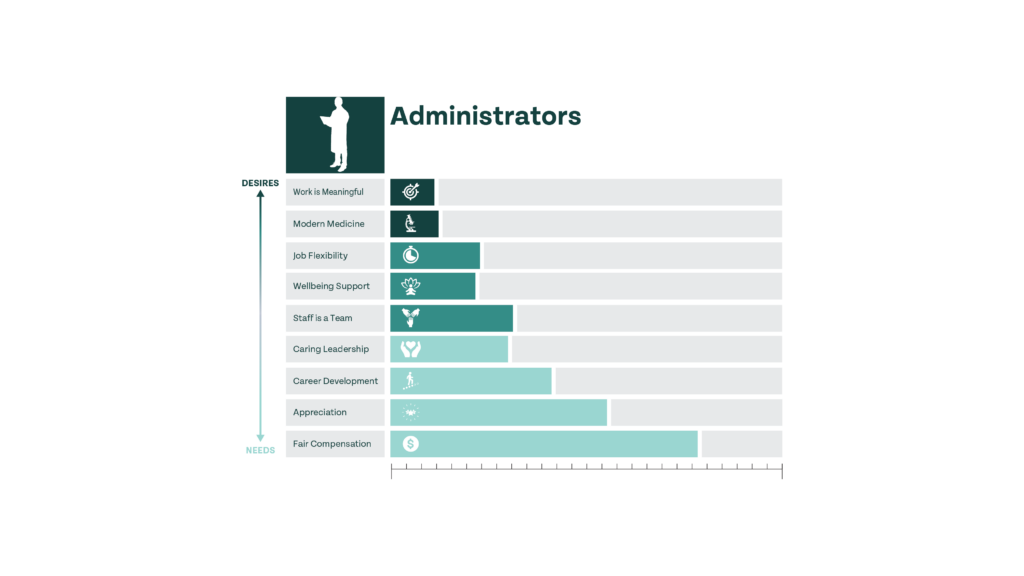
The bottom factors clearly are highest priority to this role. However, we’re going to include some of the more mid-range factors, too, to ensure we’re looking at factors that rank low for expectation vs. reality.
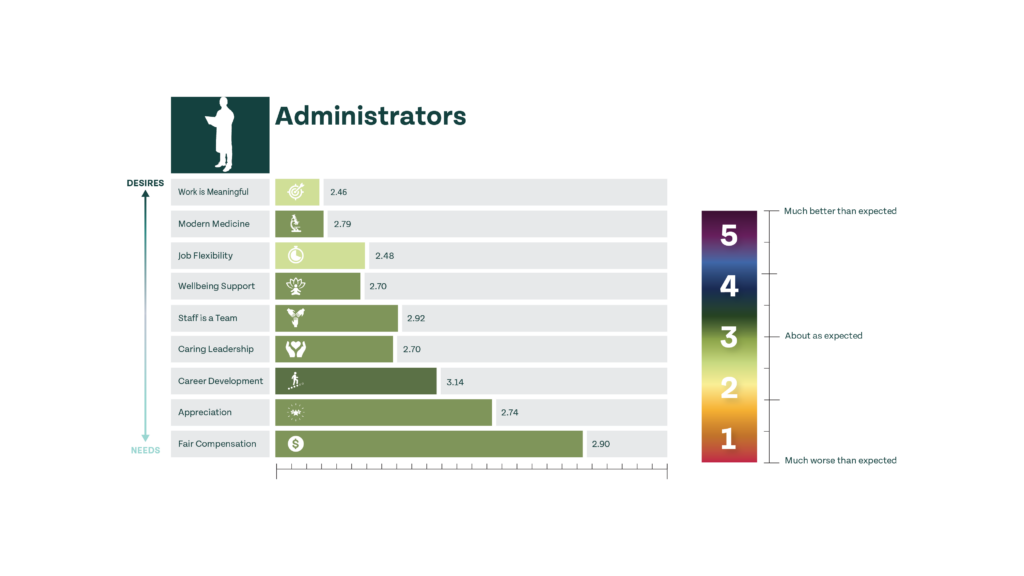
These colors aren’t far off of what we saw for nonowner veterinarians, which shows us that the expectations of administrators are largely being met—with just a couple of factors ranking below 2.5. And because work is meaningful is much lower priority, we’ll turn our sights to job flexibility to better understand how this role defines it and why they may not feel it’s meeting their expectations.
Flexibility in scheduling and job duties:
All roles agreed on a single definition for this factor, including admins.
Definition (all roles): Flexible working hours that accommodate personal life and family needs.
This is a straightforward definition. Flexibility in scheduling and job duties isn’t about different working styles, remote options, etc. It’s about the ability to set boundaries between work and personal time.
With that in mind, why might flexibility score lower than other factors for this role?
Administrators may be less likely to have a counterpart for their work, leading them to feel like they can’t take time away from the office. If they see themselves as the end of the line—the one who must be available to answer questions and solve administrative problems—they may worry that time away for anything that isn’t absolutely necessary is harmful to their practice or their team.
So what can you do about it?
Working to cross train various roles on certain daily duties may enable everyone, in all roles, to feel more comfortable taking time away when they need to. Being able to create and hold boundaries between work and personal life is vital for preventing burnout, so it may also be helpful for leadership to ask those in admin roles to lead by example by utilizing the company’s time off policy fully (but still appropriately).
Credentialed technicians
For licensed or credentialed technicians, the top priority is crystal clear.
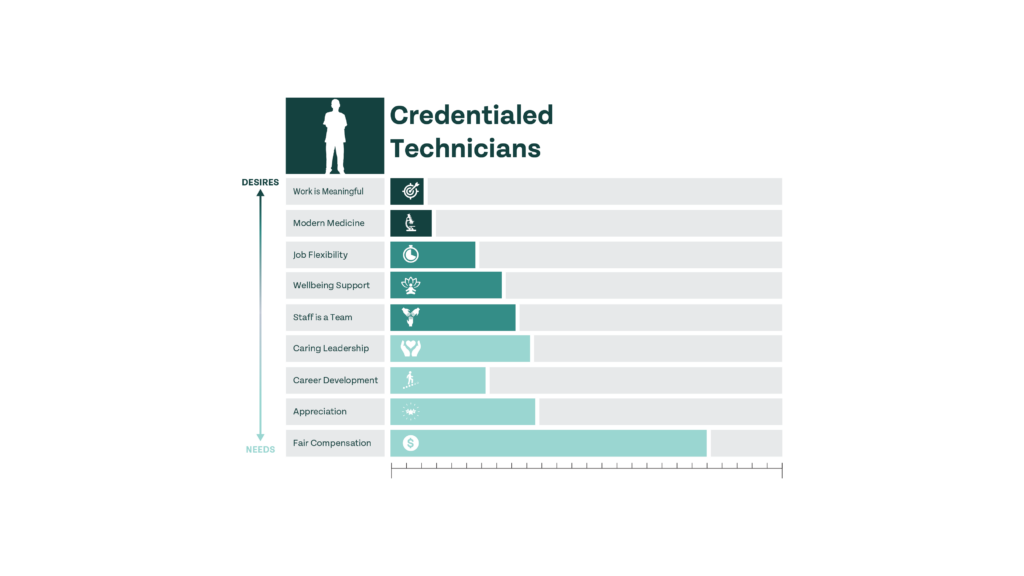
As an attrition driver, fair compensation is about twice as important as any other factor to this role.
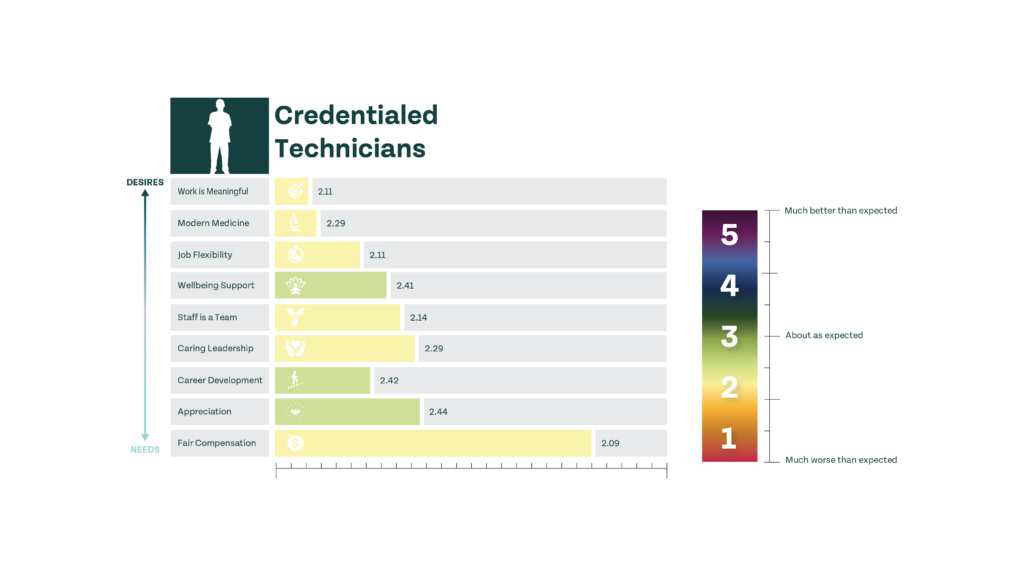
(You may recall that, with owners, the lowest score we saw was 3.35. That’s a massive difference from what technicians are experiencing.)
Fair compensation comes in dramatically lower than any other expectation vs. reality scores we’ve seen so far, at 2.09, making it the obvious factor to focus on for this role—so let’s take a look at how techs define this factor.
Fair compensation:
Definition 1 (all roles except assistants): Compensation that reflects one’s qualifications, experience, and workload.
Definition 2 (techs & assistants): Compensation that allows for financial stability and personal growth outside of work.
The majority of roles, including credentialed technicians, agree that compensation should be tied to their background and current work. One could imagine that many people in other jobs requiring this level of skill would agree, too. But if we look more closely at the second definition, which was selected by only technicians and assistants, a totally separate meaning comes through; essentially, they’re asking for a living wage.
Given these definitions, why might credentialed techs give fair compensation such a low expectation vs. reality score?
If we focus on the first definition, the answer is simply that these are professionals who have earned credentials or licenses. They’re doing hard physical and emotional work that requires specific skills, and they’d like all of that to be reflected in their paychecks.
The second definition, though, could really be seen as a call for help. These working professionals want to be able to pay for rent, food, and utilities by working a full-time job in their chosen field—without needing to take a second job to make ends meet. This is not in comparison to what the clinic across the street offers, or what their practice paid technicians five or 10 years ago. This is based on things like the cost of living in your area, along with that employee’s personal needs.
What can you do about it?
For starters, familiarizing yourself with the MIT Living Wage Calculator will give you an idea of what an individual would need to earn in your area to pay for basic living expenses. The simple fact is, if your goal is to retain people in this role, you must find the money to pay them. If they don’t feel they can afford to work for you, they will leave—no matter how much they love what they do.
If you’re struggling to find the money to compensate this role—or any role—appropriately, there are several steps you can take (as outlined in this comprehensive 2024 Trends article):
- Improve workflows and technology in ways that increase profitability (technician utilization is a great example of this)
- Use tiered pay (which requires clear job descriptions and career ladders)
- Avoid common, costly mistakes (like uncontrolled inventory costs or a lack of understanding and tracking around other variable costs)
This can all add up to big savings in a practice—and that can give you the ability to improve technician retention through fair, even competitive, compensation.
Veterinary assistants
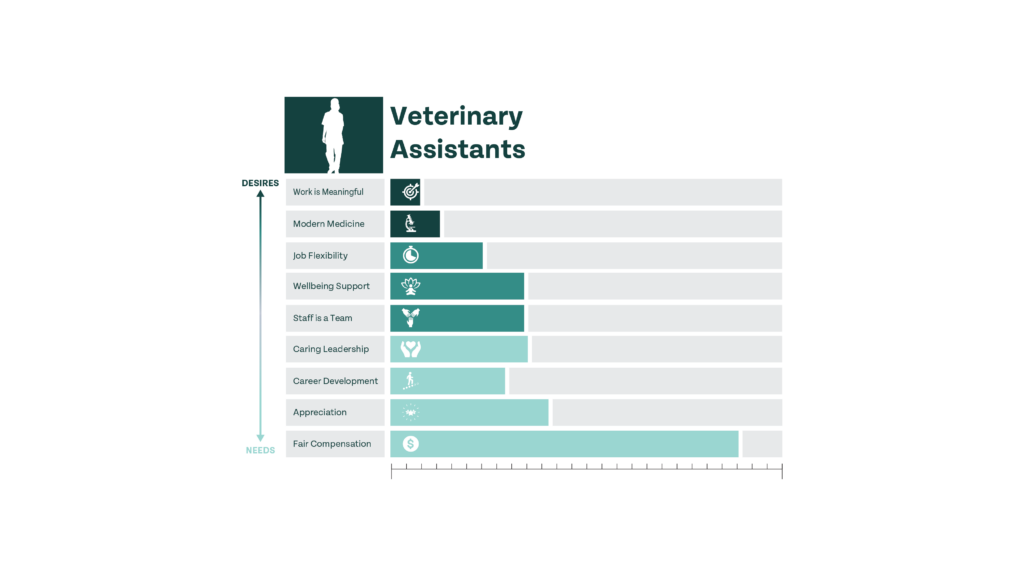
As with technicians, it’s easy to understand what factor is highest priority to veterinary assistants: Fair compensation. Other factors matter, of course, but fair compensation is, by far, the strongest attrition driver for this role.
And when it comes to how their reality compares to their expectations, the outlook is even dimmer than with their credentialed colleagues. Not a single factor breaks a score of two—which means that every single factor is at least somewhat worse than expected.
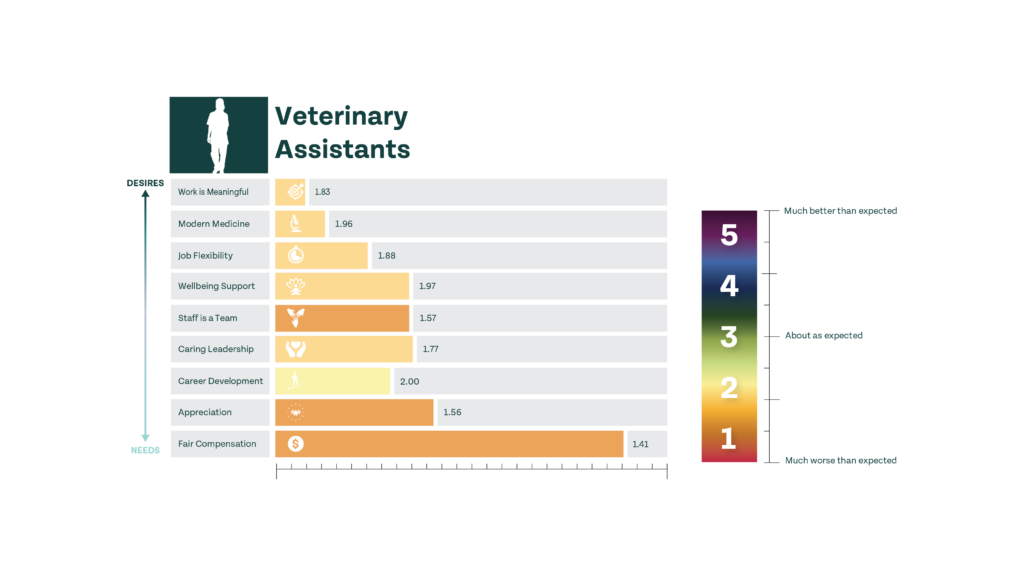
Still, findings don’t need to be surprising to be informative, and the high priority/low expectation vs. reality score of fair compensation for veterinary assistants certainly shows that any practice that wants to retain folks in this role would be wise to look at how assistants define fair compensation.
Fair compensation:
Definition 2 (techs & assistants): Compensation that allows for financial stability and personal growth outside of work.
Definition 3 (only assistants): Compensation that is periodically reviewed and adjusted based on performance and inflation.
Assistants were the only role to not tie fair compensation to qualifications, experience, and workload. Instead, they, along with technicians, defined fair compensation as a living wage, and they also chose one definition that no other role selected, which focused on reviewing and adjusting pay based on performance and inflation.
Based on these definitions, why might veterinary assistants give fair compensation such a low expectation vs. reality score?
By defining fair compensation as, essentially, a living wage, assistants are calling for pay that enables them to work a single, full-time job and be able to pay bills. This doesn’t require much sleuthing; assistants often work for pay that does not equal a living wage.
What’s more notable here is that, by tying it to performance reviews and inflation rather than qualifications and experience (as other roles did), assistants are saying that they want their paychecks to reflect the work they do each day, regardless of whether they have a license or other credentials. This may indicate that they don’t feel that their contributions are valued in the same way that credentialed technicians’ are.
What can you do about it?
Once again, starting with a living wage is always a good idea, and if your practice has tiers that assistants can move up to, make sure there’s transparency around what’s required to reach the next tier. Based on our findings in Phase 1, veterinary assistants are less likely to make veterinary medicine a career than credentialed technicians, administrators, or veterinarians, but there are plenty of team members in this role who, given the chance, will do quality work and seek out opportunities to advance, so communicating with individuals in this role to understand not only what they say they need, but what their goals are, is key.
Customer service representatives
Although CSRs didn’t respond in high enough numbers to give us data on definitions or satisfaction vs. reality scores, we do have plenty of data from Phase 1 to understand what they prioritize.
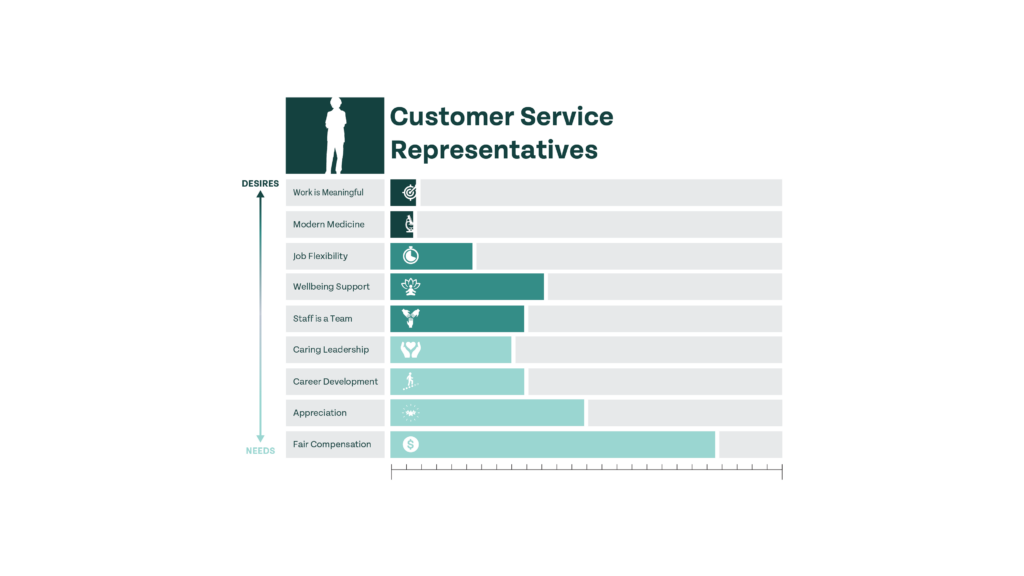
Interestingly, although fair compensation is the strongest attrition driver, it’s not by as wide a margin as we saw with veterinary assistants or credentialed technicians. Appreciation and wellbeing support are also priorities for CSRs—which is unlikely to surprise anyone who’s ever worked at a front desk.
The data is not sufficient for us to offer statistically significant claims regarding expectation vs. reality scores or definitions, but it is sufficient for us to make some educated assumptions. This is in large part because the responses we did get generally lined up with what we saw in other roles. In other words, for factors where we saw general agreement on definitions, CSRs tended to also be in agreement. In those where there was some division, CSRs showed less alignment, but tended to align with the definitions selected by other roles.
Given that general alignment with other roles, it’s safe to say that practices aiming to improve CSR retention can make progress by focusing on fair compensation, just as with assistants and technicians.