Takeaways: Definitions
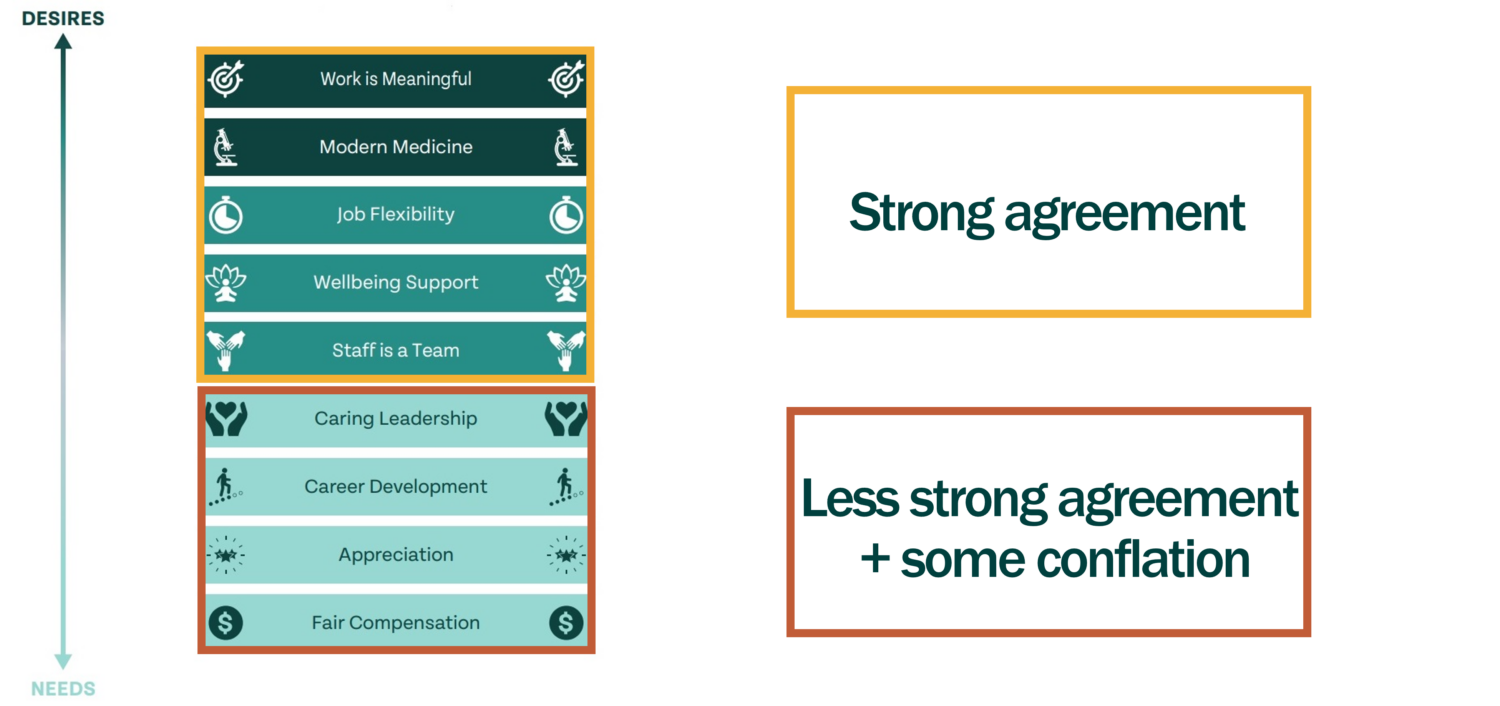
What, exactly, do these similarities and differences in definitions tell us? Factors with strong agreement provide a clear path for how to improve that factor, and those with different definitions offer insight into how those factors are seen by various members of the team.
Takeaways: Definitions
For starters, the level of agreement on these definitions is noteworthy. We already knew, based on Phase 1, that there was alignment across practice roles on the factors themselves. Now, we know that there’s also significant agreement on what these factors mean, which means we have a solid understanding of what people truly want.
This makes the path to a solution much clearer than it would be otherwise.
Take, for example, flexibility. If we’d had little agreement on what “flexibility in scheduling and job duties” truly meant, we would not know whether practices seeing to improve flexibility should offer more remote work possibilities, provide opportunities for part-time or job-sharing roles, or if the ability to take time off on short notice was at the root of this need—all of which were options in the survey.
Because veterinary professionals in clinical practice tend to define this factor as “flexible working hours that accommodate personal life and family needs,” we can work toward finding solutions for that specific definition of flexibility—with confidence.
For those bottom four factors, the path may not seem so clear. However, the variety of definitions chosen—and the connections between those definitions—provide a tremendous amount of guidance.

Let’s start with caring leadership and career development.
The definition for caring/inspiring leaders that received significant responses from all roles was, “Leaders who prioritize the wellbeing and professional growth of their team members.” That’s as clear a tie to career development as one could ask for, but the conflation appears on the flip side, too. The top definitions for opportunities for career development focused on access to ongoing education and training, and clear, structured opportunities for upward mobility—and while it’s not spelled out within the definition, there’s no getting around the fact that it’s leadership who provides those opportunities.
Because these definitions intertwine organically, it makes sense to look at how to combine them in a way that simplifies how we approach making improvements. So, instead of two factors with four definitions to consider, we can create the following:
Caring/inspiring leaders consider the impact of decisions on staff and prioritize the wellbeing and professional growth of team members, which may include continuing education, skill enhancement, and clear career ladders.
The very base of the pyramid—fair compensation and work is appreciated—can be combined in a similar way, but with a caveat.
In the case of appreciation, owners have a very different definition than the rest of the staff, believing that informal gestures like thank you notes are enough, while the staff is clear in saying that they believe appreciation should be shown through fair compensation and benefits.
(This is where the pizza party became so demonized; it’s not that team members don’t like it when leadership provides them with a special lunch. The problem arises when those staff members do not feel their value is recognized appropriately by leadership on their pay stubs, which makes the pizza party feel like a poor substitute.)
Additionally, when we talk about fair compensation as a factor, we must note that, while all roles except assistants agree that “fair compensation reflects one’s qualifications, experience, and workload,” both assistants and technicians have other definitions to consider.
Both of these roles defined it as “compensation that allows for financial stability and personal growth outside of work.” In other words, they want a living wage.
Assistants had one more definition to add: “Compensation that is periodically reviewed and adjusted based on performance and inflation.” Remember, assistants were the only role that did not select the “qualifications, experience, and workload” definition, and the definition they did rank highly indicates their desire to be paid based on what it is they do each day, regardless of whether they have credentials or years of experience. If they’re doing good work, they want that to be reflected in their paycheck.
If we can agree that providing working professionals in all roles with a living wage is a good goal to start with, creating a definition combining these two factors becomes quite straightforward—for everyone but owners, at least:
Appreciation for work is best shown through fair compensation, which reflects one’s qualifications, workload, performance, and experience. One’s performance and inflation should be considered in any review process.
Owners take a different view of appreciation, which makes it all the more vital that they understand how their staff sees it. After all, if you’re a leader with an outstanding technician, and you want to reward them in a way that makes them want to stay, offering them a heartfelt thank you note when they’re expecting a raise won’t just disappoint them, but could insult them—perhaps enough to look for another position where they’ll feel more valued.